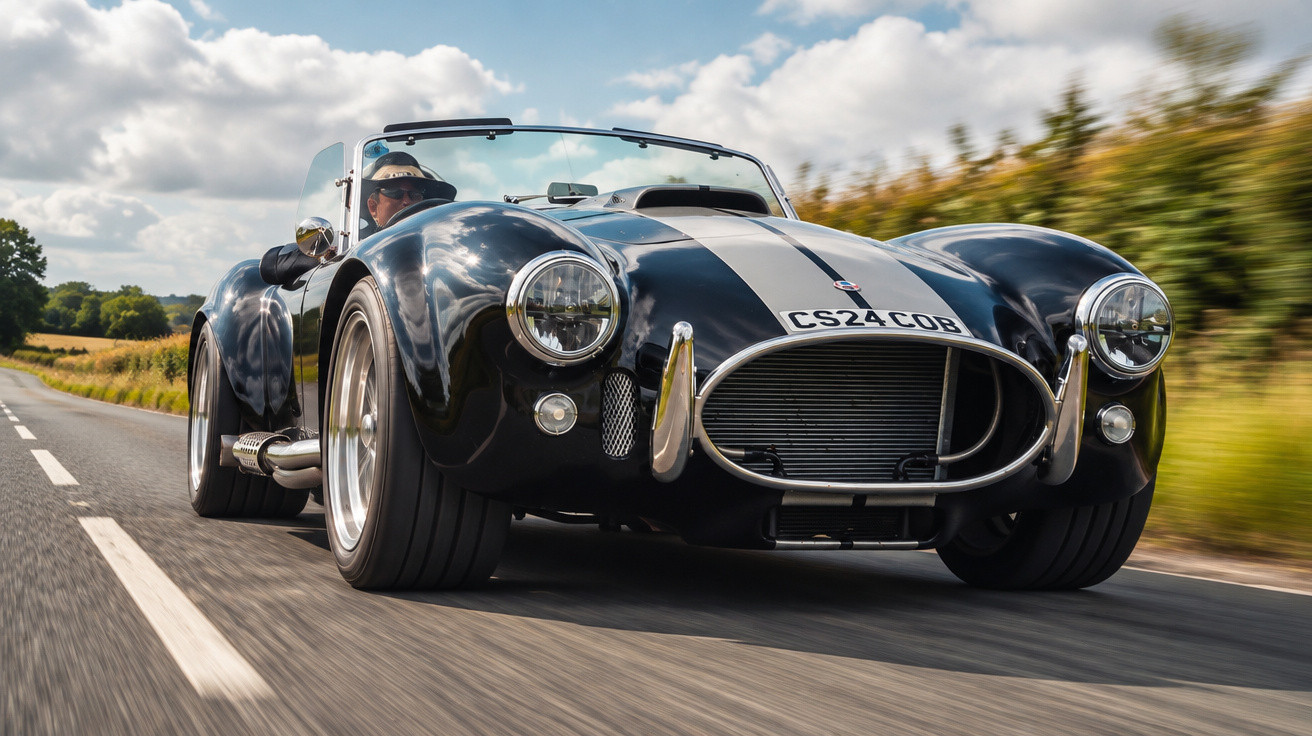
The Cobra is a car surrounded by myth and legend, and with good reason: much of its conception and evolution was, shall we say, rather underhand. Its story began with the British AC Ace sports car, launched in 1953, which was burdened with outdated pre-war straight-six engines that simply were not up to the job.
By 1961, those engines had disappeared. A partnership involving Ford in America and Carroll Shelby opened the door to the Windsor V8, and the Cobra came into being. Development was rapid. Capacity rose from 4.3 litres (260cu in) to 7.0 litres (the celebrated 427cu in displacement), while Shelby shifted his focus towards GT racing. His first effort, powered by a 6.4-litre Ford FE V8, earned the nickname ‘The Turd’ from driver Ken Miles. Recognise those names? Ford would later call on Shelby and Miles to sort out the GT40 in its campaign to defeat Ferrari at Le Mans.
AC Cobra origins and racing development
The Cobra was effectively the opening act. It had serious straight-line speed but was close to impossible to drive properly. The chassis was reworked and the Mk III arrived in 1965, although it came too late to qualify for homologation that season. Only 56 racing cars were built, with most subsequently detuned for road duty. Even so, they were brutally powerful: the 427cu in engine made 485bhp and enabled 185mph. At just 1,068kg, it was exceptionally light, too. Yet with the GT40 programme demanding attention, the Cobra’s time had ended by 1967.
Photography: Mark Riccioni
Its name endured, which is where my own obsession began. It was not its comparatively short, and mostly unsuccessful, racing career that captured me, but its enormous drag-strip thrust. For years, it held its head high in Guinness World Records as the world’s fastest car, finally being overtaken by the Porsche 959 in 1986. It was already 20 years old then. Twenty! Nothing else had managed to surpass it. Picture the modern world if the Veyron were still on top: no Chiron, no other hypercars whatsoever and, indeed, no lightning-fast EVs.
Cobra acceleration and enduring legend
Able to reach 0–60mph in four seconds, Shelby reportedly had a favourite stunt: he would attach a $50 bill to the windscreen and tell a passenger that they could keep it if they managed to take it. According to the legend, nobody ever did. I understand why. It is not merely about the physics of acceleration; there are also the cupcake seats, the full-force barrage of wind and noise, and the sheer rawness of the whole experience.
This is a new example, a Shelby CSX10000. It is the official continuation car, made by Superperformance in the US under licence from Shelby, and is now officially brought into the UK in right-hand drive by Clive Sutton. It remains visually faithful to the period, but the old big-block FE V8 has been replaced by Ford’s Coyote 5.0-litre. Do not be concerned: producing 460bhp and 420lb ft, it delivers almost exactly the same output as a semi-competition 427 and, more crucially, brings the requisite sound and attitude.
It’s mellow at low revs, will pull away in fifth, but changes character into a snarling race motor at the top end
What is it about American V8s that allows them to connect so directly with the primal cortex? Their soundtrack is Neolithic: a rumble you feel as much as hear. The instant that blub-blub-blub begins, I turn into a lumbering neanderthal, completely unable to resist it. Everyone nearby feels its pull, too; the effect it has on people is like the opening bars of I Wanna Be Like You on Baloo in The Jungle Book. It is docile at low revs and can pull away in fifth, before transforming into a snarling racing engine towards the red line. I have driven a Cobra 427, and I do not find it any more full of character than this. It merely has history on its side.
Shelby CSX10000 drivetrain and handling
The drivetrain, then, is superb. The Tremec six-speed manual is accurate, heel-and-toe changes become addictive, and the pace, soundtrack, vast reserves of brawn and fury combine to make it feel like a force of nature. Sadly, though, Ken Miles’s verdict from 60 years ago remains applicable. It fidgets and shudders more than a Morgan; the chassis twists, there is bump steer, flex and a general sense of ineptitude. It is a crude, cobbled-together machine. Its looks and soundtrack lure you in, while its handling pushes you away. This is a car with two distinct sides: go and hear it, but do not bother driving it.
Specs:
Specs: 5.0 n/a V8, 460bhp, 20.0mpg, 1,050kg, 4.2 secs
Hero: Muscular looks, muscular engine, muscular attitude, muscular noise
Zero: Doesn’t have the muscle to hold itself together. Wilts at a country road


Comments
No comments yet. Be the first to comment!
Leave a Comment