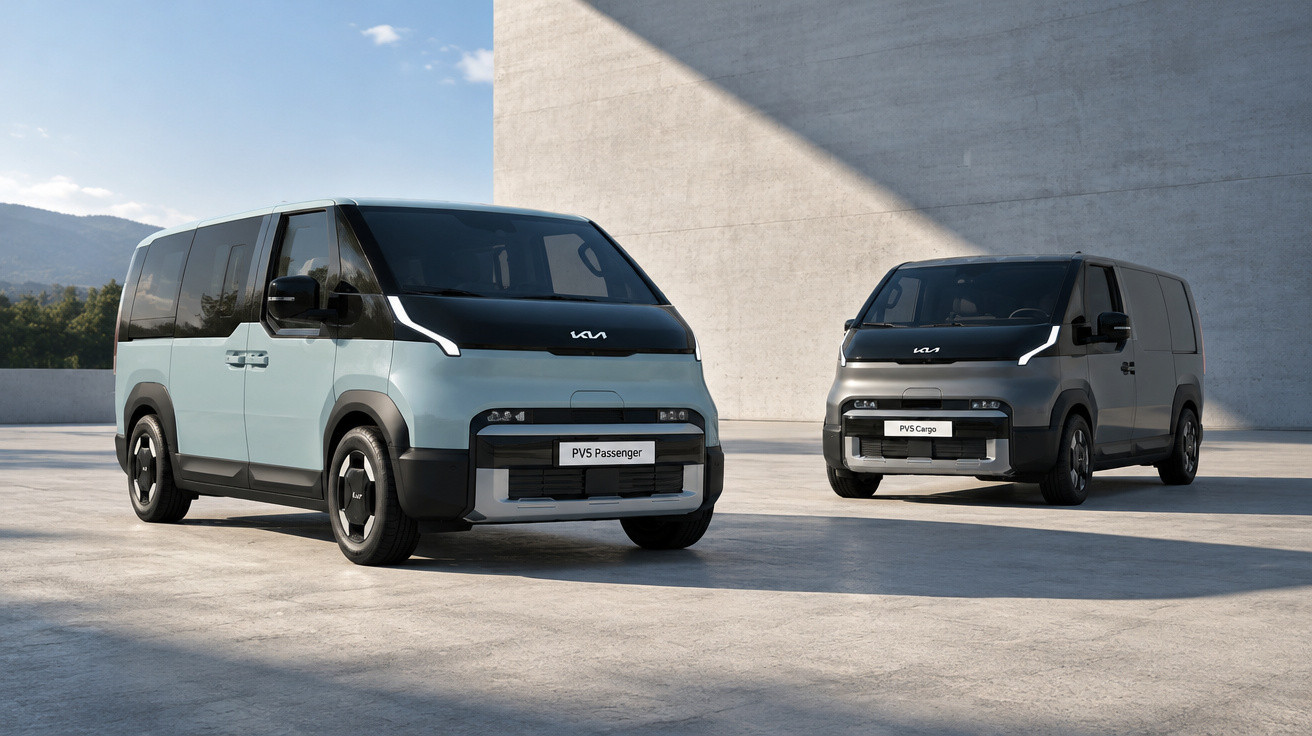
Kia has followed the release of several exterior pictures a few days ago by fully revealing its new mid-sized PV5 van. It would not seem out of place in another RoboCop remake.
Full specifications were disclosed during Kia EV Day in Tarragona, Spain. Passenger and Cargo versions will be offered from launch, with sales due to begin in Korea and Europe in the second half of 2025. Further derivatives will arrive later, including a Chassis Cab, Crew Cab, ‘Light Camper’, Freezer Box, Drop Side and WAV (Wheelchair Accessible Vehicle).
Kia PV5 Passenger range and seating
Starting with the PV5 Passenger, buyers will have a choice of 51.5kWh and 71.2kWh batteries. A front-mounted electric motor produces 161bhp and 184lb ft of torque. The larger-battery model has a claimed maximum range of 249 miles, which is a little below the 280-290 miles promised by the Volkswagen ID.Buzz. Kia says a 10-80 per cent rapid charge takes only 30 minutes, while its ‘cell-to-pack’ battery arrangement does away with numerous separate battery modules to improve energy efficiency.
Inside, the Passenger has three rows. Images and information released so far indicate a 2-3-0 configuration providing five seats, alongside an unusual 1-2-3 arrangement for drivers needing six seats and generous individual space. Kia reportedly consulted Uber during the PV5’s early development, so these could well become a familiar sight from your preferred ride-hailing service in the years ahead.
Kia says the exterior follows its ‘Opposites United’ design philosophy. Black plastic cladding and substantial bumpers are intended to create a ‘robust’ lower portion, while the glass-heavy upper half combines with distinctive LED lighting for a more ‘sleek’ appearance. That is about as sleek as a big box on wheels can realistically be. The Passenger can also be distinguished from the Cargo by its upward-opening tailgate - and, naturally, its additional windows.
Kia PV5 Cargo versions and load space
The Cargo is the full van model and comes in three specifications: Standard, Long and High Roof. It offers up to 5.1m3 of rear load capacity, with space for two Euro pallets. An L-track mounting system can be specified for the back, which also includes V2L functionality for charging tools and so on. Standard and Long models have two seats as standard, although a third centre seat is available as an option. The High Roof can be ordered in Walk-Through specification, featuring a ‘sinking passenger seat’ and a sliding door leading into the cargo area.
As with the Passenger, the PV5 Cargo is offered with 71.2kWh and 51.5kWh battery packs. There is also a further 43.3kWh choice, which will presumably be the least expensive option and the most suitable for urban delivery vans. Every PV5 uses Kia’s newly introduced, rather lengthily named E-GMP.S platform, providing a flat skateboard base onto which a variety of body styles can be fitted. Kia also claims its ‘Flexible Body System’ makes the creation of those different bodies much like assembling a huge, van-sized puzzle.
Kia PV5 technology and cabin materials
Whichever PV5 you choose, it receives a seven-inch digital instrument cluster and a 12.9in infotainment display, the latter operating on Android Automotive OS. The cabin also contains numerous environmentally considerate materials, including a thermoplastic olefin (TPO) floor, described as a hard-wearing and easy-clean substitute for PVC. Small storage compartments are scattered around the interior, too, while 'Kia AddGear' zones let owners install tailored storage solutions.
“Modern vehicles have become incredibly complex, but with the PV5, Kia has united multiple cutting-edge technologies toward the goal of simplifying users’ mobility experiences,” said Kia boss Ho Sung Song.
“This removes complexity from their personal transport needs and frees them to focus on the pursuit of their ambitions and fulfilment of their passions.”
So, what do you think, TG readers? Would you pick this or an ID.Buzz to help fulfil your passions?




Comments
No comments yet. Be the first to comment!
Leave a Comment