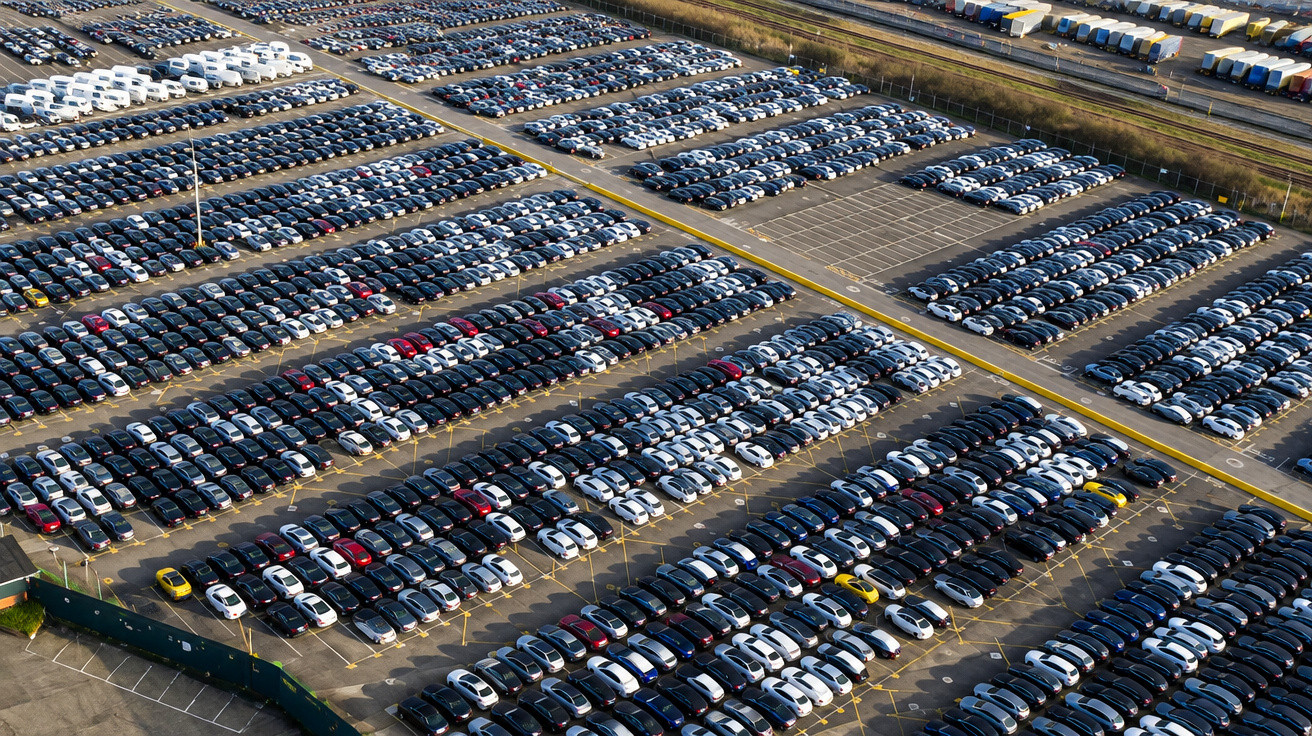
Trump's 25 per cent tariffs on imported cars
President Trump campaigned on a pledge to impose steep tariffs on overseas products, cars included. Even so, his decision to follow through has prompted widespread surprise – and, in many quarters, outright shock.
Imported cars sold in the US now face a 25 per cent tariff. From 3 May, the same 25 per cent charge will apply to imported parts, most of which are used by US car factories building American vehicles.
The President says ordinary Americans will ultimately be better off. In the short term, though, the tariffs mean that most cars in the US will become more expensive. Put simply, a tariff is a sales tax levied on imported products.
About 45 per cent of cars and light trucks sold in the US are imported. A substantial proportion of the remainder contain large quantities of imported components, or even complete powertrains. This is not limited to overseas marques: roughly 45 per cent of GM vehicles are foreign-made, chiefly sourced from Canada, Mexico and South Korea.
According to S&P, the US bought just over one million vehicles made in Canada during 2024, alongside 2.5 million built in Mexico. That compares with 2.7 million from Japan and Korea, plus 0.9 million European-made vehicles.
The USMCA agreement and cross-border car production
During Donald Trump's first presidency, a trade agreement covering North America was signed: the US Mexico Canada Agreement. It took effect during the opening months of the Biden administration. The deal enabled free trade between the three countries, while setting vehicle-production quotas intended to safeguard US assembly-line employment.
At the time, President Trump appeared content with that arrangement. Carmakers could carry on assembling cars in US factories with parts from Canada and Mexico, while their Canadian and Mexican plants could build vehicles using US-made components. He has now, in practical terms, dismantled his own agreement.
The consequence is not merely that a large number of cars will cost more. Many models may disappear entirely if manufacturers cannot find a way to sell them profitably within this newly complicated and reshaped environment. Carmakers will certainly need months, if not years, to reorganise their supply chains and raise the proportion of US-made content.
A useful US Government publication details the percentage origin of parts in every car sold in the country, and almost none has 100 per cent domestic content. In fact, several of the strongest local-content figures belong to Japanese and Korean marques manufacturing in their American factories. BMW and Mercedes produce vast numbers of SUVs in the US, but equip them with European powertrains.
Under the rules, the tariff is calculated when the completed vehicle is finished. It is not charged repeatedly whenever components cross and re-cross a border before being fitted to the final car. Therefore, a vehicle assembled overseas with 20 per cent US content will be tariffed on 80 per cent of its price.
Separating these supply arrangements and replacing parts with US-made alternatives will require months or years. Moving vehicle assembly into existing American factories would take similarly long. Building entirely new plants, meanwhile, is an undertaking involving years of planning and construction.
A manufacturer that begins assessing a new US factory now – examining its viability, choosing and planning a site, constructing it and installing its equipment – is unlikely to have cars on sale before President Trump's term ends. It is also costly: manufacturers must pay not just to create every new US facility, but also to keep their original overseas factories operating at reduced capacity or to close them.
Car makers face pricing and production uncertainty
President Trump's policies can seem unexpected and disorderly. That is not a criticism; unsettling political opponents is an explicit part of his strategy. Yet this creates a paradox. He has said the tariffs are partly intended as a shock measure to accelerate trade talks with countries he believes impede US goods. But if the tariffs may not be permanent, why would manufacturers commit to building new factories in the US?
The President has claimed that car factories are ‘being built at levels we’ve never seen’, but no new plants are currently under construction. There are only a handful of reworkings at existing sites. So far, Hyundai is the sole manufacturer to state explicitly that it will invest in fresh US production because of the tariffs. Details remain limited, however, and some of the spending involves enlarging recently opened plants, along with a potential steel works to supply them.
Either way, the current President's predecessor also introduced policies designed to bring more car manufacturing to the US. Joe Biden used tax incentives for electric cars, although they applied only to vehicles made in America.
For now, then, disorder prevails. When Top Gear contacted manufacturers during the week of the announcement, none had much to add because they had not yet established how much of the tariff they would pass on to customers.
A number of manufacturers have opted, for the time being, to halt shipments to the US completely. Buyers may therefore face longer waits for a Land Rover or, reportedly, a VW. JLR, after all, cannot simply add the 25 per cent charge to a $100,000 Range Rover Velar, then decide a few weeks later to revise the specification or reduce margins and bring the list price down from $125k to, say, $110k. Customers who had bought at the highest price would understandably be angry about the sharp fall in their car's residual value.
Car manufacturers are unwilling to disclose their potential strategies for altering US prices or model ranges. They want to see how competitors respond, and they want the tariff situation to settle. It is possible that the share-price falls following the tariff announcement will alarm the small investors and pension-fund holders who represent a substantial part of President Trump's domestic support. He might then blink. It is also possible that a worldwide trade war will prove too damaging for everybody.
No-one truly knows what US car sales, or the global automotive business, will look like even a few weeks from now.





Comments
No comments yet. Be the first to comment!
Leave a Comment