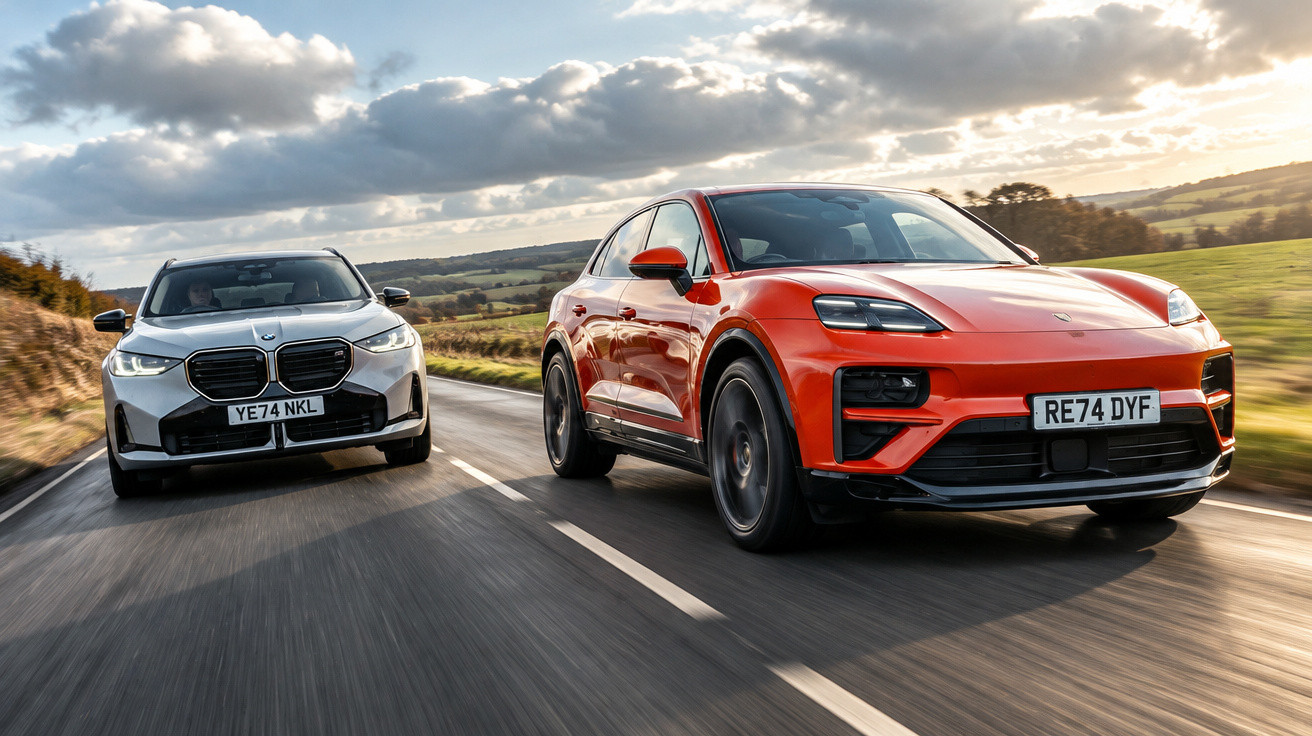
My practical advice for anybody buying an EV is simple: don’t choose the quickest version. Better still, choose the slowest. It will cost less, use less energy, travel further between charges and could even weigh less. It will also still out-drag most petrol and diesel cars away from the lights. Unless, that is, you are buying a Dacia Spring.
For this test, naturally, we ignored that advice entirely. We brought along an electric family SUV producing comfortably more than 600bhp and capable of 0-62mph in 3.3 seconds: the new Porsche Macan Electric Turbo. As with the Taycan, Porsche has retained its traditional naming system, despite there being no turbochargers involved.
The BMW X3 M50 xDrive does have a turbocharger. It also has a 3.0-litre straight-six petrol engine, an eight-speed automatic gearbox and four exhaust outlets. This is, then, a performance SUV contest between electric power and internal combustion. Which approach wins?
Photography: Mark Riccioni
Porsche Macan Electric Turbo and BMW X3 M50 xDrive: power and performance
Let’s begin with the Porsche’s staggering figures. Its pair of electric motors produces 630bhp and 833lb ft of torque when the Macan’s launch control is engaged, enough to make its 0-62mph time quicker than that of a 911 GT3.
In everyday use, output is limited to 577bhp. Its battery offers an equally substantial 95kWh of usable capacity and, provided you are not using every last bit of performance at once, Porsche claims a 367-mile range. It can also accept rapid charging at up to 270kW. The trade-off is a 2,405kg kerbweight. Perhaps the roads should be reinforced before the Cayenne turns electric as well.
At a little over two tonnes, the BMW is hardly a lightweight either. Its 393bhp and 428lb ft mean it cannot match the Macan from rest, taking 4.6 seconds to reach 62mph. There is admittedly a sizeable price gap, even though this BMW arrived with £15,000 of optional equipment. Still, the M50 currently sits at the top of the X3 range. At the time of writing, the electric iX3 has been withdrawn ahead of the Neue Klasse relaunch, while rumours suggest there will be no full-fat X3 M Competition version of this fourth-generation combustion-powered model. For now, this is the best you can get - and everyone loves an underdog.
Sadly, the G45 X3 makes a poor first impression. Finished in bedpan beige, with its enormous illuminated kidney grilles, it is not especially graceful. Its square, estate-style rear is arguably the most successful angle, but viewed from the front or side it is rather confused. There simply seems to be too much vehicle, its surfaces are overly plain, and, as colleague Sam Philip notes, its wheelarches resemble something carved by cavemen. Impressive work with rudimentary tools, perhaps, but not quite a smooth curve.
The Macan is more pleasing to look at, even with its split headlamp arrangement. It does not appear radically different from its predecessor at first, though Porsche says every component is new. Its roofline is considerably more coupé-like than the BMW’s and, despite broadly similar length and width, the Porsche stands almost 40mm lower. Its plastic front splitter looks vulnerable to the first speed hump, although the Turbo receives height-adjustable air suspension as standard. At the back are Porsche’s familiar full-width light bar and, should you somehow miss the Turbo badge, additional vents behind the rear wheels identify this version.
This Macan wears enormous 559mm RS Spyder Design wheels, an option costing a mildly alarming £2,741. Remarkably, they do not harm ride comfort by much. There is certainly a sporting firmness, yet the Porsche is fractionally more compliant than the BMW riding on 533mm wheels and ultra-low-profile tyres. Both cars use adaptive suspension, and although Britain’s pothole-ridden roads make their most aggressive settings best avoided, each is very well controlled. Performance SUVs have improved vastly in this area.
Porsche Macan Electric Turbo driving experience
The Macan’s straight-line performance is not actually the first thing that stands out; its steering is. Its slim Alcantara-trimmed wheel feels immediately right in your hands, while turn-in is exceptionally sharp and responses to inputs are instant. Its low-set driving position and steering feedback are what make this compact electric SUV genuinely feel like a Porsche. That is no small achievement considering it uses the shared PPE architecture beneath the Audi Q6 e-tron and A6 e-tron.
Driven consecutively with the X3, the Macan feels smaller and easier to position on the road, despite its marginally larger footprint and greater mass. This example has Porsche’s £1,445 rear-wheel-steering option. By contrast, the BMW has the characteristically over-thick BMW steering wheel and offers nowhere near the Porsche’s feedback. Selecting Sport adds some artificial heft, while an electronic differential apportions power across the rear axle in corners, but even the most performance-focused X3 feels slightly remote and defaults to safe understeer.
The acceleration is so violent it might genuinely make you feel ill. This is a comically quick car
The Porsche’s air suspension keeps body movement impressively contained in bends. Flatten the accelerator on the exit, though, and its acceleration is so brutal it could genuinely make you feel unwell. This is absurdly quick. Overtaking takes barely an instant, and even Normal mode presses you hard into the seat. Sport and Sport Plus raise the intensity further. Choose the latter, apply full throttle on a cold, wet day, and it can even squirm in a straight line as traction control tries to manage the output. The Turbo’s rear motor is stronger than its front unit, creating a rear-biased balance. It is entertaining, but it is hard not to feel that it may simply be too quick for its own good.
Even so, activate Electric Sport Sound and the result is an EV that is genuinely engaging to drive. That is despite its crossover body and the lack of paddles for adjusting regenerative braking or imitating gear changes, as in the Hyundai Ioniq 5 N. The BMW has authentic straight-six noise in its favour, although it is rather subdued in the cabin and augmented by IconicSounds until you work out how to turn the system off.
The B58 remains a superb engine, however. During a route covering town, motorway and country roads, it returned 37mpg against a claimed 35.3mpg. It has a healthy surge of torque, and its gearbox shifts cleanly, with large rubberised paddles available for manual control. The Macan outshines it, but the BMW is properly fast in its own right - it is simply unfortunate that the combustion-engined car is the one short of drama.
The BMW does provide marginally better brake-pedal feel. In the Macan, there is a small dead zone at the top of the pedal’s travel while the system blends regenerative and friction braking, but once the discs are engaged it stops extraordinarily hard. A handful of suicidal pheasants allowed us to confirm that. With the temperature only just above 5°C, the Macan achieved 2.9mpkWh across town, country and motorway driving, implying a real-world range of a little over 275 miles.
Porsche Macan Electric Turbo and BMW X3 M50 xDrive interiors
Just as it drives like a real Porsche, the Macan feels recognisably Porsche inside. Its sports seats are exceptionally comfortable, while the curved 12.6in digital instrument display provides clear, intuitive read-outs. The 10.9in central infotainment screen is similarly excellent. Its graphics are impressive, its background complements the car’s superb exterior colour, and it reacts and loads quickly. There is a bass-heavy Bose surround-sound system, generous centre-console storage, and separate physical buttons and switches for climate functions and steering-wheel controls. Common sense wins.
BMW, meanwhile, has placed almost every function within its huge Curved Display. Even the air vents are adjusted through touch-sensitive controls on the doors. The first time I attempted to reduce the airflow blowing directly at my face, the dashboard issued a distracted-driver warning. Argh!
The X3 cabin is a dramatic break from the previous generation, but it does not quite work. Some materials now feel a touch inexpensive, perhaps, while the overall effect is rather like allowing Mini’s interior designers loose on a BMW to see what emerged. The cloth-covered dashboard is appealing, but the concealed door handles are almost impossible to locate after dark. The dashboard can be configured, yet it has no straightforward circular dials. All climate settings are hidden in the protruding central display too, though permanent shortcuts for temperature and heated or ventilated seats remain along its lower edge.
Put your foot to the floor and the acceleration is so violent it might genuinely make you feel ill
For rear-seat accommodation, the BMW takes the win. The Porsche offers unexpectedly generous headroom considering its descending roofline, but it feels somewhat dark without the optional panoramic roof. Its floor-mounted battery also leaves rear passengers sitting with their knees elevated. Its wheelbase is 86mm longer than that of the previous combustion Macan, though, so there is more legroom than expected.
With its glass roof, the X3 gives rear occupants abundant headroom, legroom and natural light. Its boot is also usefully larger, although the Porsche nearly closes the gap when its 84-litre front boot is included. It is also worth noting that the entry-level Macan, with its smaller rear motor, offers 540 litres of luggage capacity even before its front boot is counted.
So, the Turbo is probably not the Macan I would buy. Yet in a head-to-head contest between the range-topping performance SUVs, it defeats the X3 M50. The Porsche is not quite as practical and costs substantially more, but it is more involving to drive, has the more sophisticated and intuitive interior, and is the better-looking car. Just make sure there are sick bags ready for those in the rear seats.


Comments
No comments yet. Be the first to comment!
Leave a Comment