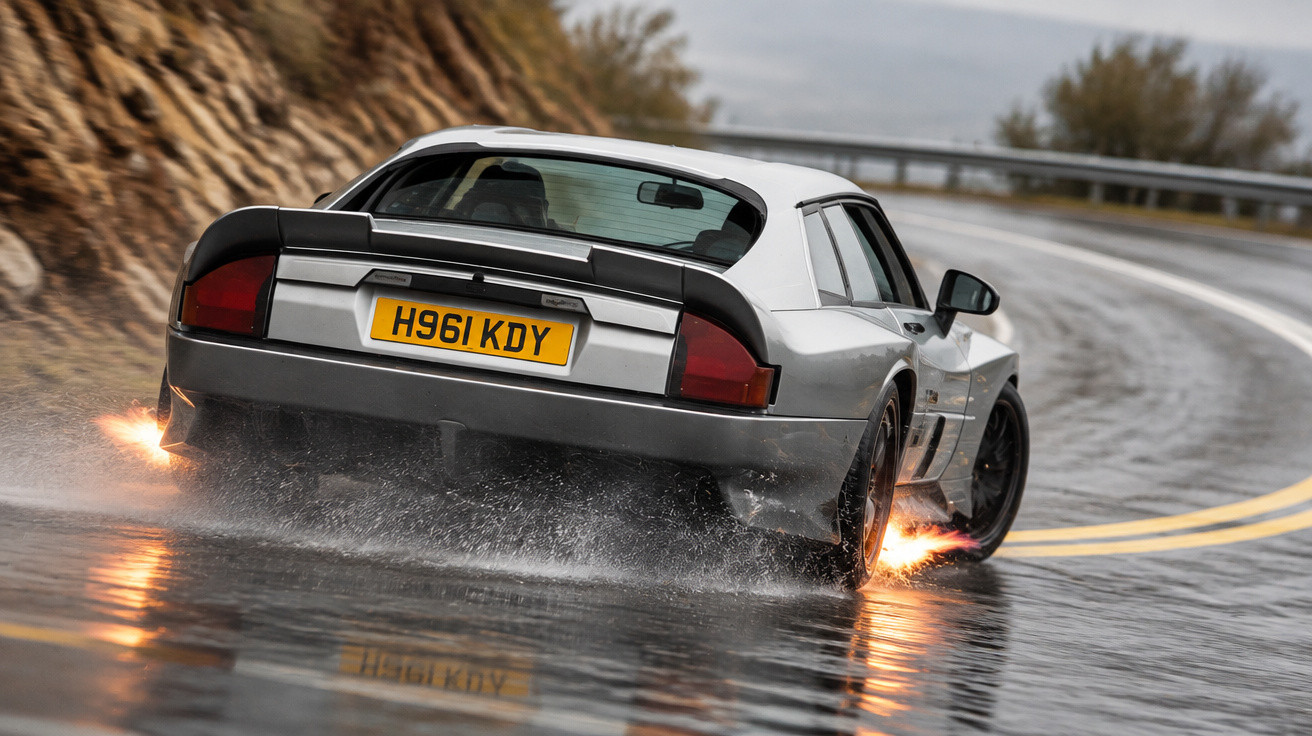
Pull through second and third in the TWR Supercat, listening to its 5.6-litre supercharged V12 howl towards the 7,750rpm limiter, and you simply cannot be indifferent. Beyond the Pagani Utopia and GMA T.50, the pairing of a colossal V12 and a manual gearbox has all but disappeared.
At roughly £300,000, this Jaguar XJS-based restomod is therefore an order of magnitude cheaper than anything else in this exceptionally rare corner of the market. It is also a gloriously defiant answer to Jaguar’s recent rebrand and its all-EV future. Better still, it is a restomod that is not a 911. Hallelujah.
Naturally, being ‘not a 911’ cuts both ways. It gives the Supercat immediate novelty and makes it hugely intriguing, yet it also leaves the reborn TWR marque with a base car lacking the 911’s many built-in strengths, the vast expertise accumulated through modifying them, and the bottomless supply of quality components offered by motorsport specialists and Porsche Classic alike. The Jaguar XJS has proper racing history and becomes cooler by the year, but it is hardly a solid-gold sports-car superhero.
Photography: Mark Riccioni
TWR Supercat styling and specification
The Supercat certainly looks like a superhero. Perhaps more accurately, a supervillain. On a dark, wet night, it would be entirely at home prowling Gotham City. Its specification is wonderfully menacing, too. The dry-sumped, supercharged 12-cylinder engine develops 660bhp and 538lb ft - even the final 6.0-litre XJR-S models of 1993 produced only 333bhp. A six-speed manual sends power through a plated limited-slip differential, while the front brakes use six-piston calipers. There is adjustable ABS and traction control, electronically adjustable dampers, extensive chassis reinforcement and a substantially lower kerbweight, helped in part by carbon-fibre bodywork. Soaked through - quite literally on this unusually grim day in southern California - the Supercat weighs 1,605kg.
On paper, then, it is an overwhelmingly exciting proposition. During the early 1980s, the late Tom Walkinshaw’s TWR transformed the XJS into a fearsome Group A racer. It was ultimately developed sufficiently to claim the 1984 ETCC championship, deliver Jaguar’s first 24-hour race victory at Spa-Francorchamps since the D-Type in the 1950s, and win at Bathurst in 1985. The prospect of that level of know-how being channelled into a contemporary restomod is extremely tempting. And, of course, manual V12.
Yet there are reasons for caution. This new TWR is centred on Tom’s son, Fergus, but it is not the old TWR that dominated touring cars, created Jaguar’s Le Mans-winning Group C machinery, and earned both fear and admiration for its ‘creative’ interpretation of regulations. In practice, it is a start-up with a powerful family link to the original operation, rather than a genuine inheritor of its motorsport achievements.
The provocative styling - consciously designed to divide opinion in proper Marmite fashion - comes from Kyzyl Saleem. It is his first full-scale limited-production project, after gaining recognition on Instagram as @the_kyza, and Magnus Walker, the Porsche collector and social-media personality, also contributed. Could the Supercat, then, be overly superficial? A dramatic appearance and a great name, but not much beneath them?
Driving the Jaguar XJS-based TWR Supercat
Rain, fog and fallen rocks provide an ideal setting to discover the answer. This is a rolling prototype, around 80 per cent complete in its dynamics, fit and finish, and I am the first person outside TWR’s inner circle to drive the Supercat in this near-final state. I am happy to say there is real depth to it. It remains slightly unfinished at the edges and more work is needed, but the foundations are very promising - and that was never guaranteed.
Initially, the overwhelming impressions are the sheer weight of the clutch and brakes - the former has a Countach-like heft, while the unassisted brakes require the firm commitment of a race car - the distinctive noise, which I would call ‘dirty V12’, and the car’s unexpected composure. The engine lacks the pure, high-pitched song of a thoroughbred V12, but its unruly blend of induction bark, mechanical thrash, V12 wail and, at high revs, supercharger whine suits a car this aggressive perfectly. Its noise and flames on the overrun could set off air-raid sirens. Sense of occasion? That box can be ticked in permanent marker.
The race-derived electric power steering feels a little incongruous alongside those heavy pedals, but it immediately gives the car agility. The precision with which the Supercat turns into bends makes it seem smaller and lighter than anticipated. I expected that view over the lengthy bonnet to leave me feeling slightly removed from the front wheels, and perched well above the rear ones. Instead, I feel positioned right in the middle of the action, fully aware of what both ends of the car are doing at road level. The six-speed manual gearbox is excellent, too. Why did gearboxes like this ever go out of fashion?
With more kilometres comes proof of outstanding traction - a marked contrast with the rough test mule Ollie Marriage drove on track in the UK, and encouraging evidence that the new TWR can identify engineering issues and sharpen the set-up. The balance is also genuinely pleasing. In the wet, the front end first washes into gentle understeer, which is simple to moderate and contain, before the car progressively adopts a more rear-led attitude. It is a wonderful sensation, and the engine’s savage soundtrack is tempered by this forgiving behaviour. The engine’s progressive power delivery deserves credit here, too. It sounds monstrous and provides serious performance, yet does so with remarkable predictability.
“It’s born of real passion and a love and respect for Jaguar’s most glorious days”
Remaining Supercat development work
Some areas still need attention. The vast gap between third and fourth gears must be resolved. The adjustable traction control reacts too abruptly. Power-steering calibration is inconsistent, and assistance vanished entirely through long left-hand corners, while low oil pressure caused the engine management system to cut power dramatically after extended, fast right-handers. Ironically, oil surge was among the greatest challenges faced during development of the Group A cars in the 1980s. Even the unassisted brakes - which I genuinely enjoy - will probably require servo assistance for most prospective owners. TWR should be capable of sorting all of that.
The greater test, though, will be producing the Supercat to a standard that justifies its price. Its interior requires Singer-level attention to detail, the body panels must align with millimetre accuracy and there can be no rattles over poor surfaces. Every detail has to be flawless. Even then, finding buyers for 88 cars - a number marking Jaguar’s 1988 Le Mans victory - will not be straightforward.
Still, I wish TWR every success. The Supercat may not possess authentic motorsport pedigree, but it comes from genuine enthusiasm, and from affection and respect for Jaguar’s finest era.
18 minutes 26 seconds




Comments
No comments yet. Be the first to comment!
Leave a Comment