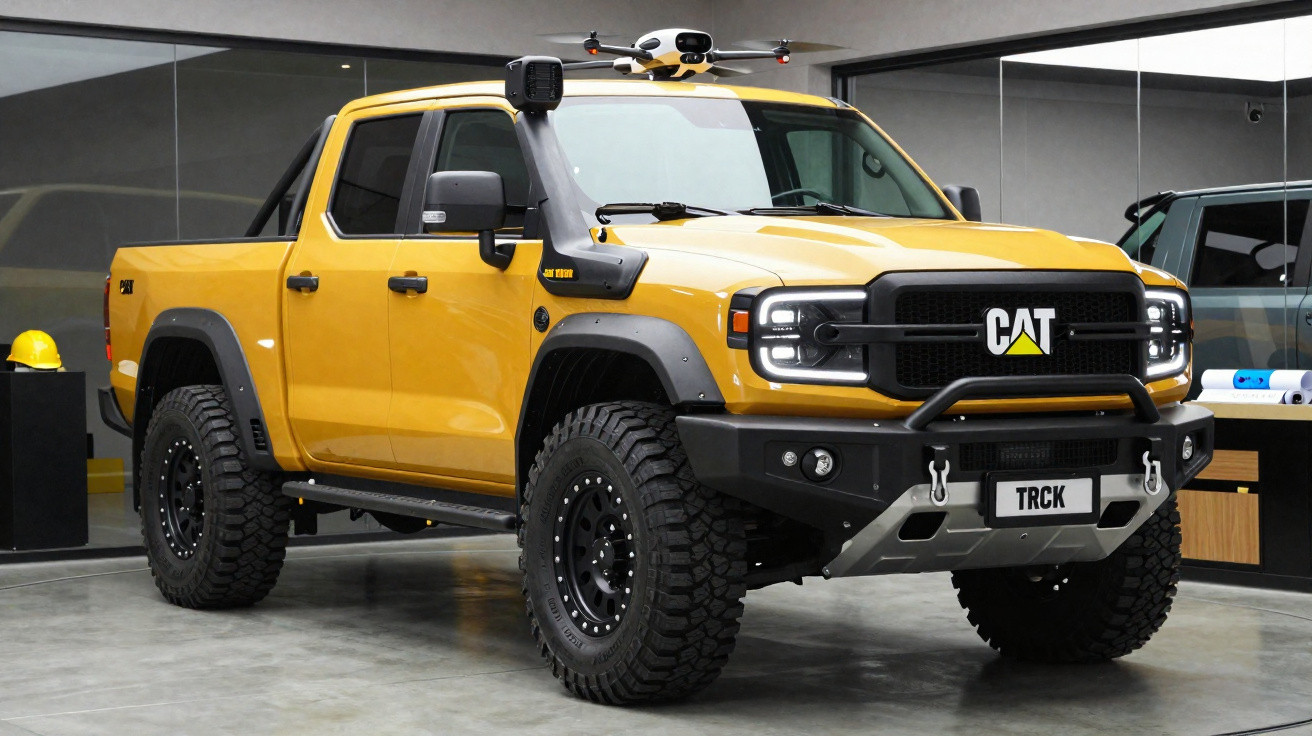
Caterpillar, a name normally associated with bulldozers and excavators, is now entering the automotive sector. The brand’s first pick-up is intended not as a lifestyle truck, but as a mobile command centre for major construction sites, with V8 power, a drone platform and artificial intelligence on board.
Why Caterpillar is suddenly entering the car market
For almost 100 years, Caterpillar has represented yellow heavyweights: tracked excavators, bulldozers, wheel loaders and diesel generators. The brand brings open-cast mines to mind far more readily than filling stations, which is precisely why its move towards road vehicles is so unexpected.
While groups such as Volvo and Hyundai have long developed lorries, buses and construction machinery alongside one another, Caterpillar has stayed away from road-legal vehicles. The company consistently focused on equipment for work rather than transport. Now, however, the US group is breaking with that tradition by entering new territory with its own 4×4 pick-up.
There is a strategic logic to the move. Construction sites are becoming more complex, more digital and more interconnected. Demand is growing for vehicles that can do more than simply carry materials from A to B. Caterpillar sees a gap between the conventional pick-up and the heavy lorry, and places the new “Cat Truck” squarely between them.
“The Cat Truck is less a car and more a tool – a multifunctional hub for safety, control and heavy loads on major construction sites.”
The Cat Truck: a Ford in Caterpillar clothing
Caterpillar has spent decades developing durable powertrains and chassis for off-road machinery. Yet the company lacks experience of crash testing, type approval, comfort requirements and everything else a road vehicle demands. It has therefore brought in an experienced partner: Ford.
The Ford Ranger Super Duty, an especially tough, high-towing version of Ford’s pick-up, forms the technical basis of the new Cat Truck. Its frame, drivetrain and many suspension components come directly from Ford. Caterpillar is concentrating on adaptations, additional technology and the industrial-use concept.
Its origins remain visible, although not immediately obvious. The front end in particular is different, with wider headlamps, a redesigned bumper and a huge, almost upright CAT-style grille. At the rear, a reinforced load bed makes clear that this pick-up is designed for hard labour rather than weekend trips to the DIY shop.
V8 Powerstroke: 500 PS as a working tool
Beneath the bonnet is not an experimental power unit, but a proven workhorse: Ford’s 6.7-litre V8 “Powerstroke”, known from the F-350 Super Duty. In the Cat Truck specification, the engine develops around 500 PS and delivers an immense 1.356 Nm of torque.
These figures may sound like conventional pub-talk numbers. On a major construction site, though, they primarily mean one thing: reserves. The V8 is intended to pull several tonnes of tools, spare parts, containers or trailers across loose ground without constantly operating at its limit.
| Model | Engine | Power (PS) | Torque (Nm) |
|---|---|---|---|
| Cat Truck (Caterpillar) | V8 Powerstroke 6,7 l | 500 | 1.356 |
| Ford F-350 Super Duty | V8 Powerstroke 6,7 l | 500 | 1.356 |
The question of power take-off will be particularly interesting. The engine has sufficient capacity to drive additional equipment directly, such as hydraulic pumps or high-performance compressors. This is exactly where it differs from a conventional pick-up intended for private buyers.
Mobile command vehicle rather than lifestyle pick-up
Caterpillar explicitly does not position the Cat Truck as a lifestyle model. The pick-up is primarily intended for large infrastructure and mining projects, acting as the link between office containers, the machinery fleet and safety teams.
Its developers define three core functions:
- Safety: monitoring staff, identifying hazards early and controlling access.
- Supervision: keeping track of construction progress, machine utilisation and material flows.
- Maintenance: getting technicians and spare parts to the right machine quickly, while carrying out diagnostics on site.
The cockpit therefore contains extensive electronics. A fatigue-monitoring system assesses the driver’s attention level. Cameras, infrared sensors or eye-tracking technology can identify signs of overload and issue warnings. On a major project involving long shifts and night work, such a system can significantly reduce accident risk.
“The Cat Truck becomes a mobile control room: driver assistance, data access and communication systems are brought together in one central place.”
Drone platform and AI assistants on board
Perhaps the most unusual aspect of the concept is its integrated drone platform. Autonomous drones can be launched from the pick-up to map the site, inspect material stores or monitor critical areas from the air.
Typical uses could include:
- Inspecting embankments after heavy rainfall
- Quickly flying over restricted zones without putting staff at risk
- Counting and locating material stores and containers
- Recording construction progress for clients
At the same time, Caterpillar is relying on AI-supported voice assistants. These are intended to guide construction personnel through maintenance procedures, read out checklists or log safety inspections while their hands remain free. In harsh environments, where tablets quickly become dusty or damaged, interaction shifts more strongly towards voice control.
Market strategy: why Europe misses out
Caterpillar remains entirely tight-lipped about pricing. There are also no details yet on equipment structure, possible variants or a launch timetable. One point, however, is much clearer: the Cat Truck is not initially planned for Europe.
There are several reasons. First, the intended areas of use are limited to regions with very large, sometimes remote construction sites, including North America, Australia and mining operations in Latin American countries. Second, EU emissions and noise regulations, together with toll systems, would hardly favour such a heavyweight with a V8 diesel engine.
For the European market, Caterpillar is currently thinking in different categories: telematics, fleet management for construction machinery and electrically assisted on-site solutions. A 6.7-litre V8 pick-up fits only awkwardly into the debate around climate targets and the shift towards urban mobility.
What the Cat Truck means for the construction industry
Caterpillar’s move says more about the construction industry than the individual pick-up might suggest. Construction sites are evolving into connected ecosystems, with sensors, data analysis and automation becoming increasingly close to the everyday work of site managers.
The Cat Truck brings together several trends:
- Digitalisation: real-time information on machinery, materials and personnel flows directly into the vehicle.
- Automation: drones and assistance systems take on routine tasks.
- Integration: the vehicle, machinery fleet and control centre operate within the same data environment.
For operators of large fleets, this creates a new tool. Rather than merely purchasing machinery, they are building a kind of “construction-site cloud”, in which the Cat Truck acts as a physical interface. Those already investing in BIM models, connected sensors and digital twins gain a practical link to day-to-day operations through such a vehicle.
Practical example: a day with the Cat Truck
What might a typical deployment at a major construction site look like? One possible scenario is as follows.
Early in the morning, the Cat Truck is among the first vehicles to enter the site. Machinery data collected overnight has already been synchronised. A dashboard in the cockpit shows which equipment has reported maintenance requirements or unusual readings.
The site manager launches two drones from the pick-up to survey critical areas: a newly built ramp and a slope at risk of erosion. The aerial images arrive directly in the vehicle, are analysed automatically and flag suspicious locations. At the same time, the fatigue-monitoring system detects early signs of exhaustion in the driver – not unusual after several night shifts.
Later in the day, a team of mechanics sets off in the Cat Truck for an excavator displaying an error message. On site, an AI assistant retrieves the appropriate step-by-step fault-finding guide. The technician uses voice commands while working on the machine. The pick-up remains nearby with its engine running and supplies additional measuring equipment through its power system.
By the end of the day, a complete log is available: maintenance work, safety checks, drone flights and the locations of key machines. Much of it has been completed without paper, handwritten notes or cryptic Excel files.
Opportunities and risks of the new strategy
The Cat Truck gives Caterpillar several opportunities, alongside a few potential pitfalls. Its biggest advantage is that the group expands its portfolio without starting from scratch. Ford contributes production experience, crash safety and road approval, while Caterpillar provides expertise in heavy-duty operation and digital construction-site solutions.
The risks lie elsewhere. Fleet customers know Ford dealer networks, warranty terms and service intervals. How responsibilities and costs will be divided between Ford and Caterpillar remains unclear. High weight, fuel consumption and the V8 diesel will also be viewed critically in some markets.
At the same time, the Cat Truck could act as an entry point. Companies that already operate a complete CAT fleet may see the pick-up as a logical addition. Psychologically, the move from a yellow tracked excavator to a yellow command vehicle is smaller than switching from a purely civilian pick-up to an industrial-vehicle brand.
What it means for other manufacturers
Caterpillar’s entry is likely to attract competitors’ attention. If a traditional machinery manufacturer plans a “construction-site vehicle” with drones and AI, the boundary between commercial vehicle, work equipment and IT platform is being redrawn. Other heavyweights, such as Komatsu, Liebherr or Hitachi, could examine similar concepts – perhaps with alternative powertrains or closer links to existing telematics systems.
For the automotive industry, this creates further pressure to offer specialised industrial solutions rather than viewing pick-ups solely as leisure or tradesperson vehicles. The Cat Truck demonstrates how far a commercial vehicle can diverge from its production-model base without losing that foundation.




Comments
No comments yet. Be the first to comment!
Leave a Comment