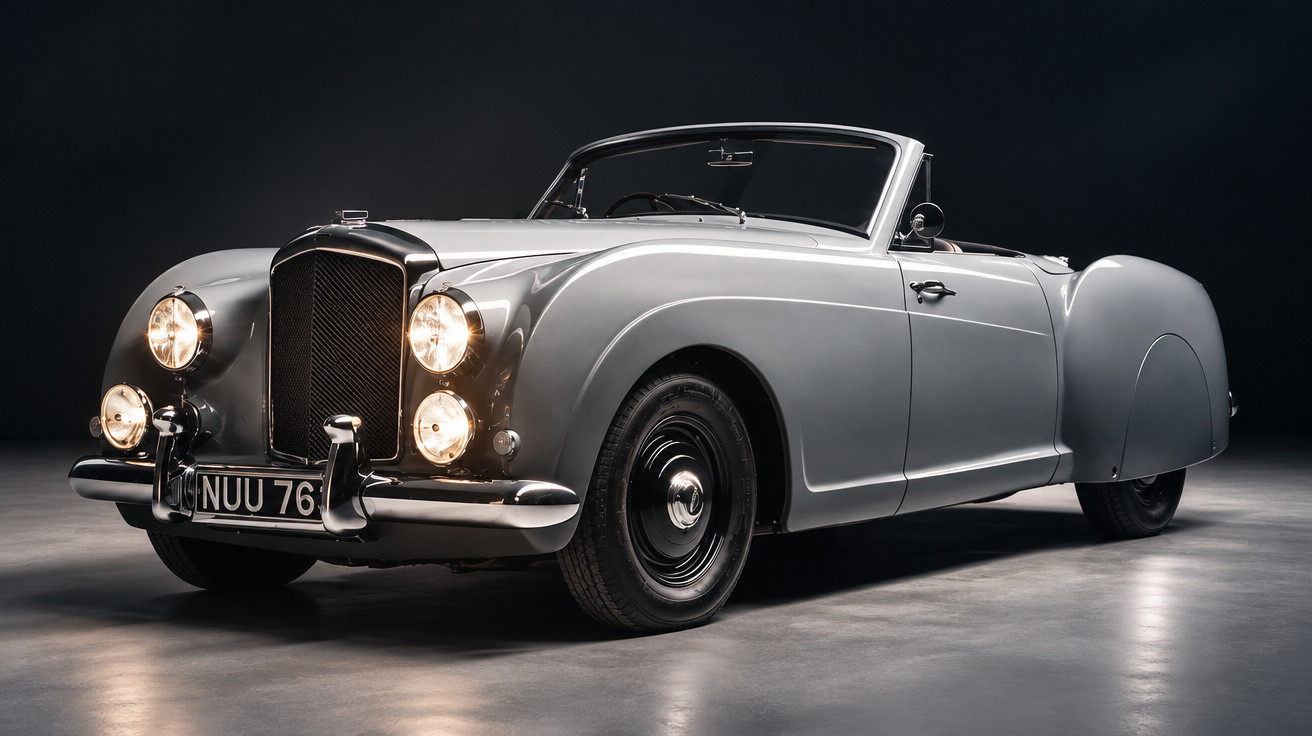
Ask a James Bond enthusiast which car 007 drove and the answer will almost invariably be Aston Martin. Yet the Bond of Ian Fleming’s original novels favoured Bentleys. For car designer Tony Hunter, one particular Bond Bentley eclipsed all others: the 1960s Continental Mk2 known as ‘The Locomotive’.
There was just one problem: the car existed only in fiction. That is, until now.
James Bond’s Bentley The Locomotive brought to life
After years spent seeking real-world versions of the car Fleming called “the most selfish car in England” in Thunderball, Hunter decided he would need to lift it from the novel’s pages himself. He chose a 1953 Continental R-Type as the donor vehicle, then sent it to a coachbuilder in Poland, where the project would occupy the following seven years.
Photography: Bentley
“This car is possibly the most famous Bentley that never existed, and I always wondered why no one else had tried to build something like it,” Hunter said. “I quickly realised why.” What had innocently been expected to take 18 months stretched far beyond that before the vision became reality. Even so, that timescale paled beside the decades Hunter had devoted to imagining, drawing and researching The Locomotive.
Reimagining Fleming’s Continental Mk2
The early-1950s Continentals had softly rounded forms, whereas Fleming described the Mk2’s tail as “knife-edged” and “rather ugly”. Hunter therefore took a little creative freedom, shaping elegant, sweeping rear fins in its place. His intention was to create a design convincingly buildable in the 1950s, while remaining faithful to the original description.
Naturally, The Locomotive is far from an ordinary Bentley. Hunter equipped it with an array of spy-themed controls and devices, with every feature assessed for both its period authenticity and pleasingly tactile operation. Its functioning telephone came from a 1950s RAF bomber and has been ingeniously wired to an iPhone concealed underneath. Machine-gun, oil and smoke switches carry labels in era-appropriate Gill Sans, while a concealed compartment sits behind the speaker grille. The finishing touch is a small pull-out drawer containing Bond’s necessities: a hip flask, cup and Benzedrine tablets.
A spy car interior designed for driving
Inside, Hunter sought the atmosphere of a gentleman’s club, using substantial armchairs and a bespoke American-walnut-veneered dashboard. Quilted upholstery has been a personal hallmark throughout his career, so although Bentleys of this period would have used fluted leather, he jokes, “flutes are fine but diamonds are forever”.
At every point in the design process, Hunter treated Bond as though he were a Mulliner customer. Looking at the view from behind the wheel, he considered bonnet louvres essential, referencing the spy’s earlier Bentley Blower. “I also imagined Bond driving this car down through the UK then onto the continent and having to pull the fuel pipe across the car. That’s why it’s got two fuel fillers.” Hunter said.
Although The Locomotive’s outward styling took precedence, Hunter said: “It was important to me to capture the driving experience, the excitement, feel and sounds of what I imagined this car would have been like.” Power comes from a restored Bentley S1 engine, a 4.9-litre straight-six paired with a manual gearbox, and a supercharger is set to join the specification soon.
Many people might hide such a labour of love in a garage, but Hunter intends to follow Bond’s example and use it as intended. “Cars are there as a tool to have an adventure, there to help you enjoy the world, see things and go places. That's one of the reasons I became a car designer because of that love of driving. I love when a car has been used and has a bit of patina about it. My intention is to use The Locomotive but I’m not going to pamper it.”














Comments
No comments yet. Be the first to comment!
Leave a Comment