Aston Martin’s new chief executive once came close to crashing an electric Hummer because he was enjoying it so much. “I was laughing so much in crab mode. I think it’s hilarious, but it’s such fun,” he said.
“I’ve driven the Rivian. Anodyne but European quality and you’d have one. And I’ve driven an EQS AMG.” His catalogue of EVs is not intended as a boast: it is research. When asked whether he would use simulated gear changes (yes) or artificial engine soundtracks (no), he outlined how an electric Aston Martin could sound distinctly electric.
Aston Martin’s electric car soundtrack
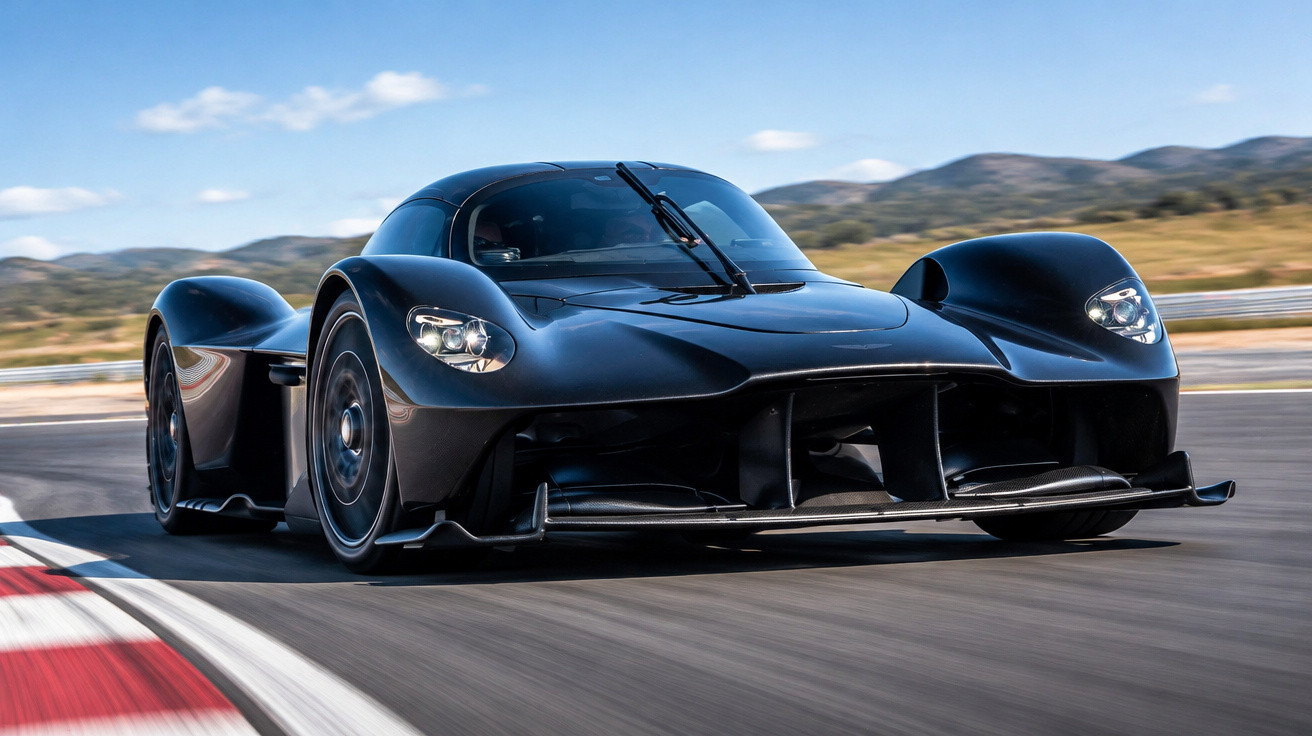
“If you mapped the telemetry of a V12 engine – even a Valkyrie race engine, naturally aspirated – measure the frequencies and then built those into the body structure of the vehicle linked to the throttle position and torque load of the electric-motors…
“… and then suppressed digitally by counter waves the nasty high-pitched, cheap sounding electrical frequency noises, you would feel exactly like you’re in a Valkyrie V12 Le Mans car.”
He believes physically ‘agitating’ an EV’s body structure, using the vibrations mapped from a true internal-combustion performance car, means “you can create the emotional connection with the vehicle”.
EV acceleration, naturally, is already assured. “It’s just biology that stops us,” he laughs. “So you can make emotional electric cars, and we’re just at the beginning of that.”
Aston Martin’s route to a BEV
There is still considerable distance to cover on Aston Martin’s product roadmap. Hallmark has led the company since September 2024, and its present strategy centres on facelifts, options and hybrids. Hybrids are necessary for a small manufacturer confronting shifting government deadlines for ICE cars, weakening consumer confidence in EVs, and even the incoming US administration’s hostility towards electric vehicles.
There is also the challenge of building a performance EV. “The problem with battery electric vehicles is it’s very difficult to get that dynamic feel that you get from a genuinely lightweight performance car. Mass is the enemy, and with BEVs, mass is part of the DNA,” he said.
He argues that achieving this is difficult because everything else must be made lighter to compensate for an average battery pack weighing 700-800kg, compared with an average engine at about 150kg.
“I could imagine in time when we finally resolve the problems with solid state batteries, you can take 30 per cent out of the weight,” he said. He also pointed to 3D printing as a means of avoiding redundant material, alongside systems such as four-wheel steering and other electronics that could reproduce the responses of a lightweight ICE car.
“So you can get there, but it requires some significant steps in technology or process to be able to get to the feeling you get in a [Lamborghini] Huracán STO or [Ferrari 488] Pista.
“Not all of our cars are sports cars,” he added. Does that hint that Aston Martin’s first EV will be an SUV or crossover? The company has not confirmed anything. Only last year, chairman Lawrence Stroll delayed the marque’s first electric car, citing insufficient demand.
Demand for Aston Martin electric cars
On the question of demand, Hallmark said Aston Martin has two clearly different groups of customers: those in favour of EVs, and those who do not merely dislike them but hate them “with a deep-rooted passion”. The balance between those groups continually changes, making it hard to set a date for Aston Martin’s first EV.
“I won’t give a year,” Hallmark said. “We have all of the prerequisites defined and some of them developed. We are fully committed to BEVs. The uncertainty from legislators, especially in Europe and in the US, is disruptive. And so we’ve got to protect the company.
“Between here and 2030, most of our cars will have an engine, but there will be a BEV.”
Nor will it simply be a Lucid Gravity wearing another badge. Aston Martin is partnered with Mercedes-Benz and Lucid, with the latter supplying battery systems, motors and control systems for its electric cars, rather than its electrified ICE models.
Will the BEV use an existing nameplate or establish a separate model line? “We haven’t fully decided,” he said. Watch this space.



Comments
No comments yet. Be the first to comment!
Leave a Comment