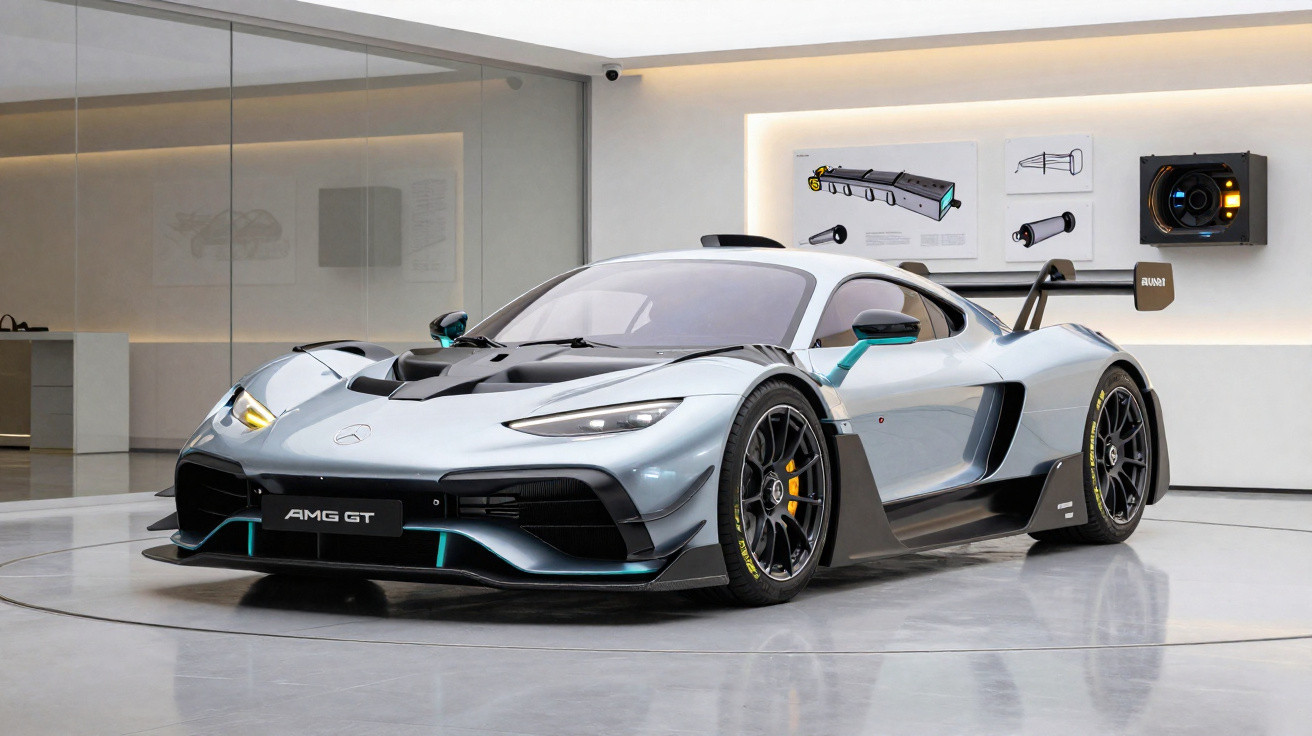
Mercedes-AMG selected Affalterbach, its home town, to unveil the next chapter in its story: a prototype designed to challenge established ideas of what a high-performance electric car can be.
Named the Concept AMG GT XX, this prototype previews the first production model to use the AMG.EA platform. At the same time, it signals the future of the brand’s design language and introduces an innovative powertrain with three axial-flux motors and an oil-cooled battery.
It also incorporates extensive technology developed with input from the Mercedes-AMG Petronas Formula 1 single-seater, while delivering figures capable of standing up to the “all-powerful” AMG One.
This prototype is certainly not short of credentials. Its development will culminate next year in the most radical, most powerful and fastest production model in AMG history.
Three motors and more than 1360 hp
At the heart of this concept is a revolutionary powertrain powered by three axial-flux electric motors. Combined, they produce more than 1000 kW, or more than 1360 hp.
More compact, lighter and more powerful than conventional electric motors, these units result from a partnership with British specialist YASA, now a Mercedes-Benz subsidiary and an expert in this type of architecture.
The outcome is Formula 1-grade technology housed within a four-door coupé, with a claimed top speed of more than 360 km/h.
The specific power output of the axial-flux motors is around three times greater than that of conventional electric motors. They are also two-thirds lighter and require only one-third of the space: the two motors at the rear are just eight centimetres wide.
In most driving situations, these two motors are responsible for propelling the Concept AMG GT XX through an electric drive unit (HP.EDU) mounted on the rear axle. The electric drive unit at the front axle, which includes an additional motor, is brought into play only when extra power or greater traction at the front wheels is required.
When the front electric motor is not needed, it is disconnected by a decoupling unit (DCU). At steady speeds, under low loads and during deceleration, this front motor remains disengaged.
Formula 1-inspired battery
The innovations in this prototype extend well beyond its motors. Another key highlight is the Concept AMG GT XX battery, which uses cylindrical cells cooled directly by oil, allowing it to retain a stable temperature even during extended periods of sporting driving.
Until now, this kind of solution has generally been associated with highly specialised settings such as Formula 1, but it could soon make its way into Mercedes-AMG production electric cars.
According to the Affalterbach brand, the battery chemistry was developed specifically for the Concept AMG GT XX and is based on NCMA: nickel, cobalt, manganese and aluminium.
This solution delivers high sustained output without any loss of performance, as well as charging speeds of up to 850 kW, provided suitably capable chargers are available. It can add 400 km of range in only five minutes.
That figure was not chosen at random: 400 km is exactly the distance between Affalterbach, Mercedes-AMG’s home, and Belgium’s Spa-Francorchamps circuit.
A clearly defined objective
Although it remains a prototype, the AMG GT XX is far from being a fantasy created solely for motor shows.
The primary purpose of this concept is to lay the foundations for a production model arriving in 2026. It will become the first vehicle built on the new AMG.EA electric platform, developed exclusively for electric performance.
If everything proceeds as planned, it will usher in a new era for AMG, which has major ambitions for the future high-performance electric cars currently under development.
As Michael Schiebe, Chief Executive Officer of Mercedes-AMG, told us during the prototype’s presentation event, “Mercedes-AMG high-performance electric cars will not have to be like the brand’s combustion models; they will have to be much better”.
Design with a racing soul
The Concept AMG GT XX is not simply another design study. It is a bold statement of what the future of Mercedes-AMG could look like. At first glance, its low yet muscular profile makes an immediate impression, drawing inspiration from the Mercedes-Benz C 111. The sharply raked windscreen and bonnet with two split air outlets add to that effect.
It is equally difficult to overlook the distinctive AMG grille, featuring ten vertical slats. This familiar brand signature has been reinterpreted in an oval, concave form. The Mercedes star sits recessed in the centre, while slim horizontal auxiliary lamps at each end enhance its aggressive appearance. The main vertical headlamps, with dipped and main-beam lights stacked one above the other, take an innovative approach that strengthens this concept’s visual identity.
The rear is no less dramatic. Its exposed carbon-fibre diffuser takes inspiration from the AMG ONE hypercar and has been engineered to ensure directional stability at extreme speeds. The active rear spoiler is seamlessly integrated into the bodywork, while six circular lights emulate the exhaust outlets of combustion-powered AMG models. The MBUX Fluid Light panel creates an unrivalled visual signature.
An interactive panel incorporating more than 700 RGB LEDs can display messages or logos at the rear of this prototype, allowing it to communicate with surrounding vehicles. There are also two additional illuminated panels on the flanks, inspired by the side lighting used on endurance racing cars, which make it possible to monitor battery charging in real time.
Maximum aerodynamic refinement
With such expressive styling, it would be easy to assume that form had taken priority over function. In reality, the opposite is true. The aerodynamics of this concept amount to a lesson in applied engineering, with a claimed drag coefficient of only 0.198 Cd.
The low, flat body shape, steeply angled windscreen, sharply profiled side windows and even the absence of a rear window have all been designed to cut through the air with minimal resistance. The most complex work, however, lies beneath the bodywork, where a specially shaped underbody helps generate the Venturi effect, reducing rear lift without relying on exaggerated aerodynamic appendages.
Another notable feature is the AIRPANEL active air-control system. Behind the front air intake, electronically controlled shutters open or close according to cooling requirements. When shut, they optimise airflow and reduce drag; when open, they intelligently direct cool air towards the heat exchangers.
Radical minimalism
If the exterior of the Concept AMG GT XX is a visual expression of speed and technology, its interior takes that commitment even further. It combines the raw aesthetic of the race circuit with futuristic, luxurious execution, exactly as expected from a Mercedes-AMG.
On entering the cabin, the almost monochrome setting is impossible to miss, allowing the electric orange accents to stand out even more strongly. Among the most striking visual elements are the orange illuminated tubes running through the centre console and door panels, immediately recalling high-voltage cables.
As expected, everything is focused around the driver, who faces two displays measuring 10.25” and 14”. One serves as the instrument display, while the other operates as the multimedia terminal.
The four individual seats are carbon-fibre shells tailored to each user and, as in motorsport, can be easily replaced to suit different body sizes.
As mentioned at the start of this article, Mercedes-AMG’s objective with this prototype is straightforward: to establish the basis for a high-performance production electric car capable of bringing Formula 1 technology to the road. We will get to know it in 2026.



Comments
No comments yet. Be the first to comment!
Leave a Comment