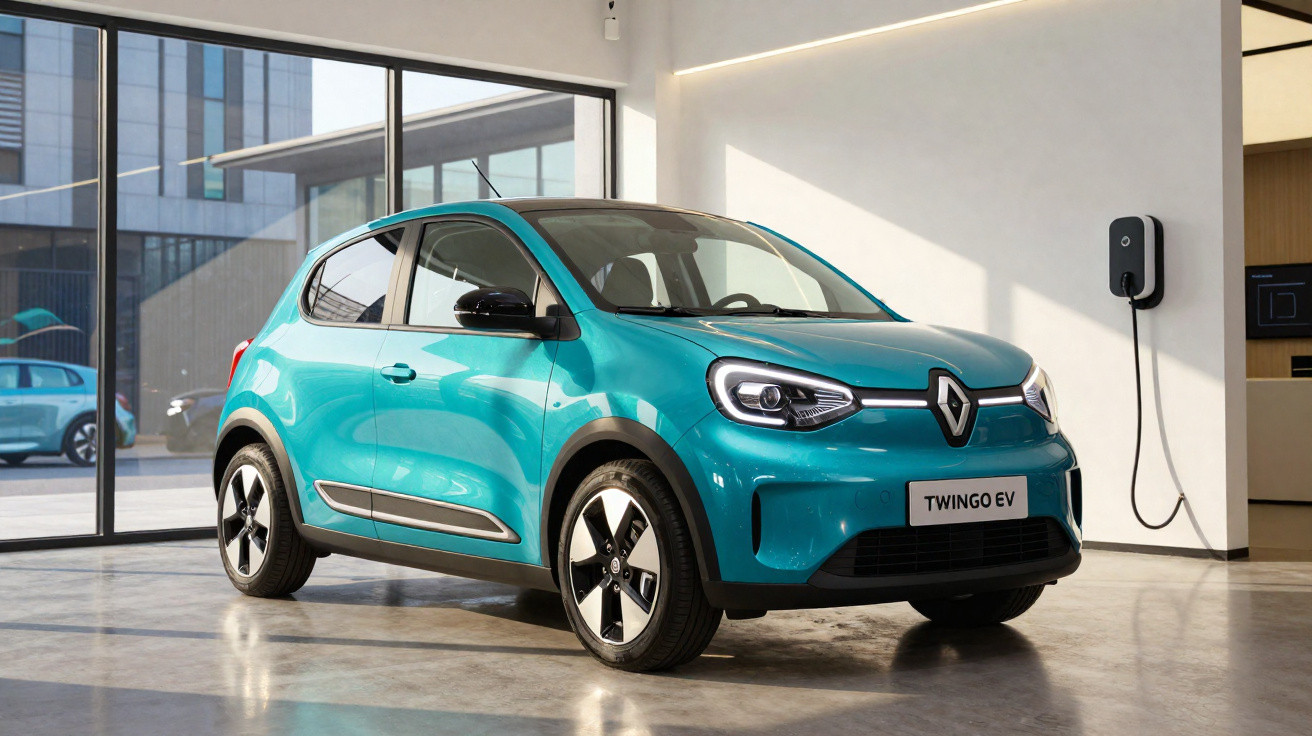
Available from €22,200, the Renault Twingo Electric is, until the imminent arrival of the Dacia Spring Electric, the most affordable electric car on the Portuguese market.
Introduced considerably later than its German “cousin”, the Smart EQ forfour, which has been available locally since 2018, the Twingo Electric appears to be a solution requiring fewer compromises.
After all, by using a 21.4 kWh battery rather than the Smart’s 17.6 kWh unit, the French model offers a claimed mixed-cycle range of 190 km, compared with the EQ forfour’s 133 km.
Straightforward and practical
Inside the Renault Twingo Electric, there are very few differences compared with its combustion-engined “siblings”. Its cabin therefore retains the simple, practical and youthful design, along with a reassuringly solid feel demonstrated by the absence of unwanted noises.
There are numerous storage spaces, a straightforward yet comprehensive infotainment system, and graphic details such as the embossed Twingo profile on the rear doors, all of which remind you that this is a car designed with younger buyers in mind.
Space is not outstanding - nor would you expect it to be - but four adults can travel in reasonable comfort, helped greatly by the generous headroom. The 188-to-219-litre boot is smaller than the 250 litres offered by the Volkswagen Group trio - the Volkswagen e-Up, Skoda Citigo and SEAT Mii - yet it is sufficient for everyday duties and the usual shopping trip.
The Renault Twingo Electric feels at home in town
As was only fitting, my first kilometres behind the wheel of the Twingo Electric were covered in its “natural habitat”: the city. Here, the little Renault is like “a fish in water”, weaving through traffic with pleasing agility and benefiting from the immediate torque delivery typical of electric models.
Parking is exceptionally easy - it even has a reversing camera - while outward visibility is good, with the high driving position proving particularly helpful. Its tight turning circle, measuring 9.1 m for a full 360º turn between walls or 8.6 m between kerbs, also lets you turn around in the narrowest streets.
Less impressive is its comfort over poor road surfaces. The somewhat “firm” suspension set-up, which pays dividends in terms of handling, is noticeable here, and the little Twingo Electric makes no attempt to hide its preference for well-surfaced avenues over Lisbon’s potholed side streets.
Beyond its comfort zone
Having covered a few kilometres in town and used around 25% of the Twingo Electric’s battery there, I decided it was time to take it out of its habitat and well beyond its comfort zone.
What was on the “menu”? A journey of roughly 90 km to the town of Coruche, using motorways and national roads. After all, just because a model has been designed for urban use does not mean it cannot undertake longer journeys.
I must admit that, during the first few kilometres, it was not just the Twingo Electric that was outside its comfort zone - I was too. To maintain an acceptable pace, energy consumption, which had been around 10-12 kWh/100 km in the city, rose to around 16 kWh/100 km, matching the official claimed figure.
The predicted range was also falling - it had started at 170 km - while the graphic showing how far I could travel on the remaining charge kept shrinking. In short, I was experiencing the infamous “range anxiety” first-hand.
However, thanks to features such as cruise control (who would have thought city cars would get it?) and battery management that demonstrates Renault’s accumulated experience, the kilometres continued to pass and the fear of not making it home gradually faded.
Stable on the motorway, the Twingo Electric did not even shy away from a few overtakes, despite being in the restrained and zen “Eco” mode, which limits both top speed and acceleration performance.
Helping to “stretch” the range are three levels of energy recovery through regenerative braking - B1, B2 and B3. Although the difference between them is slight, they do fulfil their purpose.
Do not expect much driving excitement from the Twingo Electric in bends, however. Despite its rear-engined, rear-wheel-drive layout, lower centre of gravity and suspension that controls body movements effectively, the stability control frequently makes its presence felt, with efficiency and safety taking priority over enjoyment behind the wheel.
Safe charging
It is true that I had to recharge it upon reaching my destination, but it is equally true that charging at a public point is reasonably quick: 3h15min using an 11 kW charger, or 1h30min on a 22 kW rapid charger.
The Twingo Electric also has an interesting charging feature. When plugged into a domestic socket, it “assesses” the electrical installation and, if it detects a risk of overheating, simply will not charge. This safeguards both the electrical system and the house to which it is connected.
Is it the right car for you?
If most of your journeys take place in urban areas, the Renault Twingo Electric is very likely to be one of the best options available.
Small and agile, it comes with an affordable price within the electric-car market and a very acceptable level of equipment for the segment. Furthermore, unlike its German “cousin”, it is not overly intimidated by motorways and suburban routes.
Is it a natural long-distance traveller? No, and that is not its purpose. Even so, it is reassuring to discover that the market’s more affordable electric cars can allow us to start “broadening our horizons” beyond the “urban walls”.


Comments
No comments yet. Be the first to comment!
Leave a Comment