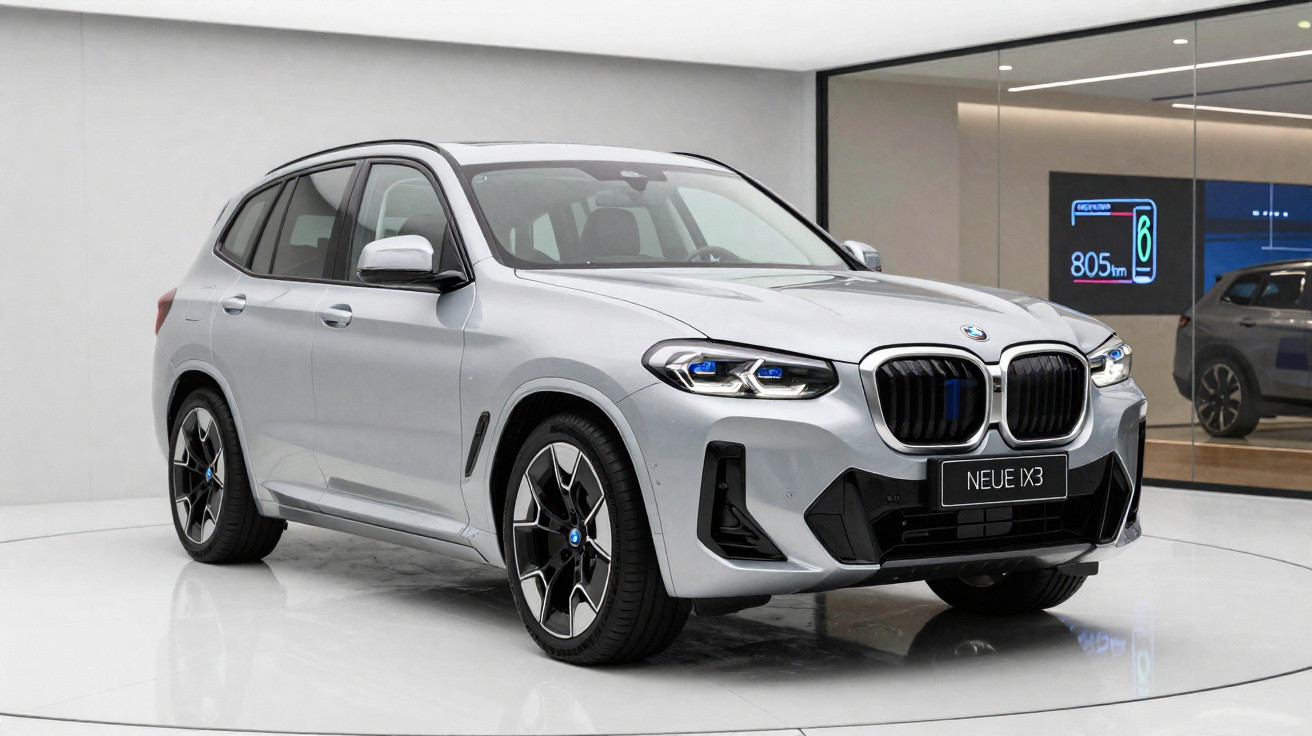
805 km of range, a 10-minute recharge and a transformed look: the BMW iX3 opens the Bavarian brand’s new “Neue Klasse” chapter. For once, the word “revolution” does not appear overused: this really is the turning of a page.
“778 km”. I had to squint at the display three times before accepting that the BMW staff had been telling the truth. Not that I doubted them, of course, but professional curiosity meant I had to check for myself. Sure enough, the BMW iX3’s estimated range is close to the claimed figure. The difference between 805 and 778 is 27. A 27-kilometre gap against the WLTP figure is peanuts.
Right now, that is the new iX3’s most striking attribute. As the first drive began in a dark car park beside Valencia airport, it was difficult to take in the electric SUV’s debut “Neue Klasse” styling properly. That wait was partly over once we emerged from underground into blinding sunshine, which revealed the vehicle’s highly unusual cabin. In truth, the interior does not feel like a BMW at all.
Panoramic Vision: BMW completely rethinks the interior
The conventional instrument display, usually hidden beneath a binnacle ahead of the driver, has disappeared. The iX3 introduces BMW Panoramic Vision, a vast digital strip positioned at the base of the windscreen. The remarkable range figure is only a tiny part of what this area can display: speed, navigation, multimedia, compass, weather, date, G-force, rev counter... None of it is strictly essential, but everything can be personalised.
The atmosphere is undeniably unusual. The responsive 18-inch central screen, which looks as though it has been hit by a fierce gust from the right, has fairly simple yet appealing graphics. Shortcuts along its lower edge make essential functions, including ventilation, easier to access. A special mention goes to the unusual steering wheel, whose spokes are arranged vertically. Its semi-touch-sensitive controls make it awkward to use.
Less trim, more plastic? The downside
While my travelling companion dealt with Valencia’s traffic jams, it was time to assess the build quality: it is good, though not as good as it was previously. The lower sections are generally finished less carefully than the upper areas. That is a shame, as older models paid greater attention to these details. The seats are comfortable but do not provide much support. You will need to choose the M Sport trim for more embracing seats.
In the rear, the floor is flat, which is the good news. The bad news is that the battery means this same floor cannot be set low enough. As a result, the seating position is not especially natural. At least the door trims are of a quality equal to those at the front. The 520-litre boot is average for the class, although its loading lip is slightly high. It is supplemented by a 58-litre front storage compartment that is not particularly wide, but is reasonably deep.
The first stretch of motorway provides an ideal opportunity to judge the iX3’s comfort. Sound insulation is strong despite the lack of laminated glass. Unlike in some rivals, there is barely any need to fight the driver-assistance systems, which are very well calibrated. It is relaxing. The damping is firm at low speeds before becoming more supple at higher pace. Curiously, adaptive suspension is not available, even as an option. It is not a major issue, because the engineers responsible for the chassis appear to have found an excellent balance between agility and smoothness.
2,360 kg on the scales, yet startlingly agile through corners
It may sound like a cliché, but it is true. Having stitched up my colleague, who had handled the urban traffic and dual carriageways, it was my turn to take the wheel and head into the mountains. To my surprise, despite a kerb weight of 2,360 kg, the iX3 dispatches bends and threads through hairpins as though it were nothing. The sensation is strange but genuine: there is virtually no body roll.
Better still, the brake-pedal feel is entirely natural and transparent. That is exceptionally rare in an electric car. Gentle at the initial press, the braking becomes progressively stronger as the pedal is pushed further. There is no unpleasant transition to report. The secret? Calibration that handles 98% of deceleration through regenerative braking. The brake pads are called upon in only 2% of situations.
800V charging: 372 km in 10 minutes, ending charger anxiety
Its dynamic performance is therefore hugely impressive. Naturally, its 469 hp also delivers brisk acceleration. But rivals can do that too. Many, however, will be left behind at a rapid charger. Thanks to its 800 V platform, the iX3 can accept up to 400 kW of DC current. That is enough to recover 372 km of range in 10 minutes. In short, charging stops are no longer a concern.
The car’s styling, on the other hand, will divide opinion, whether positively or negatively. Its black mask, echoing the grille of the 1960s BMW 1500, clearly represents a break from the past. In profile, the 20-inch wheels look rather undersized. Choose at least the 21-inch wheels to fill the wheel arches more convincingly. The rear also raises questions, with two large light clusters taking up much of the tailgate. BMW has produced more attractive designs.
Motorway consumption: the miracle of the new cylindrical cells
Equipped with new cylindrical cells, the 108.7 kWh battery is paired with particularly low energy consumption. With 19 kWh/100 km recorded on a Spanish motorway at 120 km/h without denying ourselves any comfort equipment, efficiency appears very good. It is worth remembering that the iX3 measures 4.78 metres long, 1.90 metres wide and 1.64 metres high. Its footprint is far from insignificant.
Setting aside its size and the firm damping caused by the suspension, the German SUV remains pleasant in town, with a fairly tight turning circle despite the absence of rear-wheel steering. The One Pedal mode is impressively smooth, with no jerkiness whatsoever until the car comes to a stop. The steering is light, perhaps too light, particularly on the open road, where assistance remains excessively pronounced even in Sport mode.
Why the cheapest version is oddly the best
Conversely, the options list is not very German, which is a positive. Extras are limited, preventing the bill from rising unnecessarily. The BMW iX3 starts at €64,550 in 40 form, with 320 hp and 635 km of range. The 50 xDrive variant rises to €71,950, but offers four-wheel drive in return. Between us, it would be wiser to save money at purchase and opt for the 40, which will already cover every use case. But do not mention that to BMW...
Our verdict on the BMW iX3
On BMW’s desirability scale, the iX3 will not claim the top spot, or even a middle position. It can nevertheless point to strong electric-car credentials, including its range, charging and consumption, as well as high-speed comfort and generous equipment. We would have liked greater suppleness in town, closer attention to build quality and more carefully considered driver ergonomics. But if the priority is travelling quickly and far with the family, the iX3 is unquestionably among the best electric cars for the job.
With its record range and rule-breaking looks, has BMW won everyone over, or has it lost the brand’s DNA? Tell us in the comments!
BMW iX3 50 xDrive
€71,950
Verdict
8.5/10
What we like
- Record range
- Controlled consumption
- Effective rapid charging
- Comfort/dynamism balance
What we like less
- Firm damping at low speeds
- Ergonomics need refinement
- Build quality has declined


Comments
No comments yet. Be the first to comment!
Leave a Comment