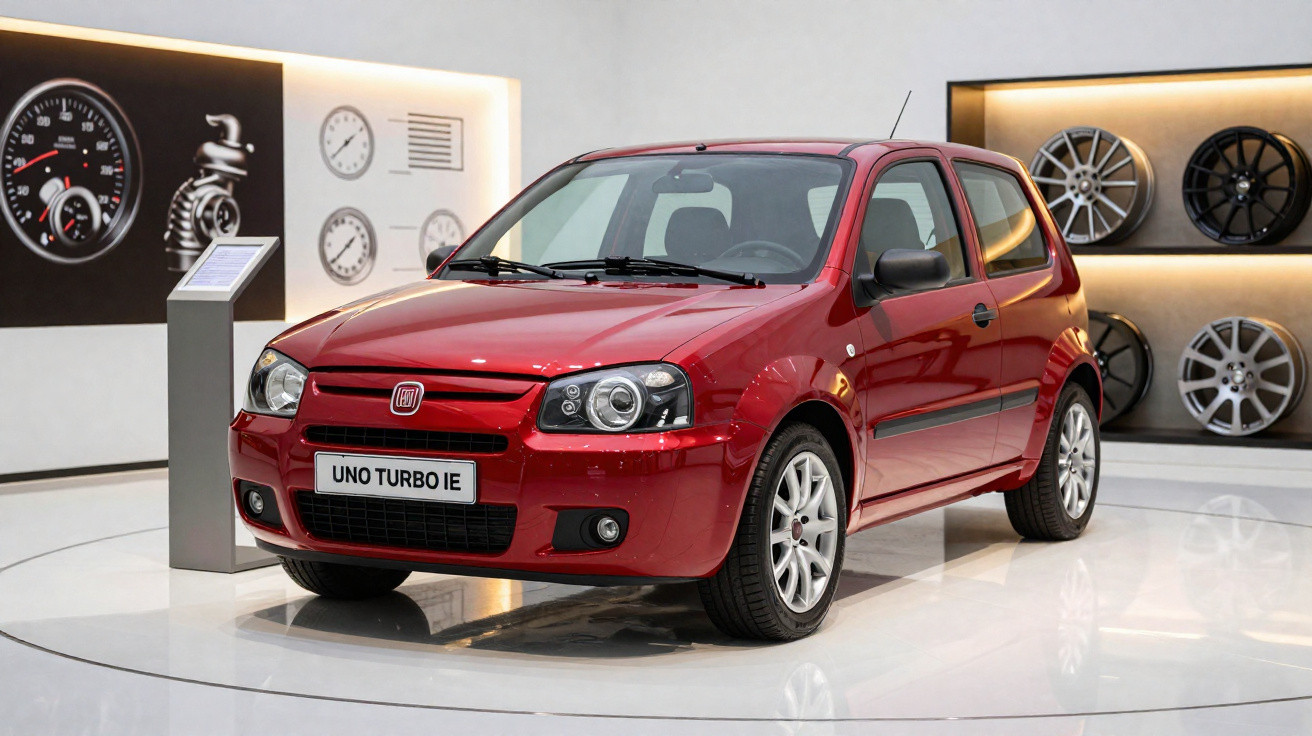
Some pieces are particularly difficult for me to write. They are difficult because I know I will have to criticise a car that, despite its countless shortcomings, I am enormously fond of. Truly enormously. So let us begin with the positive side of the much-missed Fiat Uno Turbo I.E. - because from here onwards, it is all downhill.
What an engine!
I had the chance to drive one and, “may Our Lady of Torque and Horsepower protect us”, what a surge it delivered!
If, in some distant future, I had to travel back in time and rescue one model to show my grandchildren what engines and cars were like before they were taken over by the geniuses of electronics, I would choose a Fiat Uno Turbo I.E. Deadly, unhinged, unpredictable and not especially safe.
Below 3000–3200 rpm, the celebrated 1.4 Turbo engine produced little, if anything. Beyond that point, however, you had better get out of its way. Its fixed-geometry turbocharger, running at 0.8 bar, filled its “lungs” and did not stop unleashing power until around 6000 rpm.
This was a bipolar engine: everything or nothing, with no middle ground. That nature made it very tricky to drive on twistier roads, while also making the experience all the more thrilling.
After all, we are talking about a 1400 cm³ engine - its predecessor used a 1.3 l unit - which, despite having only eight valves and multipoint injection, produced a healthy 118 bhp thanks to turbocharging. It was a benchmark for its day - the gossips claimed it had more, somewhere near 130 bhp…
Fiat Uno Turbo I.E. chassis: memorable for the wrong reasons
Although the engine was genuinely memorable for its all-or-nothing character, the same cannot be said of the chassis. Forgive the exaggeration, but there must be donkey carts out there with more respectable handling than this Fiat Uno Turbo I.E.
At the rear sat a semi-rigid axle which, besides being about as comfortable as a granite sofa, gave the Turbo I.E. handling as dependable as a politician. It rarely did its job properly and chose the worst possible moments to stop cooperating, making situations that were already delicate even worse.
At the front, the poor thing did its best to cope with the 160 Nm of torque that always arrived in one abrupt hit. Fortunately, the brakes performed brilliantly. That brilliance was only undermined by the absurdly small wheels and tyres: 175/65 R13 - remember, 118 bhp?
Equipment was a strong point
Inside, unlike its Volkswagen Polo G40 rival, which had absolutely nothing - not even central locking or electric windows - this car came with practically everything. There was an excellent steering wheel from a well-known Italian marque, a long list of standard equipment and considerable interior space. It lacked only one thing: build quality. Rattles and vibrations came as standard.
In short, it was a car that reflected its era. It had no concern for fuel consumption, pollutant emissions or that rather strange concept at the time known as safety.
On the other hand, those were days when cars went hand in hand with carefree enjoyment and fun. That alone is more than enough reason to celebrate a car which, in the end, we could even say had no faults. Let us say instead that it had quirks. It was a very temperamental car! And that was not necessarily a bad thing. After all, there were other choices for anyone seeking peace and quiet…
The young wolves who survived the experience remember it fondly. Now less young than they were 20 years ago, they can be seen on the roads calmly driving far more rational and safer vehicles. They left the fast-box club behind a long time ago. Times have changed.
Aside: I found an interesting image of the very comprehensive instrument cluster from a Fiat Uno Turbo I.E., supposedly photographed in Portugal. Apparently, some people believed the little Turbo I.E. could handle a few extra horses:
About “Glories of the Past”. This is Automobile Reason’s feature dedicated to models and versions that stood out in one way or another. We enjoy remembering the machines that once made us dream. Join us on this journey through time at Automobile Reason.








Comments
No comments yet. Be the first to comment!
Leave a Comment