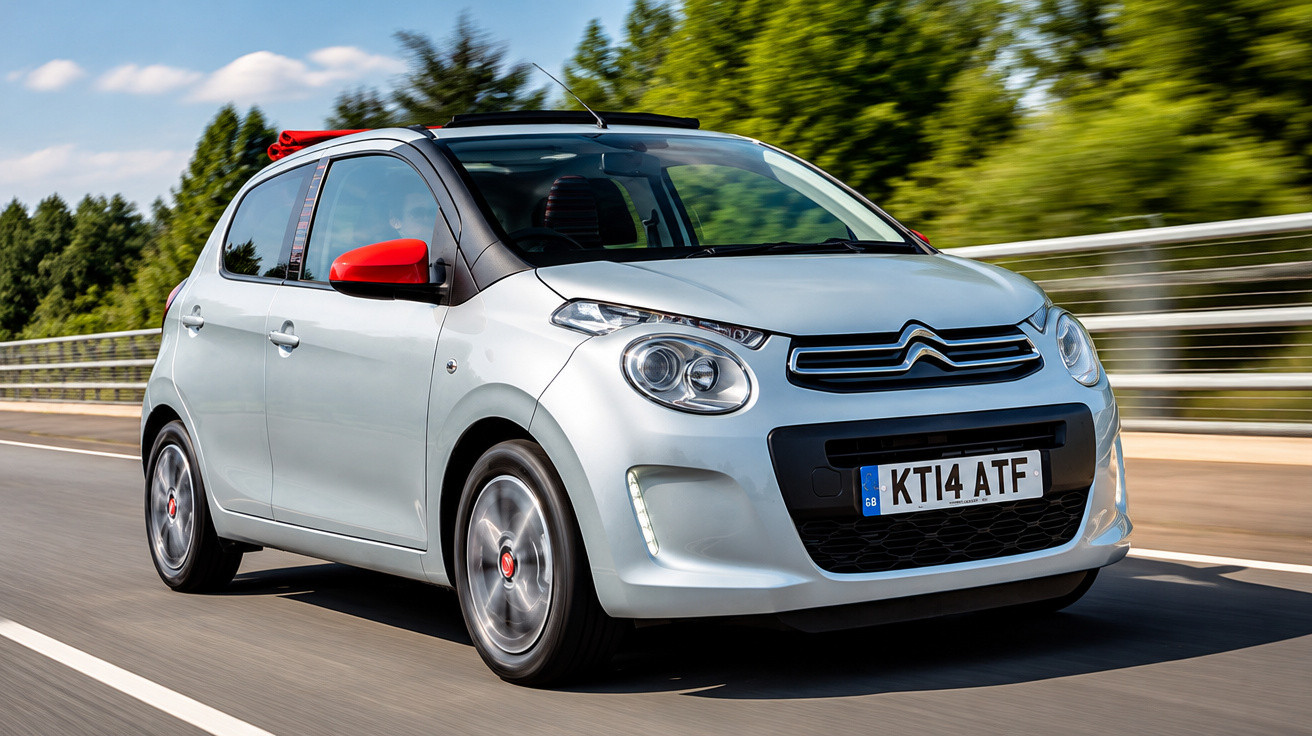
Peugeot 108, Citroën C1 and Toyota Aygo: a shared-city-car project
Nine years ago, PSA joined forces with Toyota to create a compact car for Europe. All three versions were produced at a single Czech factory, yet wore distinct badges: Peugeot 108, Citroën C1 and Toyota Aygo. The formula proved enormously successful, so the partners have repeated it. This time, however, there is rather more separating the trio.
Their exterior designs are different, PSA (Peugeot-Citroën) has added a 1.2-litre three-cylinder engine alongside the 1.0-litre triple, and a sunroof is available as an option. Beyond that, though, there is little to distinguish them. They are mechanically identical, even sharing the same damper settings. We sent three different men to drive one apiece and report their findings.
OM: I had the Peugeot 108. You must admit it is visually less offensive than the Hello Kitty-cute Citroën and Manga-influenced Aygo, isn't it?
VP: Perhaps, but I respect Toyota's effort to escape its beige image. That is why there is an enormous ‘X’ across the front – the Aygo looks as though it might bite.
PH: More like an overbite. Still, with any jointly developed car, you begin to ask whether it suits the wider brand. Citroën wants to project a human-centred, good-value image. The C1 arguably fulfils that brief better than the 108 supports Peugeot’s efforts to move upmarket.
OM: I am simply glad they have achieved some meaningful styling separation. The windscreen and front doors are the only body panels common to all three.
PH: Collaboration makes financial sense. Designing and tooling a small car costs almost as much as doing so for a large one, while the profit margins are narrower. PSA’s job was to pressure suppliers into offering the best prices. It is adept at that.
VP: True, although Toyota remains in charge of the engineering and quality targets. Both companies learn from the arrangement – and there is a Toyota engine at the core of the car as well.
OM: Or a PSA engine. Its in-house 1.2 has slightly more power, which makes using the outside lane marginally less stressful.
VP: It was offered to Toyota, but Toyota declined and stayed with the 1.0 triple.
Engines, chassis and driving character
OM: I can understand the decision, to an extent. The 1.2 does not sound as pleasant, while its gearchange feels too loose. Its extra urgency chiefly comes from shorter gearing, too. I drove both engines in the 108, and when I selected third in the 1.0 for the first time, I genuinely thought I had accidentally chosen fifth.
PH: I suspect the gearing comes from the previous model, probably for emissions reasons. The floorpan beneath all three has been revised, however, with a new rear beam axle, altered anti-roll bars, fresh springs and dampers throughout, plus extra sound insulation. Those changes have sharpened the steering and improved ride quality. Even so, it is still not ‘Up’ to Volkswagen standards.
VP: Very witty. I had hoped the Aygo’s more aggressive appearance would bring a separate dynamic set-up, but it does not. Nevertheless, it is an entertaining little car, with pleasingly quick steering and a respectable chassis.
OM: I must say that, perhaps unexpectedly, I preferred the lower-specification versions. I drove a 108 Allure with leather and chrome trim, and disliked it far more than the simpler Active, mainly because those supposedly upmarket touches clashed with the genuinely scratchy, inexpensive door panels.
PH: I completely agree. Entry-level cars should remain basic. Decorative frippery tends to look out of place and lifts the price towards proper supermini territory. We can probably all agree that these cars are cheaply built: look at the pop-out rear windows, the one-piece glass tailgate and the clever parcel shelf that flips up as the boot is opened.
Cabin space, equipment and pricing
VP: Cheaply made, and not especially roomy. The rear of the Aygo feels as cramped as a hobbit’s shed. Rear legroom is dreadful.
OM: There is a reason for that. Pascal Béziat, PSA’s project director, told me that customers rarely use the rear seats, including in the five-door models. Boot capacity matters more to them, and it has increased from 139 litres to 196 litres. German customers apparently complained that a standard beer crate would not fit in the boot. It does now.
PH: I imagine the packaging engineers enjoyed the ‘research’ behind that.
OM: Let us not linger on it. We should talk about prices. The 108 begins at £8,245, and I think the most satisfying version is the £10,145 1.0 Stop/Start 5dr Active: 88g/km CO2, with DAB and Bluetooth included as standard.
VP: The Aygo starts below £8,000, and buyers with a few extra pennies can freely demonstrate their creativity – or their lack of it. It is highly customisable.
PH: The French pair offer the same, including some rather awful graphics, and they also have the large £850 roll-back fabric roof. An open-air city car is a distinctive proposition.
OM: It is, although the gains in comfort and refinement impressed me more. Interior design and material quality? Less so. They are not in Volkswagen’s league.
VP: It would be the Aygo for me. The 108 and C1 are simply too appealing to people in a certain age group.
PH: So our conclusion is that you should not spend too much, and that the Toyota’s styling appeals most to us, making it our choice of the three. Yet I would not call the Aygo a class leader. The Volkswagen Up is too capable, and the new rear-engined Twingo has also caught our interest.







Comments
No comments yet. Be the first to comment!
Leave a Comment