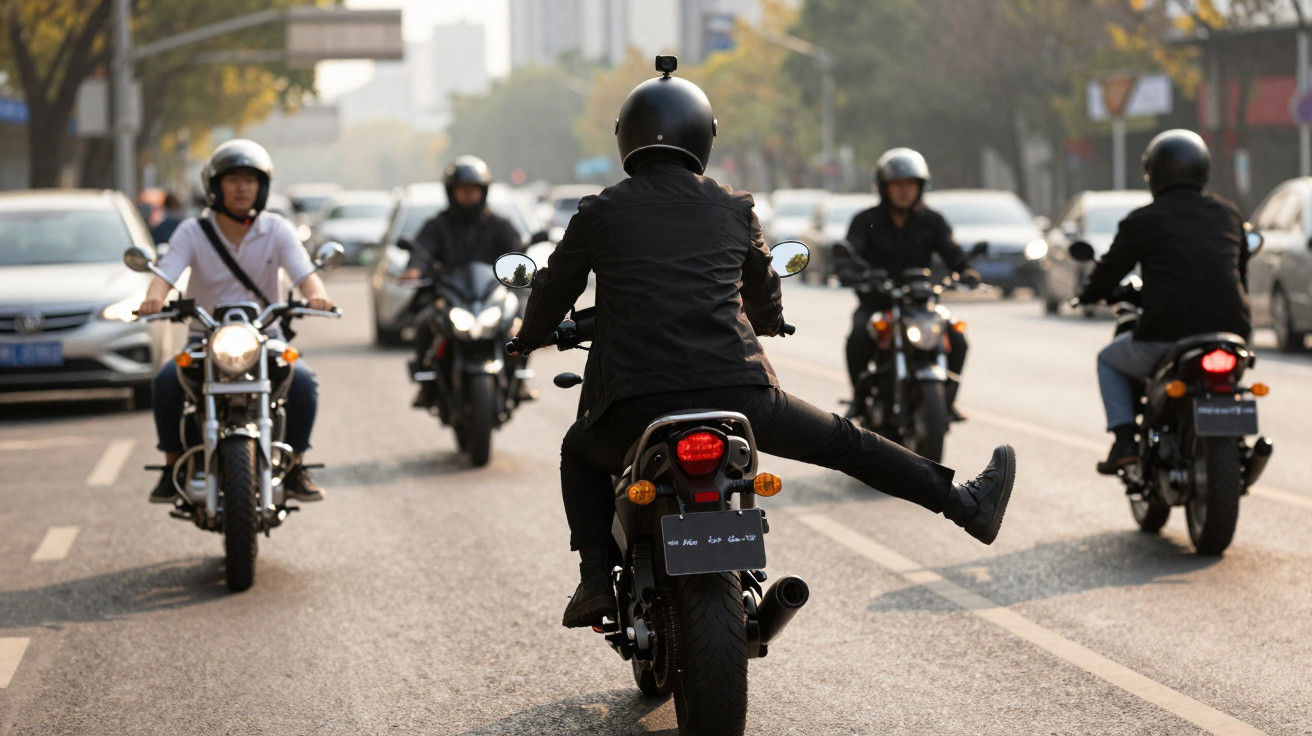
When travelling by car, you will see it time and again: a motorcycle is ahead, then a leg suddenly moves out to the side and the foot briefly drops towards the tarmac. There is no indicator and no brake light, yet the movement appears to convey a clear message. This unusual two-wheeled ritual is far more than a spontaneous whim.
An old racing technique that became a ritual
The gesture has its roots in motorsport. In the past, racers would lower a foot before a bend to steady the motorcycle and shift its centre of gravity. On gravel, poor surfaces or with the suspension technology of the time, this could offer a genuine advantage.
Modern bikes, improved tyres and sophisticated suspension mean the technique is now rarely needed in everyday riding. Even so, a toned-down version has survived in road-riding culture.
What was once a practical riding technique is now often a symbolic remnant of that racing tradition – a kind of ritualised gesture on the road.
Many everyday riders no longer do it consciously for handling-related reasons. Instead, they have seen professional racers or other bikers use it. It has become part of a culture defined not only by motorcycles, but also by gestures.
Signal: “I am braking” or “I feel unsure”
On public roads, an extended leg can quickly take on a specific purpose: it becomes a signal to other road users.
- Indication of slowing down: When a motorcyclist decelerates sharply without applying maximum braking force, they may use their leg as an additional sign: “I am slowing down, take care.” This can make coordination easier, particularly when riding in a convoy or group.
- A subjective sense of added stability: During very slow sections, sudden braking on a slippery surface or unclear situations, lowering a foot can make some riders feel slightly “closer to the ground” – even though it often offers little objective riding benefit.
This is particularly common in town traffic when approaching traffic lights, roundabouts or queues. The leg acts as an intermediate stage: the rider is still rolling, but already mentally preparing to stop.
Non-verbal communication between bikers
Motorcyclists rarely communicate with words; they “speak” through lights, hand signals and, indeed, their legs. In many countries, a brief kick of the leg backwards or sideways has become an established way of saying thank you.
A typical example is when a driver voluntarily makes space, moves slightly further to the right or lets the motorcycle pass in the outside lane. The rider cannot give a full wave at that moment, so the leg briefly goes out instead.
The leg becomes a fleeting “thank you”, a silent handshake on the road – quick, practical and impossible to miss.
Over time, this has developed into its own code, one that outsiders rarely understand:
- A brief extension backwards: Thanks to a car or lorry driver for being considerate.
- Lowering the leg slightly during group rides: A warning of a hazard, such as a pothole, oil spill or debris on the road.
- Repeated, relaxed stretching: Sometimes simply an expression of good spirits or relaxation on long journeys.
Safety: visibility and the emergency instinct
Safety is often an unspoken factor behind these gestures. A motorcycle can easily disappear into a car’s blind spot. Any extra movement or unexpected outline can draw attention.
An outstretched leg creates precisely that effect: the motorcycle appears wider, more active and more noticeable in peripheral vision. In dense traffic or at high motorway speeds, that may provide a few extra metres of reaction distance.
Experienced riders also describe a second consideration: a “Plan B”. If someone senses that the bike is becoming unstable in a dangerous moment, they may instinctively lower a leg in case they need to jump clear more quickly or influence a slide. This is highly dependent on the situation and is by no means a reliable escape method, but it shows that the leg can remain in the rider’s mind as a last reserve.
Road safety professionals warn: the gesture must not replace defensive riding, properly working brakes and good protective clothing.
Placing too much faith in such tricks can even be dangerous. An unprotected foot close to the tarmac risks broken bones if it catches at higher speed or strikes an obstacle. Protective boots reduce that risk, but cannot remove it entirely.
Psychology: belonging and freedom on two wheels
The motorcycling world thrives on symbols: helmet choice, jacket, riding style and gestures. Lowering a leg feels to many like a small code understood only by those “in the know”. Anyone familiar with the scene immediately feels that they belong.
- A sense of community: The gesture reinforces the feeling of togetherness on the road. Riders recognise one another as part of the same group, whether they ride a naked bike, tourer or enduro.
- A rite for newcomers: Many beginners copy the behaviour of experienced riders. Eventually, they do it automatically and feel they have finally become part of the biker “family”.
There is also an emotional dimension. For many people, motorcycling represents freedom, independence and direct contact with their surroundings. Briefly stretching a leg, with the foot almost in the rushing air, symbolises exactly that immediacy. No cage and no metal bodywork – just rider and machine in the wind.
How common is the leg technique really?
Road safety organisations and motorcycle associations report that most motorcyclists know the gesture, but far from all of them use it regularly. In some regions it is almost standard communication; elsewhere, it appears only occasionally.
| Region | Use of the gesture | Typical situation |
|---|---|---|
| Alps and mountain passes | Relatively common | Thanking drivers, warning of falling rocks or debris |
| Urban traffic | Occasional | Slow approaches, stop-start traffic, traffic lights |
| Motorways | Less common | Overtaking long lorry convoys, thanking considerate drivers |
Studies indicate that only some bikers have made this gesture a fixed part of their riding behaviour. Many use it more spontaneously when a situation suits it or when they want to strike a particular tone – polite, cautionary or companionable.
What motorcyclists should keep in mind
Anyone who rides and uses their leg should bear several points in mind:
- Use it only at a controlled speed and from a stable seating position.
- Position the foot so it cannot catch on kerbs, crash barriers or other vehicles.
- Do not experiment while leaned over at high speed – this creates a crash risk more quickly than many people realise.
- Clearly communicate the meaning of the gesture within your own group to avoid misunderstandings.
- Ride in full protective clothing, especially sturdy motorcycle boots.
For those in a car, the leg can be viewed as an additional indication: the biker ahead is likely signalling readiness to brake, gratitude or heightened awareness of the current situation. Leaving a few more metres of space and easing off the accelerator are never bad ideas.
Terms and context for non-bikers
Many drivers know the familiar hand signals used by motorcyclists, such as the brief low greeting on country roads. A leg, by contrast, can seem more unsettling, almost like a loss of balance. Usually, though, it is routine rather than an emergency.
It is still worth remaining alert. If a biker repeatedly moves their leg anxiously, brakes abruptly or swerves significantly, it could indicate a genuine hazard, such as oil, gravel or an obstruction. Recognising this gives you more time to react and ultimately protects both yourself and the other rider.
Above all, the gesture demonstrates one thing: motorcycling is more than simply getting from A to B. It is a culture of its own, with codes, uncertainties, rituals and small symbols that exist between the lines of the road. The outstretched leg sits precisely in that grey area between riding technique, safety instinct and silent communication.















Comments
No comments yet. Be the first to comment!
Leave a Comment