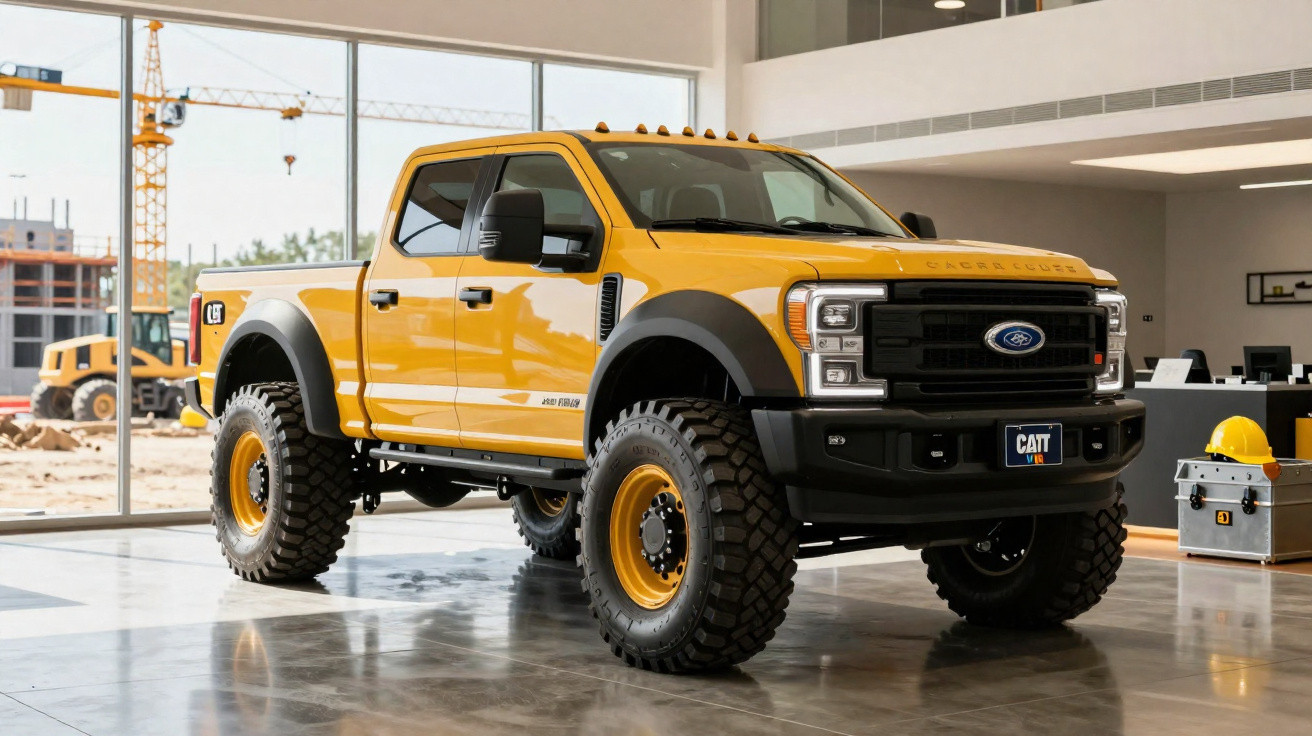
Caterpillar, previously known for enormous excavators, bulldozers and generators, is moving into entirely new territory: the company has unveiled the “Cat Truck”, its first pick-up of its own. Beneath the yellow-and-black badge, however, this is not a wholly in-house creation, but a smart application of Ford technology – including a formidable V8 diesel.
From tracked excavators to pick-ups: why Caterpillar is now building vehicles
Caterpillar has existed since 1925 and began in Texas with machinery designed for the toughest work: tracked machines, excavators, cranes and diesel generators. On construction sites around the world, there is almost always a yellow “CAT” machine at work in the dirt.
Unlike brands such as Volvo or Hyundai, which have long included lorries and vans in their ranges, Caterpillar has until now stayed out of conventional vehicle manufacturing. That is now changing. The company is launching a heavy-duty vehicle that fits naturally with its core business: a 4×4 pick-up for towing, hauling and overseeing major construction sites.
“The Cat Truck is not a lifestyle pick-up, but a rolling tool for extreme operations – purpose-built for everyday construction-site work.”
The concept had already been circulating among Caterpillar executives since 2024: a “Swiss Army knife” on wheels, bringing together multiple construction-site functions. Turning that idea into a finished vehicle, however, is a different challenge altogether. Caterpillar has therefore enlisted the help of a company with decades of commercial-vehicle experience: Ford.
Ford engineering: what really sits beneath the Cat Truck bodywork
For the Cat Truck, Caterpillar uses a proven platform from Ford’s portfolio. Its foundations come from the heavy-duty Ranger and Super Duty families. Crucially, this is not a compact mid-sized pick-up, but a full-scale heavy-duty vehicle engineered for extreme towing and payload demands.
There are several visual differences: the Cat Truck has its own imposing grille, wider headlamps and, naturally, the familiar CAT logo. Its chassis, axles and overall architecture, though, are clearly based on Ford’s US model.
V8 diesel with serious pulling power
Caterpillar has also looked to Ford for the engine: beneath the bonnet is the 6.7-litre V8 “Powerstroke” diesel familiar from the Ford F350 Super Duty.
- Engine: V8 “Powerstroke” diesel
- Displacement: 6.7 litres
- Power: 500 PS
- Torque: 1,356 Nm
These figures make the mission clear: this is not a show truck for a shopping district, but a working machine capable of moving heavy trailers, tool containers, emergency generators or mobile workshops. Its immense torque makes it possible to power demanding auxiliary drives, including hydraulic pumps, winches or compressors at a construction site.
Construction sites first: what the Cat Truck is actually designed to do
Caterpillar is not presenting the Cat Truck as a leisure pick-up for cowboys and campers, but as a “vehicle for short journeys” on and between worksites. It is intended to take on safety duties, oversee processes and assist maintenance teams.
“The Cat Truck becomes a mobile control centre: it monitors, records and supports the work of entire construction crews.”
To achieve this, Caterpillar incorporates several technical elements that clearly set it apart from an ordinary commercial vehicle:
- Driver-fatigue monitoring: Cameras and sensors assess the driver’s eye movements and reactions, issue warnings when there are signs of microsleep, and can document operations.
- Drone platform: The vehicle is intended to feature a take-off and landing area for autonomous drones. These fly predefined routes to inspect earthworks, material storage areas and hazardous zones.
- AI voice assistants: On-demand digital assistants answer questions about the machine, service intervals or safety protocols, and can work through checklists.
This turns the Cat Truck into a type of command centre on four wheels, bringing together technology, logistics and workplace safety. On major pipeline, mining or infrastructure projects in particular, vehicles of this kind could streamline processes significantly.
Direct comparison: Cat Truck versus Ford F350 Super Duty
As both vehicles use the same engine, their key technical specifications invite a direct comparison. The layout shows where Caterpillar adds its own expertise and where Ford sets the standard.
| Model | Engine | Power (PS) | Torque (Nm) |
|---|---|---|---|
| Cat Truck (Caterpillar) | V8 Powerstroke 6.7-litre diesel | 500 | 1,356 |
| Ford F350 Super Duty | V8 Powerstroke 6.7-litre diesel | 500 | 1,356 |
From a technical perspective, the two are closely matched. The distinction lies in the details: Caterpillar equips the Cat Truck with its own software, monitoring and drone systems, while tailoring the entire vehicle consistently to construction-site use. Although the Ford F350 also targets farmers, tradespeople and trailer enthusiasts, Caterpillar is thinking almost exclusively about large industrial customers.
No prospect for Europe – yet still relevant to UK readers
One point is clear: the Cat Truck will not come to Europe. Neither its powertrain, emissions treatment nor dimensions suit local approval rules and road conditions. Caterpillar is targeting markets where vast off-road worksites, long distances and high towing loads are everyday requirements – including North America, parts of South America and resource-rich regions.
Even so, it is worth examining the vehicle from a UK perspective. Caterpillar’s move illustrates how the construction site of the future is changing: away from a collection of machines alone and towards connected systems that capture and analyse data, while supporting decisions directly on site.
“The Cat Truck symbolises a construction site where data becomes just as important as diesel and concrete.”
Construction firms in the UK already use fleet management, telematics and drone surveying. A vehicle that integrates all of these functions directly could be compelling here too, even if regulatory requirements ultimately meant it needed a different powertrain or more compact dimensions.
What risks and opportunities does such a concept vehicle bring?
A “high-tech commercial vehicle” of this kind does not offer benefits alone. More sensors and software also mean greater complexity. If one system fails, it could slow down entire processes on a construction site. The central questions are:
- How resilient are AI systems and drones in dust, mud, cold and heat?
- Who owns and manages the data collected – the client, the operator or the manufacturer?
- How can servicing and repairs for these specialist vehicles be organised when they are operating far from the nearest workshop?
This is where Caterpillar can draw on one of its principal strengths: the company operates global service networks for heavy construction machinery and could use comparable structures for the Cat Truck. On that basis, its entry into the pick-up sector looks less like an unusual detour and more like a logical extension of its existing business model.
What UK construction professionals can learn from the Cat Truck
For construction companies, engineering consultancies and planners in the UK, the project offers several useful ideas:
- Vehicles as data hubs: Pick-ups and vans can serve as mobile hubs that bring together measurement data, drone imagery and maintenance information.
- Build safety in from the outset: Fatigue-detection systems can also be integrated into conventional fleets without requiring an entirely new vehicle.
- Use manufacturer partnerships: Caterpillar and Ford’s approach demonstrates that traditional industry boundaries can be softened – a machinery manufacturer does not have to develop every vehicle component itself.
Anyone planning major construction projects in the future will need to engage more closely with integrated solutions of this kind. Whether the Cat Truck, in its current form, will ever travel beyond a US construction site remains uncertain – but Caterpillar’s direction sends a clear signal: the construction site of the future needs more than large machines; it needs intelligently connected vehicles that become part of a project’s digital nervous system.







Comments
No comments yet. Be the first to comment!
Leave a Comment