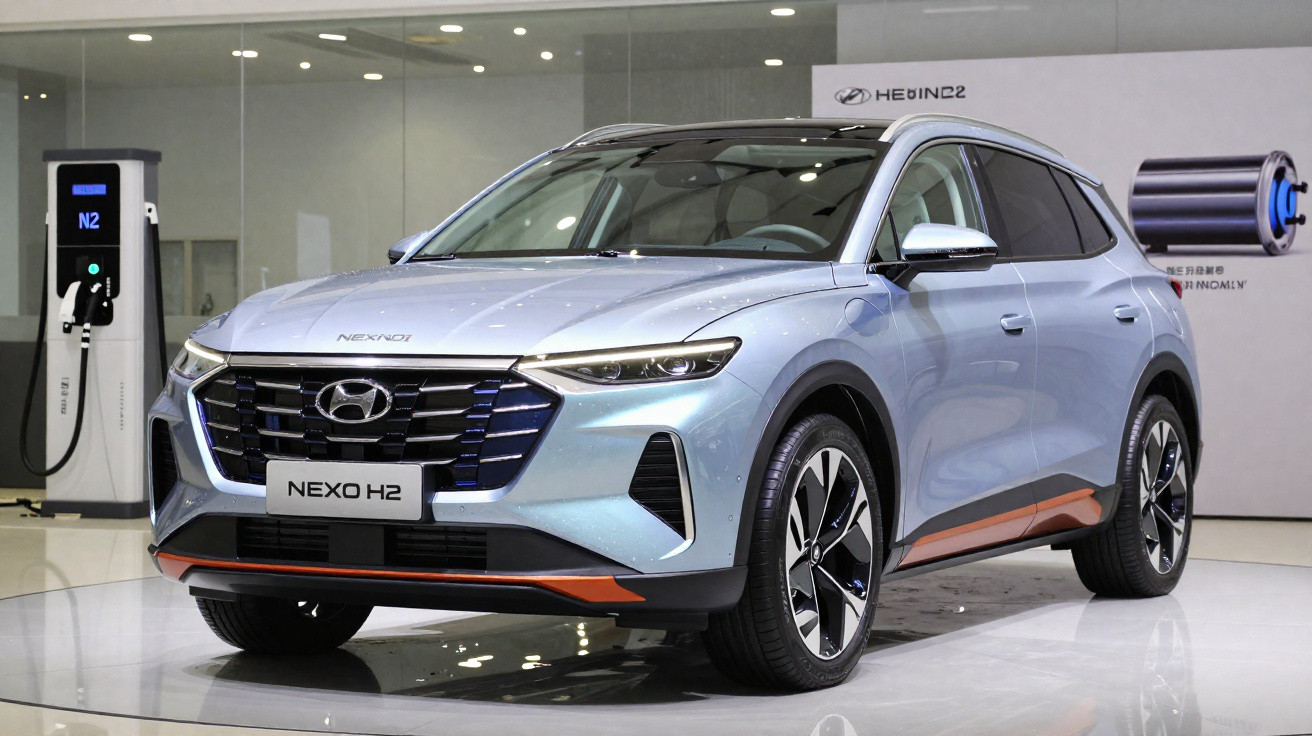
Virtually every week brings the unveiling of new battery-electric cars. Keeping up with the pace is difficult, yet Hyundai has found time to concentrate on another technology that can also power electric vehicles: the hydrogen fuel cell.
Today at the Seoul Motor Show in South Korea, it revealed the new-generation Hyundai Nexo alongside the facelifted IONIQ 6. Rather than using batteries to store energy, the second-generation Nexo uses a fuel cell that converts hydrogen into electrical current. The outcome? Nothing but pure water from the exhaust.
We explained how this system works in this video featuring the first-generation Hyundai Nexo, which is now about to be withdrawn from sale.
Hydrogen technology continues to advance
The South Korean company has been developing this propulsion technology for more than 25 years. This second-generation Hyundai Nexo not only introduces a new exterior design, but also brings substantial improvements to its fuel-cell powertrain.
From a styling perspective, its striking pixel-style headlamps could have come straight from a science-fiction film. Then again, Hyundai's latest models, including the IONIQ 9, Santa Fe and compact electric Inster, have already prepared us for this look.
More power and performance
Power has increased over the previous model. The new electric motor produces up to 150 kW (204 hp), compared with 120 kW (163 hp) previously, although its 350 Nm of torque is lower than the predecessor's 395 Nm. Front-wheel drive remains standard. This power increase has improved performance: 0-100 km/h now takes 7.8 seconds, down from 9.2 seconds, while top speed rises from 172 km/h to 179 km/h.
The entire system powering the motor - the fuel cell and 2.64 kWh battery - is also more powerful. Meanwhile, the capacity of the three hydrogen tanks has risen only marginally, from 6.33 kg to 6.69 kg.
Hyundai claims a range of 650 km, broadly the same as that of the original Nexo. The hydrogen tanks can be fully refilled in just five minutes.
South Korean engineers also highlight improvements to the system's operation in sub-zero temperatures. Thanks to a new generation of membranes, technicians say that starting in these conditions will be faster.
A modern Hyundai Nexo interior
Inside, the Nexo is now 4.75 m long - 8 cm longer than before - and offers greater comfort. It features the control modules and displays familiar from Hyundai's newest models: two adjoining 12.3-inch screens, one for the instrument cluster and the other for infotainment.
There are plenty of soft-touch surfaces, numerous storage spaces for small items, multi-zone automatic climate control, climate-controlled seats, several USB ports and two wireless mobile-phone charging pads.
With the rear seat backrests folded down, luggage capacity expands from 493 litres to 1719 litres. Digital rear-view mirrors, both exterior and interior, are available as an option for the Hyundai Nexo.
For anyone intending to lend the Nexo to a large family or wide circle of friends, its digital key can be shared with up to 15 devices.
How does the fuel cell work?
The fuel-cell system is based on LT (Low Temperature) PEM (Proton Exchange Membrane) modules. Individual cells are combined to create a module. Within the fuel cell, every membrane sits between an anode and a cathode. Hydrogen enters the cell at the anode end, while oxygen enters at the cathode end. The hydrogen and oxygen react and combine to form water on the cathode side, releasing energy in the process.
At the anode, hydrogen is split into electrons and protons. The positively charged protons “migrate” through the membrane towards the cathode. Negatively charged electrons travel to the cathode through the external electrical circuit. This electrical current provides the required electrical energy. At the cathode, the protons react with incoming oxygen and the electrons to create “processed water”, most of which exits through the exhaust system.
Energy efficiency - the ability to convert fuel, in this case hydrogen, into usable energy to drive the wheels - reaches 60%. That is well above the 40% achieved by the best hybrids on the market or a combustion-engined vehicle, at around 30%, although it remains below a battery-electric vehicle, which is always above 70%, even in the worst case.
The fuel cell converts the chemical energy generated by oxidation directly into electrical energy; this oxidation process is also known as “cold combustion”. The “gases” emitted from the exhaust are simply clean water vapour.












Comments
No comments yet. Be the first to comment!
Leave a Comment