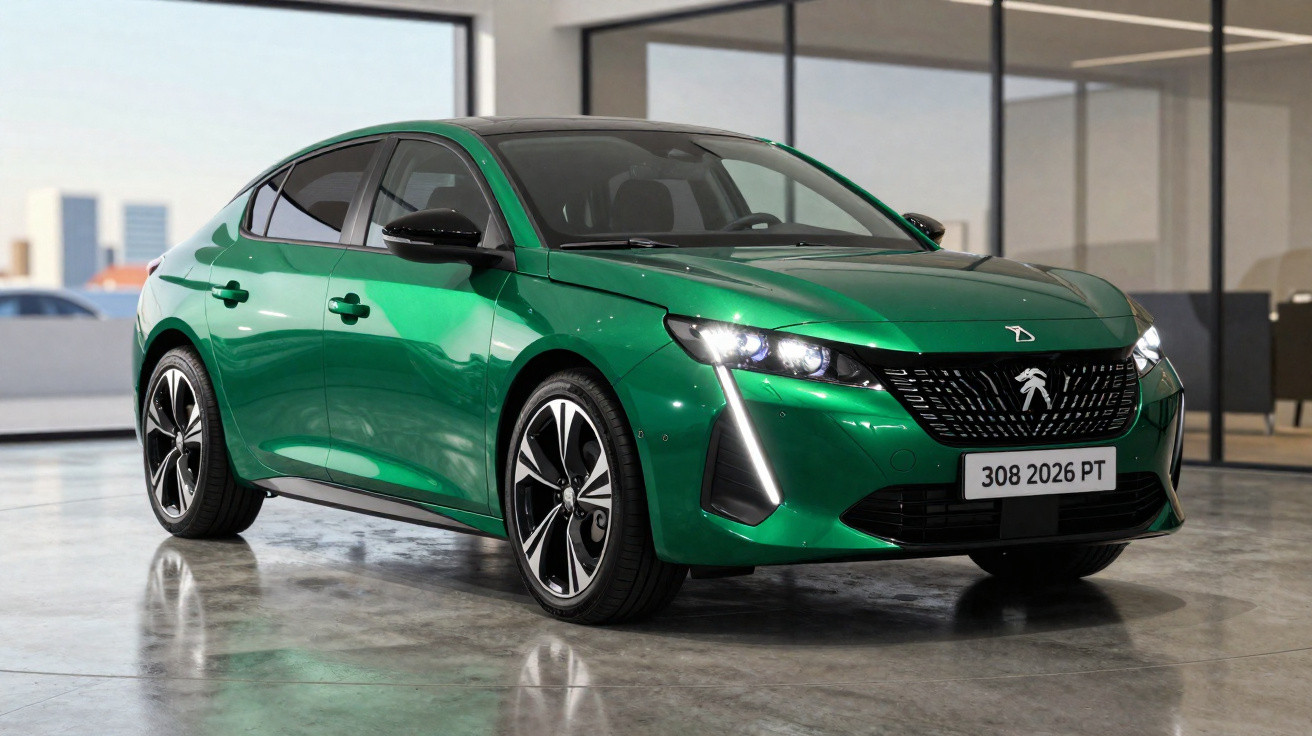
It has changed little, but it has changed for the better. The Peugeot 308 2026 is its most complete version yet.
The Peugeot 308 continues to build on its success. It has ranked among Portugal’s best-selling cars in its segment for four years, and it has every reason to remain there. Or nearly every reason… because the 2026 version improves on everything except its price.
Part of that price rise is concealed beneath the bonnet. Every engine is now electrified, including the new 1.2 Turbo, which is now a 48 V mild hybrid. In other words, it remains an entirely petrol-powered engine, assisted by a small electric motor to lower fuel consumption and emissions.
That electrification, together with the automatic gearbox, has substantially increased this model’s price. As explained in this video, other factors have also contributed to the rise, and some of them are very familiar to us:
These revisions have undeniably made the Peugeot 308 better, helping to offset some of the higher purchase price.
For this first drive, the focus is specifically on the 1.2 Turbo mild-hybrid, which is likely to become Portugal’s best-selling version. The fully electric and plug-in hybrid models will be covered another time. Hatchback or estate? That choice is yours.
New year, new face
Telling the Peugeot 308 2026 apart from its predecessor is straightforward, as its front end is entirely new. The lighting now uses a two-part arrangement, with the light signature positioned at the top and running across the full width, while even the badge is now backlit.
Beyond that, the only change is to the wheels. On the GT version tested, these are 18-inch alloys fitted with low-profile tyres. I expected this to affect ride comfort, but it did not.
Inside the Peugeot 308, the updates are more restrained. The i-Cockpit still dominates the cabin - and still divides opinion. I have liked it from the outset, although I acknowledge that not everyone will adapt to such an unconventional layout.
Otherwise, it remains what it already was: one of the segment’s most robustly built and well-finished models, offering carefully selected materials, generous room for passengers and luggage, and one of the most comprehensive standard-equipment packages available.
Changes beneath the surface
The Peugeot 308 2026 has received further changes that cannot be seen, as they sit under the bonnet. All powertrains are now electrified, either partly or fully, but the main focus must be the unit driven in the video above: the 145 hp Hybrid.
This is the entry-level powertrain and, despite what its name might imply, it is a 48 V mild hybrid. It is expected to be the most popular choice among Portuguese buyers. It uses a 1.2 Turbo petrol engine, but there is no reason for concern: it is not the PureTech. There is therefore no oil-bathed timing belt; instead, it uses a timing chain - a significant change, including for buyers’ peace of mind.
Its 145 hp output is achieved with the assistance of a small electric motor producing 29 hp and 50 Nm. That may not sound like much, but it cuts emissions by 17 g/km and reduces consumption by almost one litre per 100 km. The improvements can be greater in urban driving, where up to 50% of journeys are powered solely by the electric motor.
A winning formula needs little alteration
On the road, the updated Peugeot 308 remains true to itself: predictable, solid, stable, comfortable and adequately dynamic, especially in this range-topping GT specification. The 18-inch wheels and low-profile tyres make a major contribution, yet they still provide a good level of family-friendly comfort. After all, this model “graduated” from the French school.
The Hybrid 145 may be the least powerful engine in the range, but I never felt it lacked performance, despite the small 1.2 Turbo under the bonnet. It will not win any traffic-light races, but it performs its role effectively, even with the car loaded with people and luggage.
The new engine is also more pleasant to use than the previous one, while the refinement of the dual-clutch automatic gearbox - the only transmission offered - is partly responsible for that improvement.
During this first drive on Portuguese roads, I was unable to assess fuel consumption, so we will have to wait for a longer test. The brand quotes just 5.0 l/100 km on the combined WLTP cycle for the 308 SW, an excellent figure that I would like to put to the test.
It costs more, but there are reasons why
The Peugeot 308 2026 may not look dramatically different, but significant changes have taken place where they are less visible - and are most noticeable in the wallet. Prices have risen considerably, with the entry-level version costing more than €6,000 above its predecessor. Prices now start at €33,535 for the Hybrid 145 Style.
Excessive? Perhaps. But the entry-level model is no longer what it used to be. A purely combustion-powered engine with a manual gearbox has been replaced by an electrified mild-hybrid powertrain paired exclusively with a dual-clutch gearbox. That alone accounts for several thousand euros of the increase.
It also comes with more standard comfort and technology equipment, as the range now begins with the Style trim rather than the former Active grade, which has been dropped. Even the 15% reduction in emissions, which lessens the effect of Portugal’s outdated vehicle taxation, has not been enough to narrow the price gap.
In the case of the GT tested here, the highest equipment level, the price comes uncomfortably close to €40,000. That is a very high figure, although there is practically nothing left to add from the options list.
For companies and sole traders, it may make more sense to choose the 308 Plug-in Hybrid 195, with up to 85 km of range, or the E-308, with up to 450 km. They are more expensive still, but offer several tax advantages, including VAT deduction for the electric model.






Comments
No comments yet. Be the first to comment!
Leave a Comment