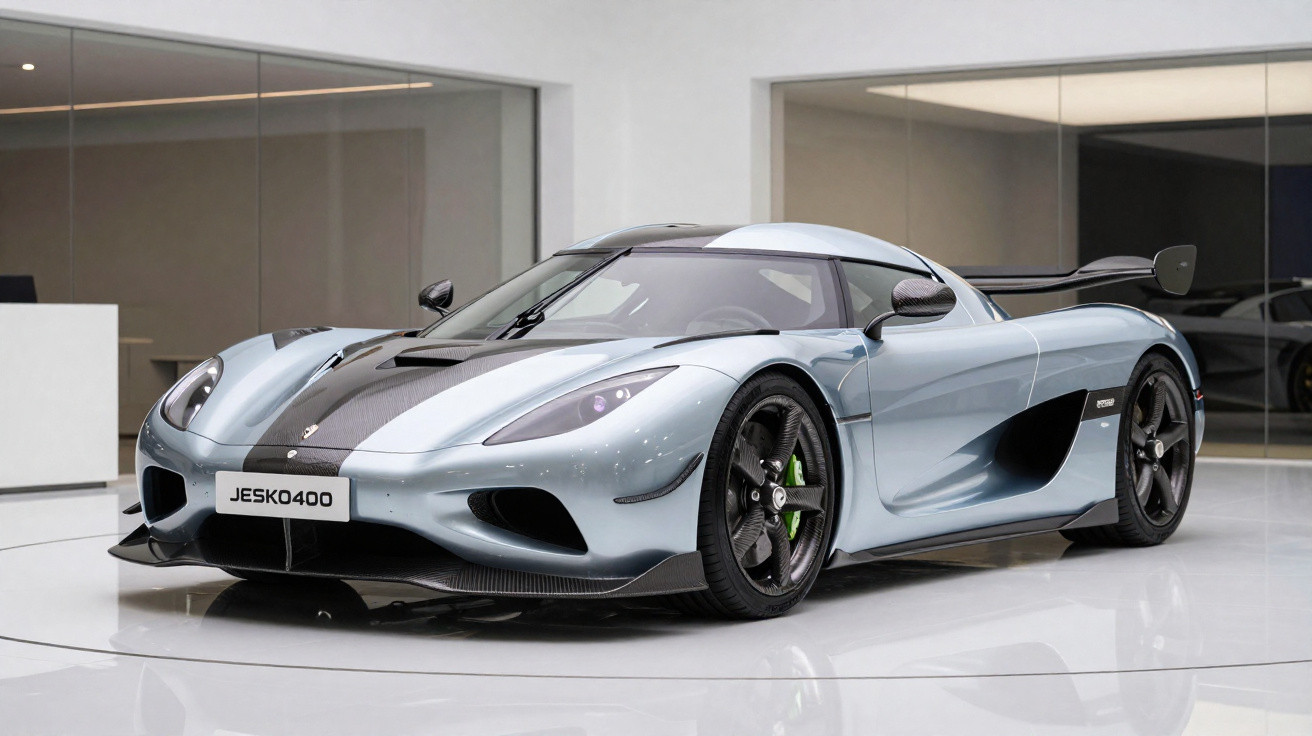
Koenigsegg’s Swedish hypercar can now pass 400 km/h in less time than it takes to finish a morning coffee or heat up yesterday’s meal in a microwave. Put simply, it is a colossal slap in the face for the entire automotive industry.
Koenigsegg joins the hypercar record elite
Only a very select group of manufacturers can achieve this kind of record: the legendary Bugatti, with the large turbocharged W16 fitted to its famed Veyron, Chiron and exceptionally rare La Voiture Noire. Croatia’s Rimac also belongs in this company, thanks to its all-electric Concept-One and Nevera. More recently, BYD shook European manufacturers with the YangWang U9, which reached 496 km/h at the Papenburg high-speed track in Germany.
That list would be incomplete without Koenigsegg, the small Swedish manufacturer founded by Christian von Koenigsegg in 1994. It has never needed 12 cylinders or 120 kWh batteries to embarrass its rivals. Using “simple” V8 engines, the marque has proved that this more conventional engine layout can compete with the industry’s most revered monsters.
Its hand-built, ultra-exclusive range amounts to barely a dozen models, including the Jesko - named after the founder’s father - unveiled at the 2019 Geneva Motor Show as the successor to the already formidable Regera. It was the brand’s first hypercar designed for both track use and “daily” road-legal driving. Limited to just 125 cars, it was offered in two main forms: the Jesko Attack, focused on maximum aerodynamic downforce, and the Jesko Absolut, revealed in March 2020 with one sole purpose: reaching stratospheric top speeds. It is the latter that smashed one - in fact, several - records in early June that will be remembered for a long time.
Jesko Absolut: a cheetah built for the stopwatch
Beneath the Jesko Absolut’s bodywork sits the same 5.0-litre twin-turbo V8 used by the Attack version, though it has been enhanced with new software known as Absolut Overdrive, enabling it to put the maximum possible power down on the road. And it has power to spare: when fed E85, it produces 1,600 hp at 8,500 rpm, helped by a 180° flat-plane crankshaft weighing only 12.5 kg - the lightest in global production for an engine of this capacity.
Most audacious of all, it is rear-wheel drive, whereas its rivals require four-wheel drive to avoid leaving all their tyre rubber on the start line.
Matched with Koenigsegg’s Light Speed Transmission (LST), a nine-speed gearbox with seven clutches, the Jesko’s engine pulls relentlessly without running out of breath. Unlike the dual-clutch transmissions (DCTs) found in most supercars and hypercars, which must shift through ratios in sequence, the LST can jump from second to seventh gear, or from fourth to ninth. Much like an electric powertrain, there is therefore no gap in torque, and it can deliver all of its power on demand.
Its drag coefficient is lower than that of most modern family saloons developed with fuel economy in mind: an absurdly low Cd of 0.278. Its wheels have been covered, the enormous rear wing has made way for two vertical fins, and its tail has been lengthened. Every detail was engineered to let it slice through the air like a fighter jet, even though it sacrifices 150 kg of downforce at top speed compared with the Attack version.
An insatiable appetite for records
The Jesko Absolut first demonstrated its strength on 7 August 2025 at Örebro airfield. On that occasion, Markus Lundh completed the 0–400 km/h run and came to a full stop in 25.21 seconds, taking the record from the Rimac Nevera R by 0.58 seconds thanks to Absolut Overdrive.
Then came 6 June 2026, Sweden’s National Day, when in-house test driver Markus Lundh took the wheel of this €3 million jewel to reveal what else it had in reserve. A machine of this calibre needs room to show its full potential, so Koenigsegg chose Ängelholm airfield, a historic site already familiar with the brand’s exploits and blessed with an exceptionally long straight.
The Jesko that launched down the runway that day was unmodified, apart from the addition of a roll cage and One:1 bucket seats. Lundh then set four further world records in the car: 400 metres in 8.54 seconds at 305.39 km/h, an absolute first for a production car; 800 metres in 12.76 seconds at 373.87 km/h; and 0–100 km/h in 2.35 seconds. All of this was achieved on standard Michelin Pilot Sport Cup 2 R tyres.
It is utterly extraordinary, yet Koenigsegg has already indicated that, in theory, the Jesko Absolut could reach 531 km/h, based on internal simulation testing. It now simply needs tyres designed to withstand such a speed, otherwise the twin-turbo V8’s Herculean force could tear their sidewalls apart. For now, the marque has offered no indication of a possible next attempt, although it is already known to have approached Michelin to demand that prototype tyre technology tested at 531 km/h on a test rig be transferred quickly to a road-approved tyre. Apart from Bugatti, Koenigsegg is the only manufacturer to have encountered this “problem”: is that not, in itself, already a record?







Comments
No comments yet. Be the first to comment!
Leave a Comment