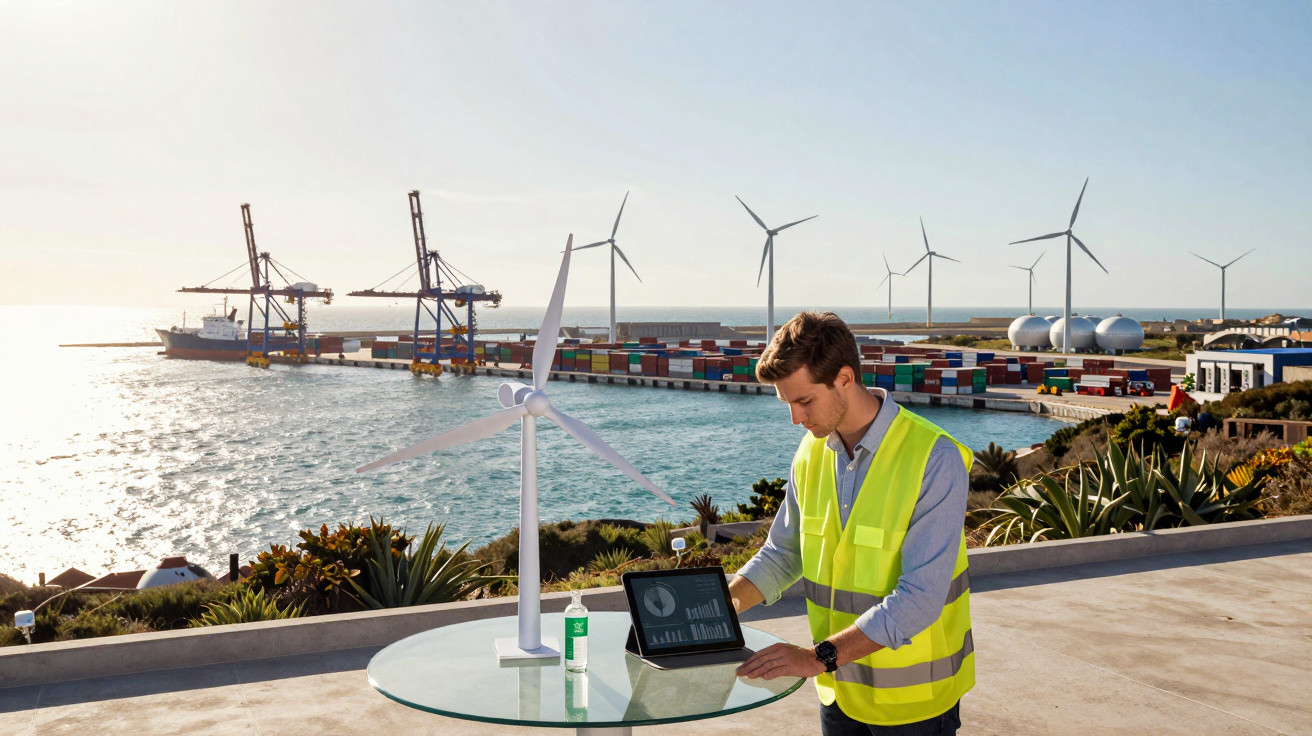
The proposition may sound ambitious, yet it has a technical basis: Portugal could produce sustainable fuels more cheaply than diesel, provided it proceeds with the deployment of offshore wind farms. This is the conclusion of the National Laboratory of Energy and Geology (LNEG), shared exclusively with Expresso, based on a recent study into the country’s potential for producing green hydrogen and low-carbon fuels.
Portugal’s proposed model follows a straightforward chain: electricity produced at sea would power onshore electrolysers, generating green hydrogen. That hydrogen would then provide the feedstock for advanced fuels including ammonia, methanol and HVO (Hydrotreated Vegetable Oil, also referred to as “green diesel”) - synthetic fuels.
Offshore wind could support Portugal’s sustainable fuels
This prospect nevertheless hinges on the auction for the first 2 gigawatts (GW) of offshore wind capacity, which has yet to be launched. The Directorate-General for Energy and Geology (DGEG) says the process is being prepared, although it is not expected to move forward until late 2025 or early 2026.
The study identifies a crucial competitive advantage: offshore wind turbines in Portuguese waters could run for between 4200 and 4500 hours annually, considerably more than in countries such as Denmark and Germany. This gap could significantly lower the cost of electricity supplied to electrolysers - and therefore the final price of the fuels produced.
“It is very important how many hours electrolysis units can operate at their maximum capacity over the course of a year, using only offshore wind electricity. While investment costs do not vary substantially from one country to another, the operating hours of an offshore turbine in Portugal differ from those in Germany or Denmark. And they can make us more competitive,” Sofia Simões, coordinator of LNEG’s resource economics unit, told Expresso.
HVO could cost less than diesel
According to the laboratory, HVO production powered by offshore wind stands out as the most competitive option, with costs potentially ranging from €63 to €110/MWh. This range is below the average price of diesel in 2024, which was around €158 to €172/MWh.
Alongside HVO, green ammonia could also become internationally competitive. Methanol, liquefied hydrogen and sustainable aviation fuel, however, remain more expensive. LNEG nevertheless notes that solar and offshore wind technologies could complement each other in future because of their naturally different generation profiles.
Pedro Marques, a researcher at INEGI (Institute of Science and Innovation in Mechanical and Industrial Engineering), had previously discussed this issue in one of our Auto Talks on the production of sustainable synthetic fuels in Portugal. Revisit what was discussed:
Auction is crucial to move forward
Among the locations assessed is Leixões, where a 1 GW offshore wind farm is expected to be operational by 2035, with 500 MW allocated to hydrogen production. Some of this renewable gas could be sent to Germany through the future European hydrogen network, while ammonia and other fuels would be exported by sea from Sines.
“We know that Portugal has an extensive coastline and high offshore wind potential. We have been global pioneers in floating offshore wind energy. We sought to assess how we can harness that potential and create added value for the country,” Sofia Simões concluded.
As reported by Expresso, the initial auctions are expected to cover areas capable of hosting 2 GW of offshore wind capacity, with a long-term target of 9.4 GW. In addition to Leixões, wind farms are proposed for Viana do Castelo (1 GW) and Figueira da Foz (2 GW).
The study notes that the domestic value chain is expanding - LNEG has identified at least 130 companies connected to hydrogen and another 140 involved in the offshore wind sector. However, it warns that building a genuine “hydrogen economy” will require regulatory stability and a clear timetable for the auctions.











Comments
No comments yet. Be the first to comment!
Leave a Comment