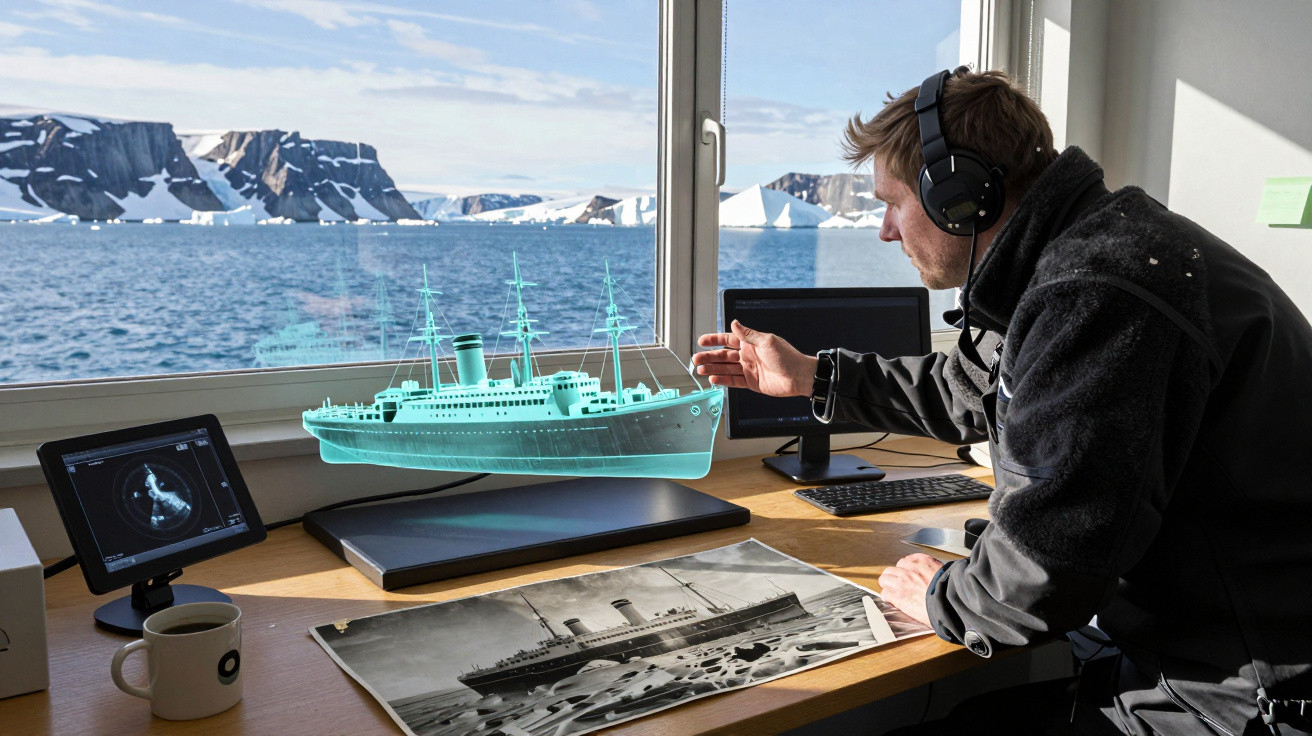
More than eight decades after it sank near Greenland, the Terra Nova has been seen again in remarkable clarity. An expedition has created the first detailed three-dimensional images of the vessel associated with Robert Falcon Scott’s final voyage, while also showing that its wooden structure is rapidly vanishing.
How was the Terra Nova documented on the seabed?
The Heroic Era Expedition, led by the Royal Canadian Geographical Society in collaboration with the Woods Hole Oceanographic Institution, surveyed the wreck in July 2026. The ship lies at a depth of around 300 metres, roughly 18 kilometres south of Greenland.
Researchers deployed the crewed submersible Alvin and the remotely operated vehicle Falcon, which carried imaging equipment from Canadian company Voyis. Thousands of high-resolution records were combined to build a three-dimensional digital model of the wreck.
What did the new images reveal about the Terra Nova?
The survey found that the hull remains clearly defined and has not been covered by the fishing nets seen on other wrecks in the area. Its bow, propeller, rudder and distinctive twin steering-wheel arrangement can still be identified, providing previously unseen details of the ship’s construction.
Nevertheless, the vessel is in an advanced state of decay. Its decks have collapsed and almost entirely disappeared, while the reinforced wooden hull has broken in two. This split exposes internal areas including the engine room, boiler and sections of the former crew quarters.
Why did scientists create a digital replica?
The aim is to make a digital twin of the Terra Nova before water, marine organisms and time destroy what remains. Researchers will be able to examine the model without touching the fragile structure, and it will allow them to monitor later changes to the wreck.
- High-resolution imagery recorded the entire visible area.
- Sensors mapped the vessel’s three-dimensional form.
- The model will retain details even after further deterioration.
- Biologists also investigated the organisms living at the site.
The expedition also surveyed the Quest, Ernest Shackleton’s final ship, which was found in the Labrador Sea in 2024. Examining the two vessels together makes it possible to compare ships linked to the so-called Heroic Age of Antarctic Exploration and explore how wooden wrecks develop into marine habitats.
Watch the video shared by the BBC News YouTube channel, which shows the wrecked Terra Nova in detail.
What role did the ship play in polar history?
Built in Scotland in 1884, the Terra Nova was designed to withstand ice and was initially used for seal hunting. It later took part in British expeditions and carried Robert Falcon Scott and his team in their attempt to be the first to reach the South Pole between 1910 and 1912.
Scott arrived at the pole in January 1912, weeks after the Norwegian Roald Amundsen. He and four companions died on the return journey. After rescuing survivors from the expedition, the Terra Nova resumed commercial service and operated mainly from Newfoundland.
Time is running out for the Terra Nova
During the Second World War, the ship carried supplies to bases in Greenland. In September 1943, it was damaged by ice and had to be abandoned. Once the crew had been evacuated, it was deliberately sunk so that it would not endanger navigation, and it was rediscovered in 2012.
The images now turn the wreck into an accessible archive before the ocean erases its last details. Digitally preserving the Terra Nova is urgent: every lost section takes with it information about naval engineering, polar exploration and the people who faced some of the planet’s most extreme environments.
















Comments
No comments yet. Be the first to comment!
Leave a Comment