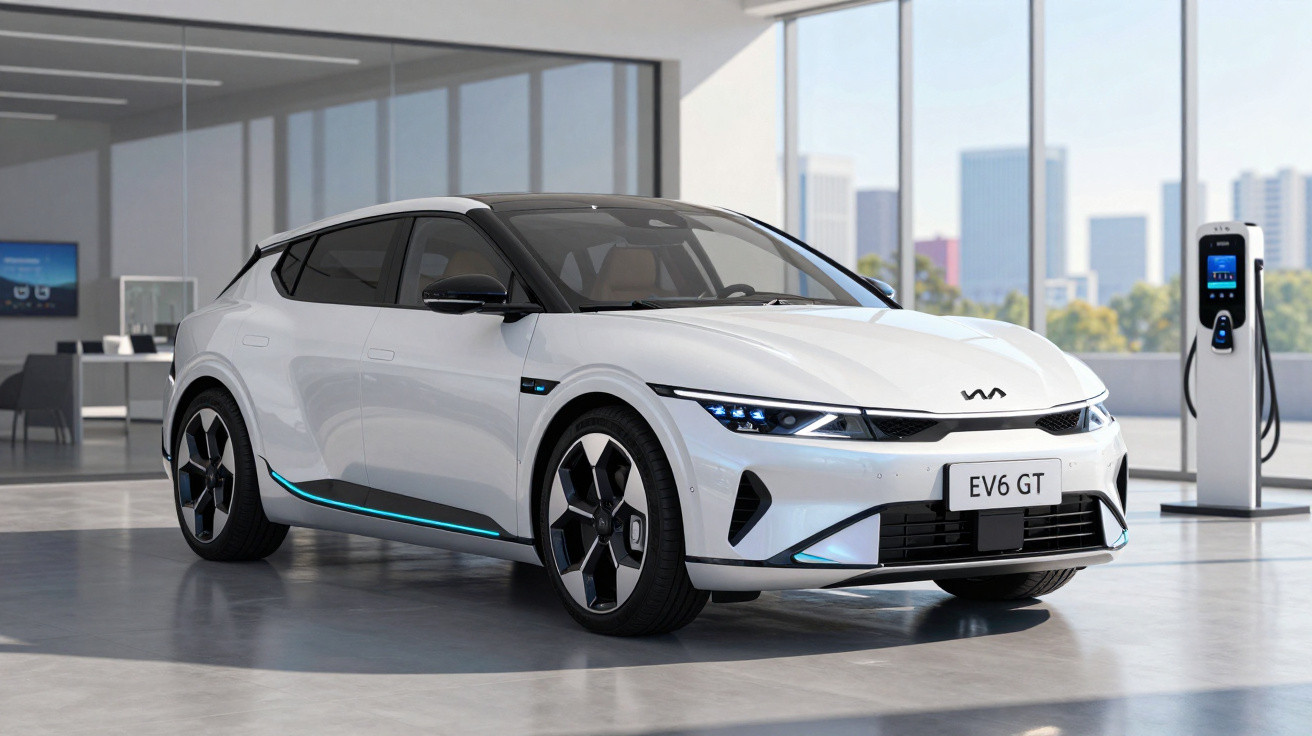
After Hyundai revealed its Ioniq line-up of electric models, it is now Kia’s turn to strengthen the Korean electric offensive with the arrival of the Kia EV6, a direct rival to the Volkswagen ID.4.
Kia has recorded exponential growth in Europe over the past decade, both in sales volumes and market share, although it is fully aware that it does not yet possess Volkswagen’s market strength.
While the German rival’s ID family is already expanding rapidly - the ID.3 is already on our roads and the ID.4 is imminent - it is now clear that the Korean brands appear to be joining forces in pursuit of a prominent position in this new era of vehicle electrification.
“Siblings”, yet different
On this subject, Luc Donckerwolke, Hyundai’s Chief Creative Officer (CCO) - who has a significant background at the Volkswagen Group and a curious history at the Korean company, having resigned in April 2020 before returning later that same year - explains that the Ioniq 5 and EV6 were developed in opposing ways. The Hyundai was designed “from the inside out”, whereas the EV6 was created “from the outside in”.
Karim Habib, Kia’s vice-president of design and head of its global styling centre - and formerly design chief at BMW and Infiniti - says that “this is a new design language created for the electric era and necessarily different from more conventional models”.
Seven of the 11 electric models Kia intends to have on the road by 2026 will use this new electric platform, while the other four will be electric derivatives of existing models.
The target is for electric cars to account for 40% of all Kia registrations in 2030, representing more than 1.6 million vehicles sold globally that year.
Electric cars that look too alike?
From an outside perspective, it is clear that new cars developed as fully electric vehicles are a breath of fresh air for the motor industry in styling terms, broadening horizons and introducing new design languages.
Even so, it remains true that, in many cases, identifying a model’s manufacturer would be difficult if its badges were removed, precisely because familiar styling cues are absent.
With the EV6, the first of several models based on this platform, Kia introduces a naming convention that will always combine the letters EV, standing for “Electric Vehicle”, with a single-digit number indicating the car’s position in the range. Here, the brand refers to a “reinterpretation of the tiger nose in the digital era”.
The front grille has almost vanished in this case, flanked by prominent slim LED headlamps and an lower air intake that contributes to a greater sense of width. Viewed from the side, its undulating crossover profile emphasises the substantial 4.68 m length, ending in a highly distinctive rear treatment. This is largely due to the vast LED light bar extending across the entire width of the EV6 and reaching into the wheel arches on either side.
Kia already offers two electric models, the e-Soul and e-Niro, but the EV6 is its first vehicle based on the new Global Modular Platform (E-GMP). It brings more advanced technology and makes full functional and spatial use of the advantages offered by an all-electric powertrain in both respects.
Its 2.90 m wheelbase, together with the battery pack’s position beneath the floor, is crucial to delivering enormous second-row legroom, with no floor obstruction and therefore greater comfort and freedom of movement for passengers.
The boot is equally generous, offering 520 litres, rising to 1300 litres with the rear seat backs folded. There is also a further 52 litres beneath the front bonnet, or only 20 litres in the 4×4 version because it has a second electric motor at the front; even so, it remains useful for storing the battery charging cables.
Spacious, digital and contemporary Kia EV6 interior
The modern cabin feels even more open thanks to its minimalist dashboard and centre console, as well as the slim seats, which are covered in recycled plastics - no fewer than 111 plastic bottles for every EV6.
The dashboard is centred around a contemporary arrangement combining two curved 12” screens: the left-hand display serves as the instrument cluster, while the right-hand one handles infotainment.
There are still not many cars with an augmented-reality head-up display - the Mercedes-Benz S-Class and the Volkswagen ID.3 and ID.4 are examples - but Kia will offer this animated projection of driving-relevant information on better-equipped versions, whether it concerns driver-assistance system data or turn-by-turn navigation directions.
Helping to make the onboard experience more rewarding, a top-of-the-range Meridian audio system with 14 speakers will be available, marking a first for Kia.
2 or 4 driven wheels and up to 510 km of range
This new Kia electric model, which will be built in South Korea, is available with two battery sizes: 58 kWh and 77.4 kWh. Either can be paired with rear-wheel drive alone, using one electric motor on the rear axle, or 4×4 drive, which adds a second motor on the front axle.
At the entry point to the range are the 2WD rear-wheel-drive versions with 170 hp or 229 hp, using the standard or larger battery respectively. The all-wheel-drive EV6 AWD models deliver maximum outputs of 235 hp or 325 hp, with 605 Nm in the latter case.
Although not every performance and range figure is known at this stage, the available numbers are encouraging: 0 to 100 km/h takes 6.2s in the least powerful version and one second less, 5.2s, in the AWD. It is also possible to travel up to 510 km on a single full battery charge in versions with the larger battery and rear-wheel drive only.
GT, or rather a “super” GT?
The GT version will be the only one offered exclusively with the larger battery. Its 584 hp and 740 Nm, generated by the two electric motors, allow it to “be the fastest Kia ever and move fully into supercar territory, as clearly demonstrated by the 3.5s required for the 0 to 100 km/h sprint and its 260 km/h top speed”, comments Albert Biermann, the engineer who made his name in BMW’s M division and who has been raising the dynamic bar for Korean models since 2015.
These figures make the Kia EV6 GT a car with stronger acceleration and a higher top speed than the Porsche Taycan 4S, which reaches 0-100 in 4.0s and a top speed of 250 km/h(!).
In this respect, it is worth noting that the suspension uses a special type of dampers, the details of which have not yet been disclosed, to compensate for the EV6’s considerable weight, heavily increased by the large battery packs. The EV6 weighs between 1.8 and 2.0 tonnes.
Revolutionary charging
The EV6 also demonstrates its technological sophistication by allowing its liquid-cooled battery to be charged at either 800 V or 400 V, without distinction and without requiring any power adaptors.
This means that, in the most favourable conditions and using the highest accepted charging power of 239 kW DC, the EV6 can “fill” its battery to 80% of capacity in only 18 minutes, or add enough energy for 100 km of driving in under five minutes. This applies to the two-wheel-drive version with the 77.4 kWh battery.
The three-phase onboard charger has a maximum AC output of 11 kW. Charging is especially flexible thanks to the “Integrated Charging Control Unit”, which enables bidirectional charging.
In other words, the car can power other devices, such as an air-conditioning system or a television, simultaneously for 24 hours, or even charge another electric car. For this purpose, there is a domestic-style “Schuko” socket in the second row of seats.
Like any electric car, it includes technologies intended to maximise range, such as a heat pump. This helps ensure that, at a temperature of -7 ºC, the EV6 can achieve 80% of the range possible at an outside temperature of 25 ºC, which is far less “aggressive” towards the battery’s correct operation.
Also included is an energy-recovery system controlled through paddles behind the steering wheel, allowing the driver to select from six regenerative levels: off, 1 to 3, “i-Pedal” or “Auto”.





Comments
No comments yet. Be the first to comment!
Leave a Comment