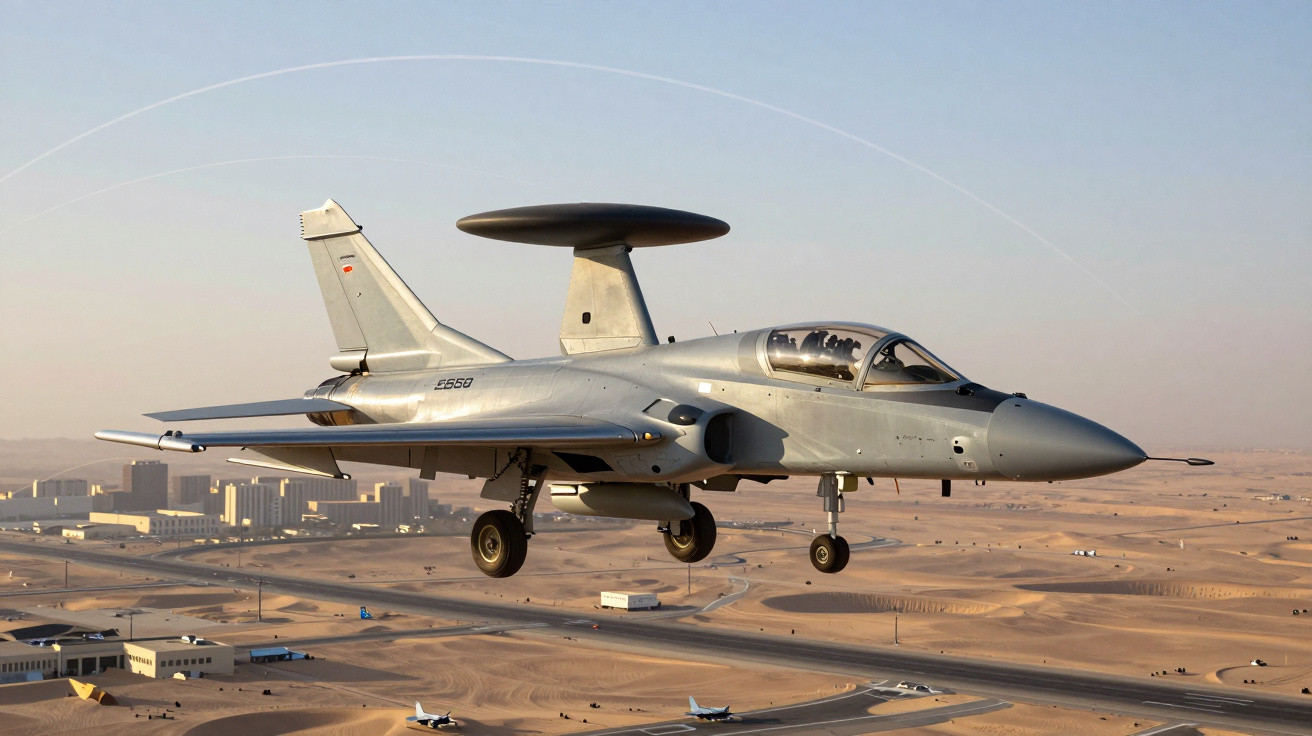
A Middle Eastern country’s air force has selected Saab’s new GlobalEye to enhance its airborne early warning and control (AEW&C) capability. The Swedish company confirmed it had signed a contract to supply two aircraft, valued at SEK 10.1 billion (approximately USD 1.037 billion), with deliveries scheduled for 2030. Saab did not identify the customer, citing national-security considerations and the nature of the agreement.
Saab expands GlobalEye’s international presence
The manufacturer described GlobalEye as an advanced, multi-domain airborne early warning and control solution. The platform combines active and passive sensors capable of detecting and identifying air, maritime and land targets at long range, while providing real-time information to strengthen situational awareness and support the early identification of threats during joint operations.
Announcing the agreement, Saab President and Chief Executive Officer Micael Johansson said: “This order underscores our commitment to providing customers with an operationally proven, multi-domain AEW&C capability. The growing international interest in GlobalEye reflects its effectiveness and reliability in modern air-defence operations.” The company said it would not release further information about either the customer or the order configuration because of restrictions inherent to the defence sector.
The latest sale follows Saab’s completion, in September 2024, of the delivery of the fifth and final GlobalEye for the United Arab Emirates Air Force. That aircraft completed the planned series under the Swing Role Surveillance System (SRSS) programme, which began in 2015 and was later expanded to increase the number of aircraft procured.
An AEW&C system attracting growing international demand
GlobalEye is built around a Bombardier Global 6000/6500 aircraft fitted with Saab’s S-band Erieye Extended Range (ER) radar. In its standard configuration, the system has an estimated range of 650 kilometres, which can be extended by focusing radar energy in a particular direction. It is also designed to withstand adverse weather conditions and electronic-warfare measures intended to disrupt its operation.
The addition of a new Middle Eastern customer also comes amid rising international interest in the platform. Recently, the North Atlantic Treaty Organization (NATO) announced that it had begun negotiations with Saab to acquire up to ten GlobalEye aircraft to replace the Boeing E-3 Sentry fleet, which the Alliance has operated for nearly four decades. Although no contract has yet been signed, the decision to proceed with negotiations reinforces GlobalEye’s position as one of the leading options in the global airborne early warning and control segment.
















Comments
No comments yet. Be the first to comment!
Leave a Comment