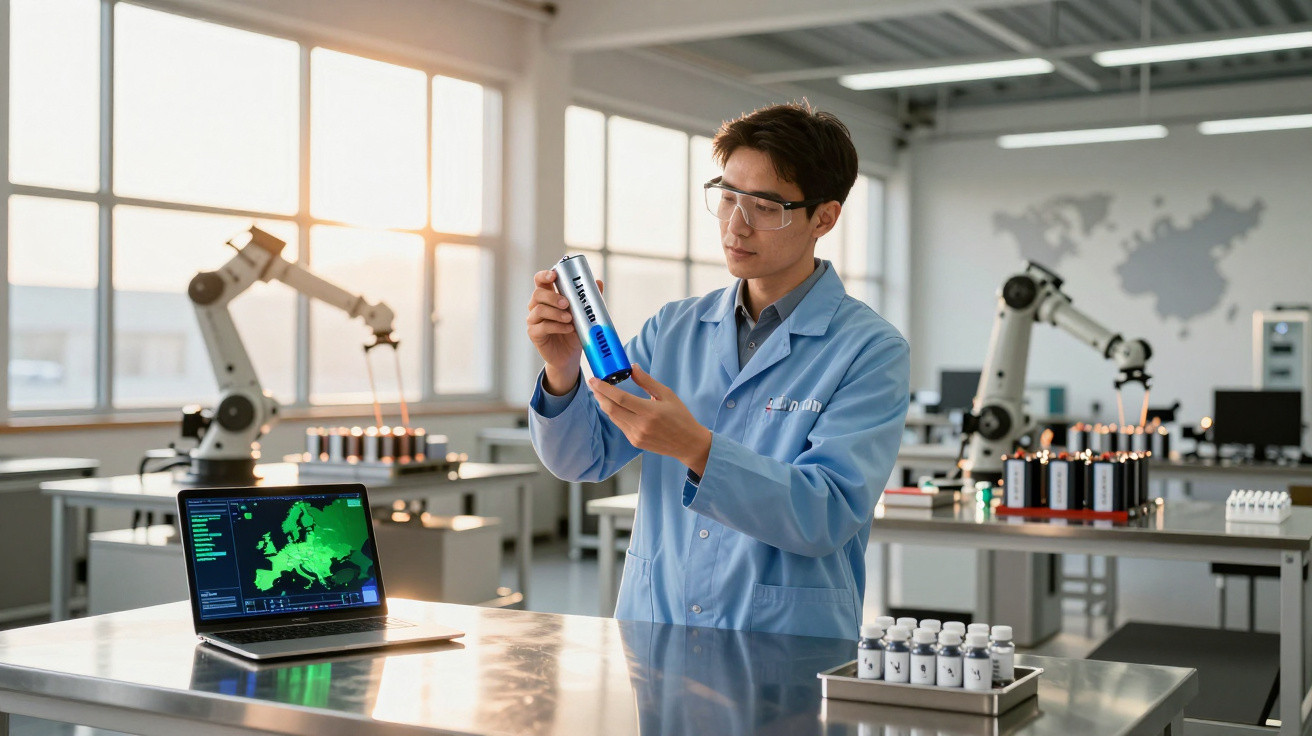
France, a country long associated with nuclear power as a defining energy asset, is now placing a major wager on domestically produced batteries. From French gigafactories to sodium-ion start-ups, an emerging strategy seeks to reduce reliance on Chinese supply chains, safeguard European energy autonomy and reshape control of electric mobility.
France’s battery gamble and why China is paying attention
For years, China has led the worldwide battery industry at every stage, from raw materials through to completed cells. European carmakers had little alternative to buying from major Asian suppliers. As electric vehicle uptake accelerates and geopolitical tensions intensify, that dependency is becoming a strategic concern.
Against this backdrop, the French-supported Automotive Cells Company (ACC) has become a key element of Europe’s response. The joint venture between Stellantis, Mercedes-Benz and French energy group TotalEnergies is increasing output of batteries manufactured entirely in Europe.
ACC’s French-made cells target the core of China’s strength: large-scale, cost-competitive battery manufacturing.
Asian competitors still have the advantage in production volumes, but the emergence of a credible European manufacturer alters the balance in negotiations. Carmakers in France, Germany and Italy can now source some batteries locally, gaining greater influence over standards, prices and technology transfer.
What is Automotive Cells Company actually building?
ACC’s first industrial facility, located in the former coal-mining area of Hauts-de-France, has been planned as a gigafactory dedicated to lithium-ion batteries for electric vehicles. Its purpose is high-volume manufacturing rather than laboratory-scale research.
The project concentrates on three main priorities:
- High-performance battery cells appropriate for mass-market electric cars
- Local European supply chains that lessen dependence on imports
- A smaller carbon footprint than Asian rivals, enabled by cleaner electricity and shorter transport distances
From an industrial-policy perspective, the signal is unambiguous: batteries are being regarded as strategic infrastructure, comparable with semiconductors and telecommunications networks. Locating the plant in an area severely affected by deindustrialisation also makes it an emblem of reindustrialisation and employment creation.
The gigafactory is not only about technology; it is also about sovereignty, employment and political leverage.
How this shifts Europe’s energy autonomy
Energy autonomy involves more than generating electricity. It also requires the capacity to store, transport and use that power without depending on overseas suppliers. Batteries sit at the intersection of each of these requirements.
Through ACC and comparable schemes, France intends to:
- Ensure a dependable battery supply for its own EV market
- Back European carmakers facing pressure from Chinese and American competitors
- Retain a larger share of the value chain within the European Union
This shift in the balance is increasingly strategic because both the US and China use subsidies, tariffs and industrial policy to support domestic companies. Europe, frequently criticised for its slow response, is now seeking to close the gap through focused battery partnerships and state-supported investment programmes.
Tiamat and the sodium-ion wildcard
French battery innovation extends beyond ACC’s lithium-ion cells. Tiamat, a start-up founded by CNRS researchers and developing sodium-ion technology, is also attracting attention.
Whereas lithium-ion batteries dominate the automotive sector, sodium-ion batteries rely on sodium, an element readily available in salt. This distinction carries significant consequences for both material security and cost.
Tiamat’s first commercial sodium-ion battery has already been integrated into a product, with industrialisation targeted from 2025.
Sodium-ion batteries offer several potential benefits:
- Reduced reliance on lithium, cobalt and nickel, whose prices can fluctuate sharply
- Potentially cheaper manufacturing, particularly at large scale
- Safer thermal behaviour in certain configurations, which lowers fire risks
They are not yet capable of powering long-range electric cars on a large scale, but they may prove competitive in urban vehicles, stationary storage and devices where lifespan and affordability matter more than range.
Why sodium-ion matters for global competition
China is investing substantially in sodium-ion as well, with several major businesses unveiling prototypes and pilot production lines. France’s entry into the race through companies such as Tiamat sends a clear message: Europe does not intend to remain a permanent follower in next-generation battery chemistries.
Should sodium-ion gain widespread use in grid storage or lower-cost electric models, a domestic industrial base could prevent billions in imports and lessen exposure to supply interruptions.
Implications for electric mobility and carmakers
For motorists, price and availability may be the first noticeable effects of this transition. Batteries made in Europe give local vehicle brands more scope to negotiate costs and manage supply. This could help reduce the cost of entry-level EVs, a category in which Chinese manufacturers are already highly aggressive.
Carmakers also benefit from closer links between battery suppliers and vehicle engineering teams. Developing batteries nearby can speed up responses to safety concerns, performance adjustments and software updates.
Control over batteries is slowly becoming as strategic for carmakers as control over engines once was.
The transition also influences the planning of charging networks and electricity grids. If France and neighbouring countries can rely on a consistent supply of locally made batteries, it becomes easier to plan large storage schemes connected to solar and wind farms. This helps to stabilise electricity systems as fossil fuels are gradually withdrawn.
Jobs, skills and regional impact
Every gigafactory can create thousands of direct jobs, alongside many more roles in subcontracting, logistics and services. Required capabilities span chemistry, robotics engineering, maintenance, quality assurance and digital systems.
Areas hosting these factories commonly invest in training centres, apprenticeships and technical colleges. The aim is to avoid earlier failures in which high-tech plants had to bring in much of their expertise from overseas.
| Aspect | Traditional car industry | Battery-centred industry |
|---|---|---|
| Core component | Combustion engine | Battery pack and software |
| Key skills | Mechanical engineering | Chemistry, electronics, data |
| Energy link | Oil supply chains | Electric grids and renewables |
| Geopolitical risk | Oil-producing countries | Battery materials and factories |
Risks, uncertainties and the Chinese response
France’s move into battery production faces a number of obstacles. Gigafactories require exceptionally large capital investment, while profitability relies on achieving scale rapidly. A slowdown in global demand or changes to trade rules could delay certain projects.
Raw materials present another challenge. Even with factories at home, Europe continues to import much of its lithium, nickel and other metals. Recycling, diversified mining sources and alternative chemistries including sodium-ion form part of the answer, although each will require time.
China is unlikely to remain passive. It already holds a substantial lead and could decide to lower prices, speed up exports of cheaper models to Europe or restrict access to particular processed materials. Such steps could place new French and European manufacturers under pressure before they become established.
Winning the battery race is less about a single breakthrough and more about building a resilient ecosystem over decades.
Scenarios for the next decade
Several outcomes remain possible. Under one scenario, European and French-backed ventures such as ACC achieve full capacity, sodium-ion establishes its market niche and Europe captures a meaningful share of global battery manufacturing. China remains the volume leader, but the gap narrows and dependency falls.
In a less positive outcome, cost pressures and regulatory hold-ups slow EU schemes. Chinese and US businesses strengthen their control of patents, supply chains and battery-related digital platforms. European factories continue operating, but as junior partners in a market shaped elsewhere.
A mixed result is also possible, with regions specialising: Europe concentrates on premium batteries and vehicle integration, China retains its position as the low-cost giant, and countries such as India or Indonesia move up the value chain through raw-material processing.
Key terms and practical angles for readers
Two concepts frequently arise in these discussions and merit clarification:
- Energy sovereignty: the capacity of a country or region to run its economy without excessive dependence on a limited number of foreign suppliers.
- Gigafactory: an industrial facility able to manufacture several gigawatt-hours of batteries annually, sufficient to equip hundreds of thousands of vehicles.
For households and small businesses, these strategic developments could soon influence everyday life. More local battery production may help steady EV prices, broaden second-hand markets and enable new services, such as neighbourhood storage systems combined with rooftop solar panels.
On a wider level, France’s battery wager is also a race against time. The country is attempting to shift from purchasing technology designed abroad to helping define standards, patents and industrial rules. Whether this fully reshapes global power remains unclear, but the first pieces are clearly on the board.


Comments
No comments yet. Be the first to comment!
Leave a Comment