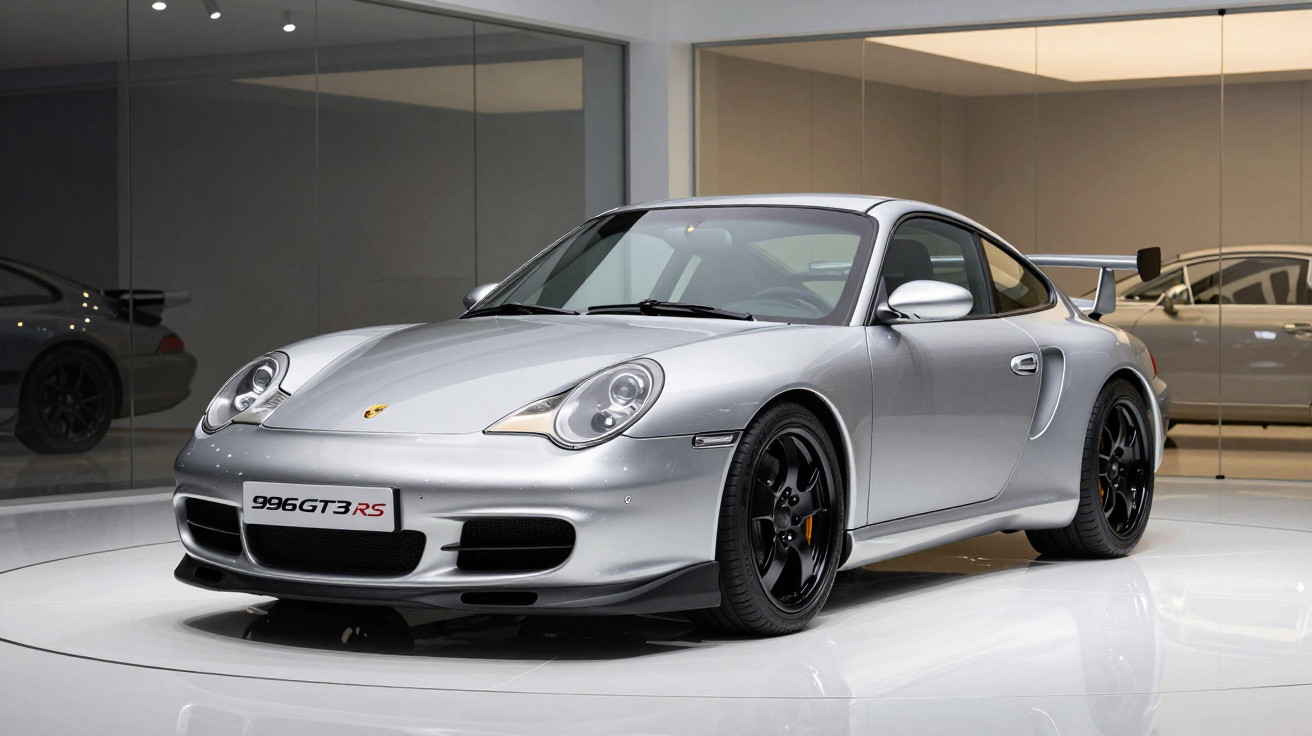
It was at the 1999 Geneva Motor Show that the first Porsche 911 GT3 was revealed to the world. It swiftly became the sports car every rival had to beat, a position it still holds today, three generations and 14 versions later, including facelifts, RS variants and Touring models.
Its standing as the benchmark is hardly surprising. In every meaningful sense, the 911 GT3 is a homologation special: a machine engineered and honed first and foremost to succeed on track, then made just civilised enough for road use.
With that mission in mind, responsibility for its development could only fall to Porsche’s motorsport department. That remains the case today for every 911 “GT” model.
Based on the 996 generation - perhaps the least loved and least highly regarded of all Porsche 911s - the 911 GT3, split between the 996.1 GT3 and 996.2 GT3, as we will see, succeeded the equally focused 964 RS and 993 RS. It would also form the basis for a range of racing cars, from one-make trophy competitors such as the 911 GT3 Cup to GT championship contenders including the 911 GT3 R and 911 GT3 RSR.
Why GT3 rather than the historic RS badge used by its predecessors? The name came from the regulations governing the FIA GT Championship at the time. GT3 was the class for cars closest to production models; at the opposite end sat GT1, a category in which the Porsche 911 would also make history.
From 911 to Porsche 911 GT3
As with any homologation special, turning a 911 into a 911 GT3 involved substantial changes. Porsche’s motorsport department left no detail unattended in its pursuit of a winning machine.
A 911 Carrera 4 bodyshell provided the starting point, although the finished car shared very little with it.
Instead of the water-cooled flat-six fitted to the regular Carrera 2 and Carrera 4, the car received another six-cylinder boxer engine far better suited to racing and already proven in competition. The same engine block used by the 911 GT1 - winner of the 1998 24 Hours of Le Mans and credited with 47 victories during its career - was selected for the Porsche 911 GT3.
The revered Mezger engine, named after its creator Hans Mezger, Porsche’s engine wizard, would serve the 911 GT3 for several generations before being retired with the 991 generation.
This engine still retained a connection to the air-cooled flat-six units, as its origins dated back to that era. In this first application, it had a capacity of 3600 cm³, delivering 360 hp at 7200 rpm and 370 Nm, and, as expected of a competition-derived car, it used dry-sump lubrication. The gearbox? Naturally, a manual - borrowed from the 911 GT2.
Next came the chassis. Adjustable suspension and anti-roll bars lowered the ride height by 30 mm, a limited-slip differential was added, and the brakes were enlarged. The lighter wheels measured 18 inches and wore Pirelli P Zero tyres. ESP or traction control? Neither was fitted. ABS alone was retained.
Weight is performance’s enemy, as everyone knows. Porsche stripped out everything that was not essential from the 911 GT3’s cabin: much of the sound insulation, the rear seats, the sunroof, rear speakers and even the air conditioning, although the latter could be reinstated.
Finally - but certainly not least - came aerodynamics. The rear wing changed from a movable item to a fixed one, an element that would become one of the Porsche 911 GT3’s defining visual signatures and a clear inheritance from motorsport.
After passing through the skilled hands, and feet, of Walter Röhrl, the result was a sports car of the highest pedigree and one that received unanimous acclaim. Praise centred on its willingness to rev, precise and communicative steering, exceptionally responsive front end and near-bulletproof composure, even on the roughest circuits.
Add a Nürburgring lap time of under eight minutes with Röhrl at the wheel, and the standard was set extraordinarily high for any challenger hoping to claim the crown.
Raw and visceral were just some of the terms used to describe its driving experience, precisely as one would expect from a car so closely tied to the circuit. Yet there was still scope to refine the formula further - being Porsche, there always seems to be...
996.2 GT3
When the 996 received its facelift in 2001, Porsche also reworked the 911 GT3, with the updated model arriving in 2003 and becoming known as the 996.2 GT3. Its heavily criticised headlights changed, no longer matching those of the Boxster, but the modifications that mattered most were under the skin. The engine was now more powerful, producing 381 hp at 7400 rpm and 385 Nm, enough to offset the additional 30 kg it carried: 1380 kg rather than 1350 kg.
Aerodynamics were revised too, with a new rear wing. The tyres became wider and brake disc diameter increased from 320 mm to 350 mm. For the first time, it could also be specified with the carbon-ceramic discs from the 911 Turbo and 911 GT2, cutting unsprung mass by 18 kg.
The best was still to come...
The return of the RS
This would become the peak of the first 911 GT3, and it would retain that role in every generation that followed. The 911 GT3 RS - Renn Sport - narrowed the divide between road and track still further, and that did not simply refer to its more flamboyant livery, which recalled the first 911 RS.
It was 20 kg lighter, thanks to a polycarbonate rear window, a carbon-fibre engine lid and a new, larger carbon-fibre rear wing, while carbon-ceramic brakes were fitted as standard. Its revised adjustable suspension used dampers 10-15% stiffer and progressive springs; it also gained specific wheel hubs. These and other detail changes enhanced the GT3’s agility and dynamic effectiveness, despite there being no increase in power from the Mezger engine.
It was once called “the perfect car”. Enough said...
...or perhaps not, because later generations of the Porsche 911 GT3 - and, by extension, the 911 GT3 RS - continued raising the bar. They have been compared with faster, more powerful machines and still emerge victorious and preferred; it remains the sports car against which every other is measured, because a car is not defined by numbers alone.
It offers a unique driving experience, one closely bound to motorsport. The principles behind the first GT3 remain present in today’s GT3. We do not know for how long, given the world in which we now live, but we hope they endure for many years yet...
About “Glories of the Past”. This is Automobile Reason’s feature dedicated to models and versions that have stood out in one way or another. We enjoy revisiting the machines that once made us dream. Join us on this journey through time here at Automobile Reason.


Comments
No comments yet. Be the first to comment!
Leave a Comment