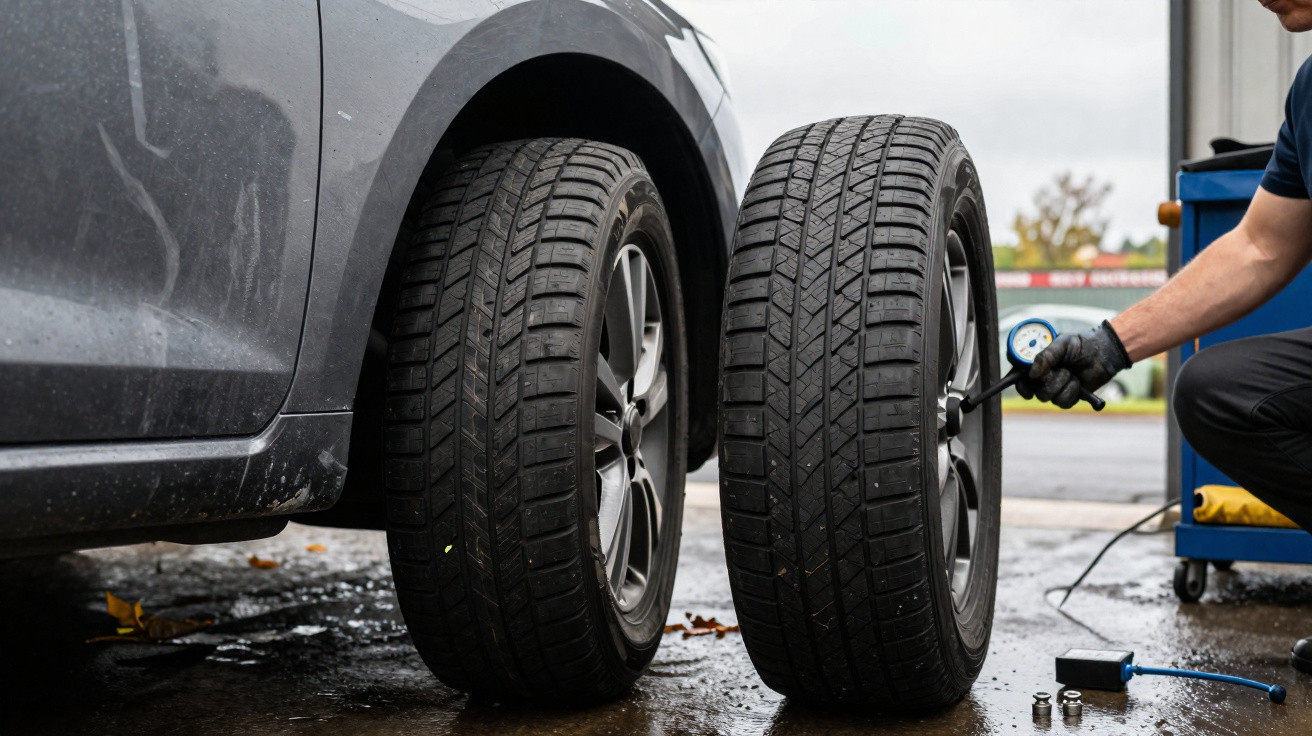
The autumn tyre question is a familiar one: book in for a seasonal change, find somewhere to store a spare set, or carry on with summer tyres and hope winter stays mild. For many UK drivers, all-season tyres offer a third option: one set that stays on the car throughout the year.
That can be a sensible simplification, especially for cars used mainly for local journeys and everyday commuting. It is not, however, a universal upgrade. All-season tyres are a compromise, and the best choice depends on your mileage, the roads you use and whether you need to travel when winter weather turns properly difficult.
Why summer tyres can be less capable in cold weather
Summer tyres are designed for warmer conditions. Their rubber compound and tread pattern are intended to give good steering response, braking and water clearance through spring and summer.
In sustained low temperatures, the rubber can become less flexible. This may reduce the tyre’s ability to conform to the road surface, particularly on cold, wet tarmac. Around 7°C is often used as a guide for considering winter-capable tyres, but it is not a hard rule that applies to every journey.
The road surface matters as much as the air temperature. A wet country lane before sunrise, a shaded stretch after a frost or a motorway covered in standing water can all be more demanding than a dry afternoon at the same temperature.
Dedicated winter tyres use compounds and tread designs intended to improve traction in cold, wet, slushy and snowy conditions. They are especially relevant if you regularly drive on untreated roads, steep hills or routes where snow is more likely.
What all-season tyres are designed to do
All-season tyres, sometimes marketed as all-weather tyres, are designed to cover a wider range of conditions than a conventional summer tyre. Their compound and tread design sit between dedicated summer and winter products.
For many motorists, the attraction is straightforward:
- one set of tyres remains fitted all year;
- there is no routine spring and autumn tyre change;
- there is no second set to store at home or pay a garage to store;
- they can offer greater cold-weather capability than summer tyres alone;
- buying one set may be easier to manage than purchasing two complete sets at once.
An all-season tyre is best seen as a practical year-round compromise, rather than a tyre that matches a specialist product in every condition.
They can suit low- to moderate-mileage drivers whose cars mainly do school runs, shopping trips, commuting and occasional longer journeys. For that sort of use, they can remove much of the hassle attached to seasonal tyre changes.
Look for the right winter marking
Not every tyre described as all-season has the same cold-weather capability. If winter use matters to you, look for the three-peak mountain snowflake symbol, usually shortened to 3PMSF. It shows a mountain with three peaks containing a snowflake.
Tyres carrying this marking have met a defined snow-traction requirement. It is generally a more useful indicator of winter capability than the older M+S, meaning mud and snow, marking alone.
The symbol does not mean an all-season tyre will perform exactly like a dedicated winter tyre in deep snow or on ice. It does indicate that the tyre has been developed and assessed for snow performance.
A quick checklist before buying
- Confirm the approved tyre size. Check the vehicle handbook, the tyre-information placard around the driver’s door opening or fuel flap, or ask a reputable tyre fitter. Size, load rating and speed rating must be suitable for the car.
- Check for 3PMSF. This is particularly worth considering if you travel during cold spells or use rural, hilly or upland roads.
- Compare wet-grip and noise information. The tyre label is useful for comparisons, although it does not show every aspect of real-world winter performance.
- Ask about age and storage. An unused tyre can have been in storage for some time. If in doubt, ask the retailer about its manufacture date and condition.
- Fit compatible tyres. Matching tyres across each axle is important. A matching set of four is usually the most predictable arrangement, subject to the vehicle manufacturer’s guidance.
Who all-season tyres may suit
All-season tyres tend to make most sense where driving is relatively ordinary rather than extreme. They may be worth considering if most of the following apply:
- You live in a town, city or lowland area where snow is uncommon and short-lived.
- Your annual mileage is modest.
- Most journeys are on urban, suburban or well-maintained main roads.
- You want greater reassurance in cold rain and occasional light snow without changing tyres twice a year.
- You do not have convenient storage for a second set.
- You can postpone non-essential journeys in severe snow, ice, flooding or poor visibility.
The UK is more often challenged by rain than by prolonged snow. A good-quality all-season tyre with strong wet-weather credentials can therefore be a practical choice for many households, provided it is the correct specification and is properly maintained.
When separate summer and winter tyres make more sense
A summer-and-winter arrangement still has clear advantages for some drivers. Specialist tyres are designed for narrower conditions, so they can offer benefits at the seasonal extremes.
Separate sets deserve serious consideration if you:
- cover high annual mileage, especially on motorways;
- regularly drive on steep, exposed or untreated roads in winter;
- travel through parts of Scotland, Wales, the Pennines, the Peak District or other hilly areas during cold spells;
- need to travel whatever the forecast, for example for shift work or caring responsibilities;
- tow a caravan or trailer in colder months;
- frequently drive abroad in much hotter summer conditions.
Dedicated winter tyres can offer more traction in genuinely wintry weather, while summer tyres may provide more precise handling in sustained warm conditions.
Choose tyres for the worst conditions you realistically need to drive in, not simply for the average day on the weather app.
Four-wheel drive does not replace suitable tyres
Four-wheel drive can help a vehicle pull away with less wheelspin, but it does not create extra grip for braking or cornering. A four-wheel-drive SUV on unsuitable tyres can still struggle to stop on a cold, slippery road.
The same principle applies to electric cars. Their weight and instant torque make tyre condition, tread depth and correct pressures particularly important. Check that replacement tyres meet the vehicle maker’s required load and speed ratings. Some models may also have specific approved tyre requirements.
Whatever the drivetrain, leave more space, slow down smoothly, avoid abrupt steering and accelerate gently on cold or wet roads.
Common mistakes to avoid
Buying tyres without checking their suitability can be an expensive false economy. Avoid these common errors:
- Replacing only two tyres without assessing the other pair. Differences in tread depth, grip and pattern can affect stability. If only two are replaced, follow the vehicle manufacturer’s instructions; many tyre professionals recommend the newer pair is fitted to the rear.
- Choosing only by price. Legal compliance does not make tyres equivalent in wet grip, noise, comfort or expected wear. Compare independent tests where they are relevant to your tyre size.
- Waiting for the legal limit. The UK minimum tread depth for cars is 1.6mm across the central three-quarters of the tread and around the full circumference. Wet-weather performance can decline well before that point.
- Ignoring damage or pressure loss. Bulges, sidewall cuts, cracking, embedded objects and repeated loss of pressure need professional inspection.
- Forgetting tyre pressures. Cold weather can lower pressures. Check them at least monthly and before a long journey, using the vehicle manufacturer’s recommended cold pressures.
- Assuming any tyre makes winter driving safe. No tyre can overcome sheet ice, deep floodwater, poor visibility or excessive speed.
A sensible decision before winter
Start with your present tyres. Check tread depth, visible condition and pressures, then think honestly about the roads you use between November and March. If you mainly drive locally, use maintained roads and can avoid the worst weather, a reputable 3PMSF all-season tyre may be a tidy year-round solution.
If your location, work or family commitments mean you must travel through snow, ice or cold upland conditions, a dedicated winter set remains worth considering. Book fitting in good time, as garages and mobile tyre services can become busy when the first cold snap arrives.
Finally, do not apply tyre dressing to the tread, and do not use household chemicals to clean tyres. Keep them correctly inflated, inspect them regularly and adjust your driving to the conditions ahead.
















Comments
No comments yet. Be the first to comment!
Leave a Comment