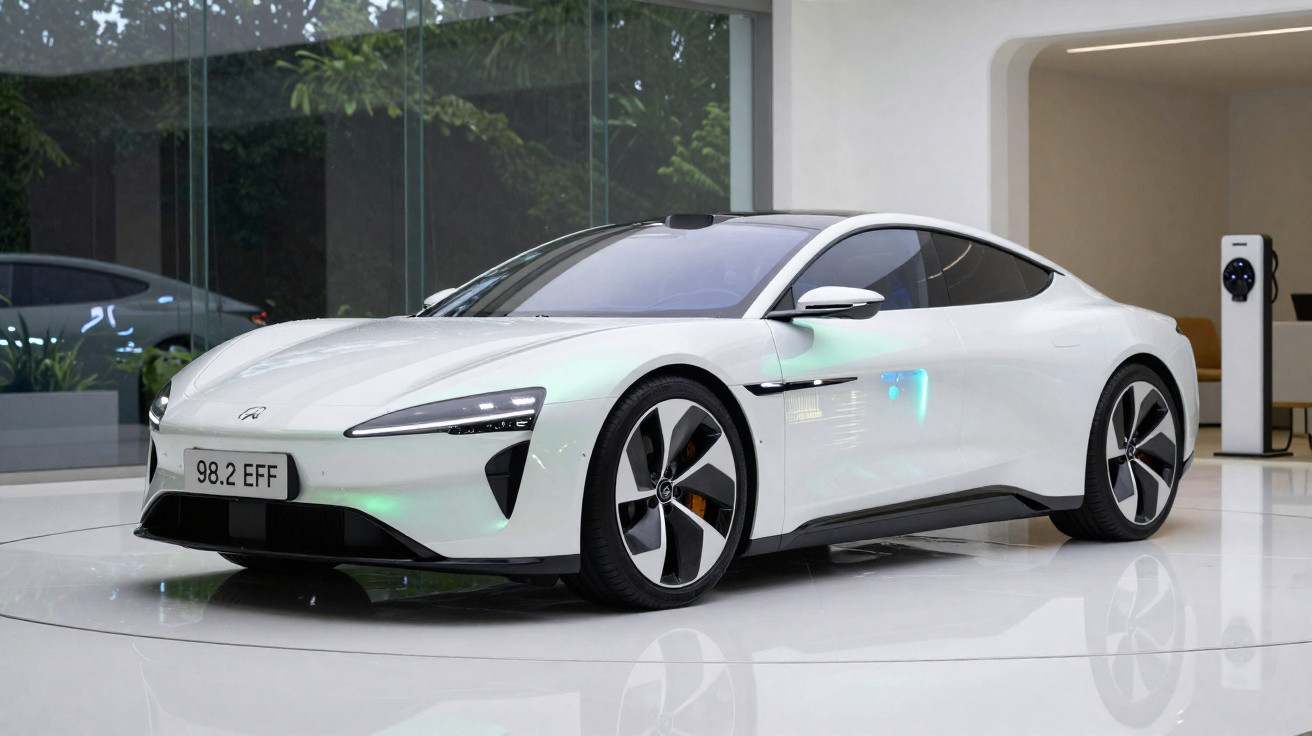
A joint venture between the two groups has developed an electric motor claimed to achieve an overall efficiency of 98.2 per cent. The technology is aimed primarily at hybrid vehicles and range-extender concepts, and could open a new chapter in the automotive industry's efficiency race.
Why Renault and Geely are advancing powertrain technology now
For a long time, Japanese and European manufacturers led the way in fuel-efficient powertrains. Chinese groups have pushed hard in recent months: Dongfeng has announced an internal-combustion engine with almost 50 per cent efficiency, Changan has followed suit, and BYD has unveiled its own highly efficient electric motors. It is against this backdrop that Horse, the powertrain company established jointly by Renault and Geely, is positioning itself.
The company has developed the new electric motor, known internally as “Amorphous”. Its key innovation is not an eye-catching body design but a component deep within the unit: the stator, the stationary section of an electric motor where the magnetic field is created.
The motor uses a novel amorphous steel in its stator, which is intended to halve internal losses while delivering a stated overall efficiency of 98.2 per cent.
Horse is therefore addressing an area where electric motors still have meaningful scope for improvement: minute yet continuous losses within the material itself.
Steel thinner than a hair: the material innovation explained
Stators are usually made from thin sheets of crystalline electrical steel. These laminations limit eddy currents, which occur in metal exposed to changing magnetic fields and are dissipated as heat. Horse has taken the approach further in two ways with its new motor:
- The stator uses amorphous steel with a disordered atomic structure.
- The stator laminations are only 0.025 millimetres thick – roughly ten times thinner than normal.
This exceptionally small thickness cuts eddy currents in the metal, while the amorphous structure further reduces magnetic losses. The intended result is less waste heat and more usable drive power from the same energy input.
Horse says internal losses in the motor are 50 per cent lower. From an electrical-engineering standpoint, that appears plausible: the finer the lamination stack and the more effectively it can be demagnetised, the lower the so-called iron losses. For drivers, the benefit is not a higher peak output but slightly greater range and lower energy consumption.
Output and torque: prepared for modern hybrids
The new motor is not designed chiefly for outright sports cars, but for everyday vehicles with electric assistance. Its key technical figures are as follows:
| Parameter | Value |
|---|---|
| Maximum power | 190 PS |
| Maximum torque | 360 Nm |
| Stated overall efficiency | 98.2 % |
These figures make the motor suitable for compact and mid-sized plug-in hybrids, as well as range-extender vehicles in which a small combustion engine serves solely as a generator. With 190 PS and 360 Newton metres of torque, it sits within the range of current electric powertrains; the advance is clearly in efficiency rather than raw power.
What does 98.2% efficiency mean in real-world use?
Today's electric motors are already considered highly efficient. In realistic operating conditions, many units achieve between 93 and 97 per cent. Reaching a maximum of 98.2 per cent may initially sound like a minor step. For engineers, however, the final percentage points are the hardest to gain, because losses can then only be reduced in very small increments.
Horse expects the new motor to save around one per cent of energy across the complete hybrid system, measured against real-world consumption.
At first glance, one per cent may seem almost insignificant. Applied across millions of vehicles over several years of use, however, it represents substantial quantities of energy that no longer need to come from either the grid or the fuel tank. Fleet operators, commuters and manufacturers working towards CO₂ targets are increasingly focused on exactly these incremental improvements.
Laboratory figures versus everyday reality
Despite the notable figures, one uncertainty remains: all of the values currently come from Horse itself and are based on test-bench measurements. In everyday use, temperature changes, part-load operation, frequent acceleration and braking, and material ageing all play a part. In practice, actual vehicle efficiency is generally slightly lower than laboratory claims.
Horse has also not yet announced which production model will use the motor first, or when it will arrive. What is clear is that the motor is listed in the joint venture's catalogue and can be ordered by brands within the Renault and Geely networks, including Renault, Dacia, Volvo and other marques belonging to the Chinese group.
Why one per cent lower consumption still matters
At system level – including the power electronics, battery and combustion engine in a hybrid – Horse cites a consumption advantage of around one per cent. That may sound modest, but it matters for several reasons:
- Manufacturers are competing for every gram of CO₂ in their fleet figures.
- Hybrid vehicles often remain in service for many years and cover high mileages.
- Efficiency gains across millions of vehicles add up to noticeable reductions in energy demand.
- Greater efficiency eases the burden on cooling systems and can allow components to be made smaller.
In many markets, increasingly strict fuel-consumption and emissions rules will determine whether companies face penalties worth billions. Even small powertrain advances can help manufacturers comply with these limits or create a little additional headroom.
The technology in detail: amorphous steel in cars
Amorphous metals are not entirely new to industry. They are used in grid transformers and highly precise electronic components. Their use in vehicle manufacturing has so far been limited, largely because they are costly and difficult to process.
Amorphous steel is produced by cooling liquid metal so rapidly that a regular crystalline structure cannot form. Its atoms become “frozen” in a disordered state. This results in:
- lower magnetic losses,
- high hardness and wear resistance,
- unusual behaviour under loads and temperature changes.
For an electric motor, the magnetic benefit is particularly important: the less energy retained in the steel itself as heat, the more power reaches the drive shaft. The challenge lies in manufacturing laminations only 0.025 millimetres thick at industrial volumes – and doing so at commercially acceptable cost.
What this means for future electric and hybrid cars
The new motor indicates the direction in which the industry is moving. After battery chemistry and cell production dominated attention for years, the powertrain itself is once again receiving greater focus. Manufacturers are seeking efficiency improvements of a few percentage points wherever they can find them: in the motor, inverter, gearbox, cooling system and control software.
For motorists, this could mean the following in the years ahead:
- slightly improved range with the same battery capacity,
- lower consumption figures for plug-in hybrids,
- more compact powertrains with equal or greater output,
- potentially less reliance on rare magnet materials if new designs reduce their use.
The key question will be how effectively amorphous steels can be incorporated within the cost constraints of a volume manufacturer. If production remains manageable and suppliers can scale up, similar concepts could eventually appear not only in expensive flagship models but also in mainstream vehicles.
What testers and customers should watch for
Once the first production vehicles using the new motor reach the road, independent measurements will show how much of the 98.2 per cent remains under real conditions. Test laboratories and specialist publications will focus particularly on:
- consumption on typical commuting routes and motorway journeys,
- efficiency under part-load conditions rather than only at the optimum point,
- thermal stability during sustained full-load driving,
- noise and vibrations caused by the new material,
- ageing effects after high mileages.
Buyers should consider official consumption figures and realistic independent tests, rather than relying solely on laboratory figures in brochures. Anyone who drives many miles each year or regularly travels in electric mode will benefit especially from every percentage point of efficiency gained, even if the improvement initially appears unspectacular in everyday driving.







Comments
No comments yet. Be the first to comment!
Leave a Comment