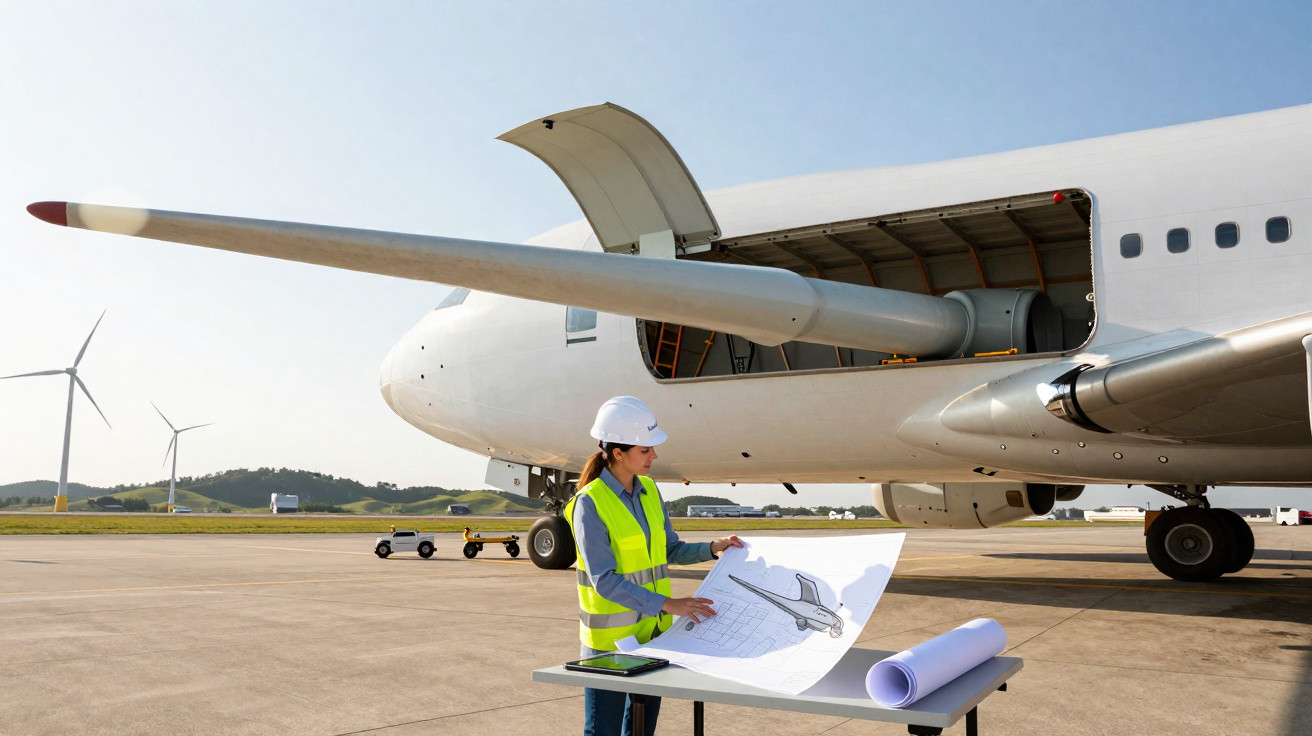
On airport runways, some proposals initially sound implausible. A 108-metre aircraft designed to carry giant wind turbine blades to places inaccessible by road certainly falls into that category. Yet the WindRunner is gradually taking shape as a real project. The announcement of a partnership with French group Assystem gives this industrial venture a particularly tangible dimension. Beyond the striking visuals and almost outsized figures lie engineers, workshops, schedules and one straightforward question: how can the equipment needed for the energy transition be moved without turning every delivery into a logistical nightmare? The gamble is enormous, and it could reshape the construction of the world’s largest wind farms.
WindRunner: the extraordinary aircraft designed to move the impossible
Once a wind turbine blade exceeds 100 metres, getting it to the installation site becomes an undertaking in its own right. Roundabouts must be bypassed, road signs removed, bridges reinforced and, in some cases, convoys can travel only when weather conditions allow. We have all seen an abnormal-load lorry hold up a road; here, however, the scale is entirely different. US company Radia conceived the WindRunner to remove some of those limitations by loading the bulkiest components directly into an immense cargo hold.
At 108 metres long, the WindRunner is expected to be larger than already legendary aircraft such as the Antonov An-225, which was destroyed in Ukraine in 2022. Its purpose is not to carry hundreds of passengers or luxury cars, but blades almost 105 metres long for onshore wind turbines. Radia cites exceptional freight capacity suited to parts that will not fit inside any conventional cargo aircraft. In theory, this giant aircraft will be able to land on relatively short, unprepared runways, close to energy-generation areas.
The concept addresses a very practical issue: wind turbines have become more powerful and therefore larger, while road infrastructure has not developed at the same pace. The longer a blade is, the more wind it captures and the better an installation performs. However, transporting it can be expensive, delay construction work or rule out sites that would otherwise be well suited. The WindRunner does not claim it will eliminate every obstacle; it aims to move some of them into the sky. That distinction matters, because a project of this ambition must still prove that it can work both industrially and economically.
Assystem brings French expertise to an exceptionally complex programme
French group Assystem has decided to join the WindRunner programme alongside Radia. Known for its engineering work in energy, nuclear, transport and complex infrastructure, the company will contribute its expertise to the programme’s studies and development. A partnership of this kind is never merely about placing a logo on a presentation. It involves coordinating thousands of technical decisions, from structural weight to onboard systems management, while also accounting for aviation certification requirements that can shift a timetable by several years.
To follow the project without being carried away by 3D renderings, a simple approach is to look at three stages: detailed design, industrialisation and the first flights. Announcing a partnership opens a door; it does not mean an aircraft is already ready to taxi on the tarmac. Let us be honest: hardly anyone checks the status of an aircraft programme before sharing an impressive image. Even so, that precaution helps prevent a technological promise from being confused with an aircraft that has been certified, manufactured and placed into commercial service.
Another common mistake is to view the WindRunner as simply a “very large aircraft”. Its dimensions are spectacular, but the project’s central purpose is the wind power supply chain. Assystem can bring a broader perspective precisely by connecting aerospace engineering, site constraints and energy challenges.
“The challenge is not simply to build a larger aircraft: it is to make possible a new way of installing energy where it is needed.”
The key areas to watch are clear:
- validation of technical choices and materials;
- the ability to manufacture the aircraft at a realistic scale;
- securing the required certifications;
- the actual cost of delivering blades by air;
- the overall environmental impact of operations.
An industrial gamble reaching far beyond aviation
Assystem’s arrival is significant because it underlines that major projects are almost never created in one country or one factory alone. The WindRunner already brings together expertise from aerospace, defence, transport and energy. France has a particular role in this equation: it has recognised engineering groups, a substantial aerospace sector and long-standing experience of complex energy infrastructure. The project remains risky, but it reflects an industry attempting to answer a constraint that has become very real.
The debate around wind power is often reduced to images of turbines in landscapes, questions of cost or intermittent generation. Less attention is paid to the journey of a blade, the bends it cannot negotiate and the villages a convoy must avoid. Yet these details can sometimes determine whether a wind farm is feasible. If the WindRunner fulfils its promise, it could provide access to areas that are currently difficult to equip with large turbines. It would replace neither roads, ports nor rail-based solutions. It would add an unusual additional option.
There is also a legitimate question: is flying such an enormous aircraft to carry wind turbine components climatically coherent? The answer will depend on many factors, including the number of flights, the road distance avoided, the type of fuel used and the additional generation delivered by larger turbines. Radia is particularly relying on the future use of sustainable aviation fuels. There is a long way between intention and reality. Yet projects capable of disrupting established habits often begin this way: with an idea that seems too large to fit the usual framework.
| Key point | Detail | Value for the reader |
|---|---|---|
| A record-breaking aircraft | The WindRunner is planned to be 108 metres long. | Understand why it could become the largest aircraft ever built. |
| A focused mission | Transporting exceptionally large onshore wind turbine blades. | Assess the direct link between cargo aviation and the energy transition. |
| French expertise | Assystem joins the programme with its complex-engineering expertise. | See how a French company fits into a global project. |





Comments
No comments yet. Be the first to comment!
Leave a Comment