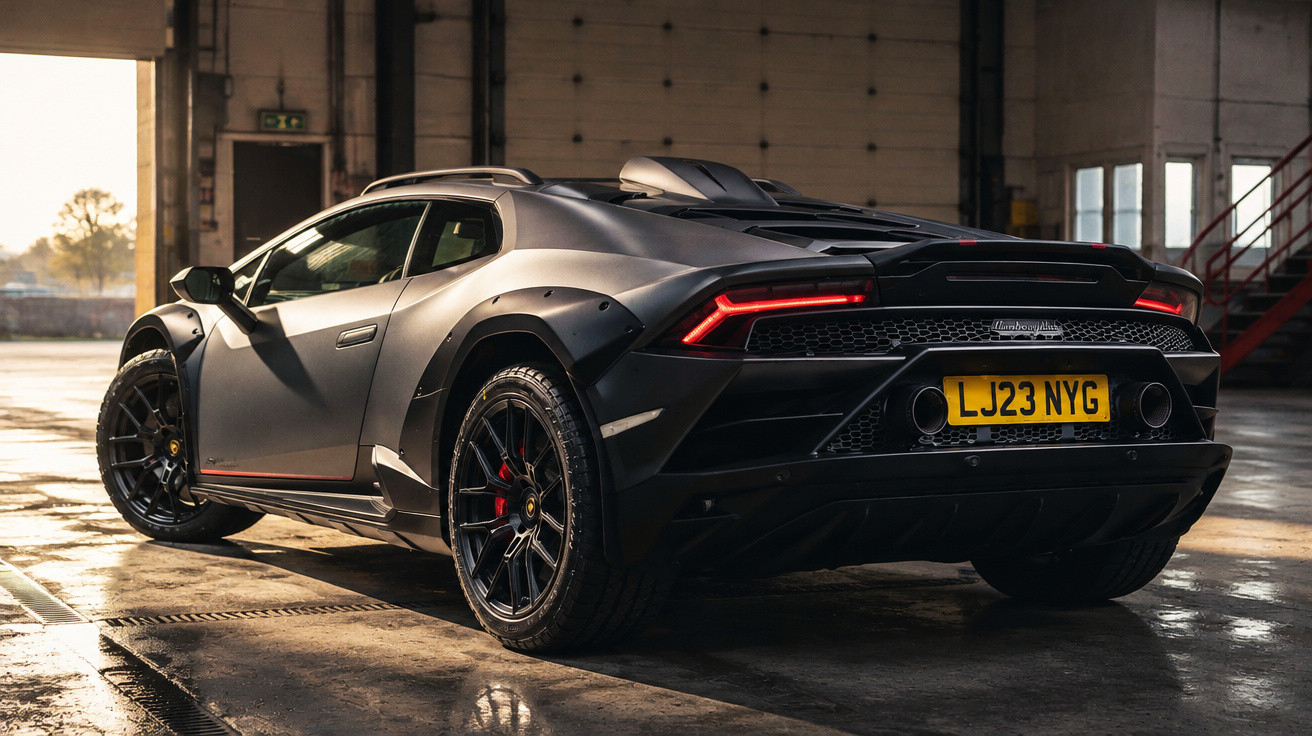
The Lamborghini Huracán formula
How do you follow the best-selling Lamborghini ever made? By creating one that sells even more. Lamborghini therefore left the Gallardo formula largely untouched. Although carbon fibre was used for parts of the floor and rear bulkhead, the remainder retained an aluminium construction. Four-wheel drive was back, the styling stayed sharply angular, and the Audi-shared 5.2-litre 90° V10 sat in its familiar longitudinal rear-mounted layout.
Previously, company politics meant that Audi’s V10 R8 models were denied a few horsepower compared with the equivalent Lamborghini. At launch, however, both the Huracán and second-generation R8 were rated at 602bhp. During its lengthy production run and 13 variants - spanning four- and rear-wheel-drive versions, coupés, Spyders, lightweight editions and facelifts - the V10 never exceeded the 631bhp first introduced by the 2017 Performante. Even the radically altered STO special edition retained that, by current standards, fairly restrained output.
Why the Lamborghini Huracán V10 reached its limit
Yet the automotive world has done some genuinely strange things with this near-indestructible V10. US tuner Underground Racing has repeatedly fitted twin turbos to produce 1,600... 2,000... and, this year, 3,500bhp - enough for more than 240mph across a quarter-mile. Then there is the Engler Desat, a 1,085bhp V10 quad bike. With so much potential apparently left in the V10, why swap it for a twin-turbo hybrid V8? Certainly, the new Temerario revs to 10,000rpm and is quick enough to embarrass an Aventador SVJ, but Lamborghini buyers hardly seem likely to be eager to make anything smaller.
We asked Lamborghini R&D chief Rouven Mohr why the wonderfully eccentric Huracán Sterrato off-road supercar serves as the final outing for the firm’s long-serving V10. “In the last years of the Huracán, the power requests increased dramatically. Especially in the last four or five years, we had to admit that the 640 horsepower V10 was not state of the art performance,” he argued. “We were evaluating internally which engine we want to [continue with]. There was the V8, or there was a V6. We also considered a new V10, but to fulfil emission regulations it would lose 20 per cent of its power. It’s clear that the old V10 was at the end of the life cycle.”
This may prove to be another instance of being careful what you wish for. No twin-turbo Ferrari has so far won the affection reserved for the naturally aspirated 458 Speciale. Consider, too, how AMG’s move from V8 to four-cylinder power worked out. Choosing to surrender an iconic engine in pursuit of outright power is a daring move, one that often reveals just how much character the old stalwart possessed. Still, the Huracán’s supercar-history status is secure, and it departed on an exceptional run of highs: the Tecnica, STO and Sterrato were all outstanding machines, laughing in the face of modern exhaust silencers. RIP.
Lamborghini Huracán Sterrato
Price new (2023): £232,820
Price now: £230,000
Engine: 5,204cc V10, 602bhp @ 8,000rpm, 413Ib ft @ 2,000rpm
Transmission: 7spd DCT, AWD
Performance: 0-62mph in 3.4secs, 162mph
Weight: 1,470kg (dry)
Photography: Jonny Fleetwood & Alex Tapley




Comments
No comments yet. Be the first to comment!
Leave a Comment