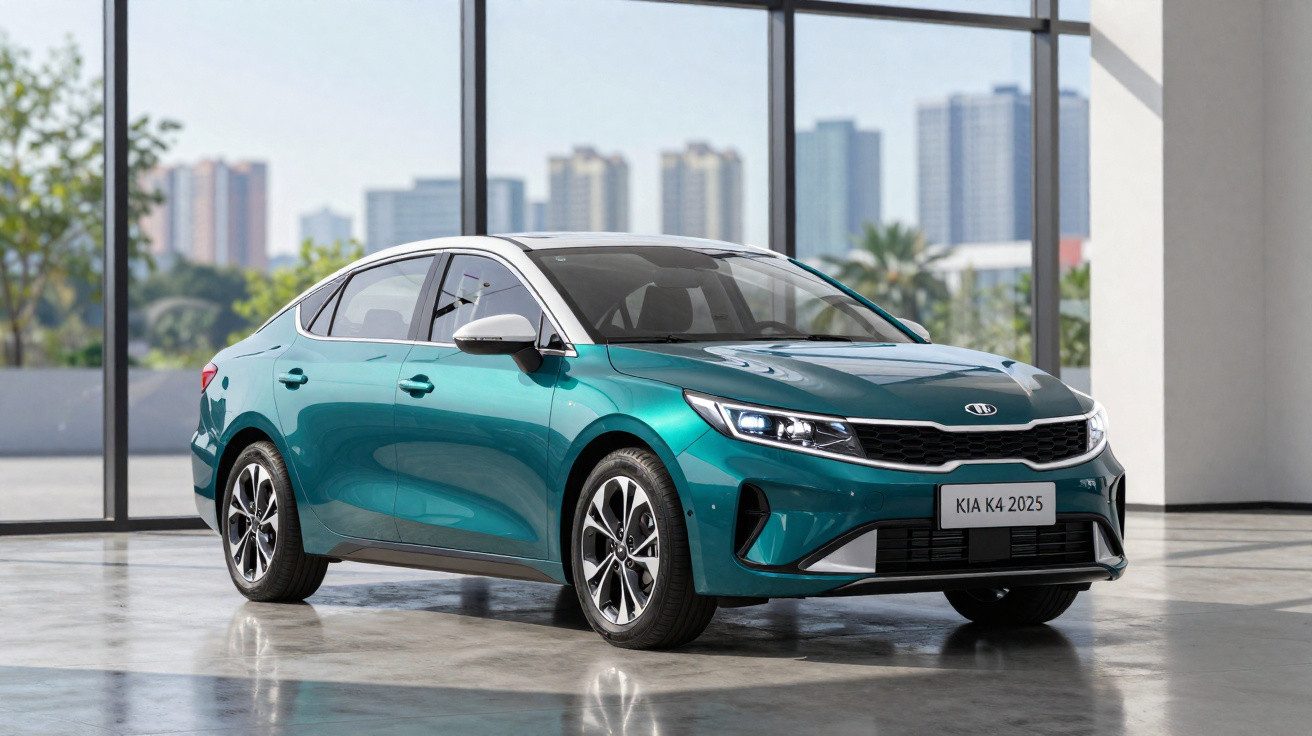
Some cars aim to impress with the numbers. Others rely on styling. The Kia K4 has a simpler, more successful ambition: to be good at what matters.
While almost the entire car industry seems determined to persuade us that the next car must be an SUV, electric, or ideally both at once, Kia has chosen a different route. The new K4 replaces the Ceed, doing so without plug-in hybrid or electric powertrains. It is petrol only.
At first, that may seem like an odd decision. After all, this is the same brand that has invested billions of euros in its EV line-up and is now one of the leading names in electric cars.
Yet Kia understands that, despite all the discussion around electrification, thousands of drivers still cover long distances, live in flats without charging facilities, or simply do not want to change technology. For those customers, a capable petrol car still makes complete sense.
That is exactly where the Kia K4 comes in. To find out whether backing such a traditionally powered model still makes sense, I spent several days behind the wheel of the 115 PS 1.0 T-GDi version with a dual-clutch automatic gearbox.
A family car that refuses to blend in
Over the past few years, Kia has moved away from making restrained, discreet-looking models and towards a design language that leaves no one indifferent, combining aggression and sportiness in rather appealing proportions. Low and wide, the Kia K4 is a strong example of that change.
The influence of the Opposites United philosophy can be seen from almost every angle of the bodywork. Its “Star Map” light signature, borrowed from the EV family, gives it a visual link to the brand's electric models, while the sharply defined surfaces and notably upright front end create a character of its own.
Its low height - just 1.44 metres - also helps maintain an elegant profile, far removed from the elevated stance now associated with almost every SUV.
Modern without making things complicated
It is a worrying trend within the motor industry: the more screens cars have, the less intuitive they seem to become.
Fortunately, Kia has not fully fallen into that trap. The K4 has a distinctly modern cabin dominated by displays, yet it still retains physical controls for the functions we genuinely use every day. It may sound like a minor detail, but a few miles behind the wheel are enough to show the difference it makes.
The climate controls remain straightforward to operate, the steering-wheel buttons are exactly where you expect them to be, and almost everything works intuitively. This is not a car that forces its driver to learn a new language.
The driving position also deserves praise. You sit relatively low, as you would in a conventional hatchback, which strengthens the connection with the car. Better still, the GT-Line seats in this version strike a good balance between comfort and lateral support.
In terms of quality, there are naturally some harder plastics in the lower areas of the cabin, which is entirely normal for this segment. In return, the surfaces you actually touch feel pleasantly upmarket, while the solid assembly confirms how far Kia has progressed in recent years.
Rear-seat room is also respectable: two adults can travel comfortably thanks to the generous wheelbase. However, the 328-litre boot means you may need to think twice about how many bags to pack for a trip.
Willing, but thirsty
The 115 PS produced by the 1.0 T-GDi three-cylinder engine are not especially striking on paper, but they are enough to move the K4 with pleasing ease.
The dual-clutch automatic gearbox deserves some of the credit. Its shifts are quick and smooth, and in most situations it keeps the engine within its ideal operating range.
There is one exception: Eco mode. In this setting, reducing fuel consumption clearly becomes the priority, and the dual-clutch gearbox adopts an overly conservative kind of autopilot. Downshifts take too long, the accelerator loses responsiveness, and the K4 becomes far too docile. The answer? Ignore this mode.
That is especially true because fuel economy remains unremarkable even when it is selected. On a mixed route, it was relatively easy to exceed 7.0 l/100 km, while in town 7.7 l/100 km appeared far too often for an engine of only one litre.
On the motorway, at a steady 120 km/h, the trip computer recorded between 5.5 and 6 l/100 km. That is more appealing, but still far from class-leading, particularly when you remember this is a small three-cylinder with a mild-hybrid system.
Take the Kia K4 through the bends
If the fuel consumption never truly impresses and the engine merely does its job, the chassis deserves unqualified praise. The K4 inspires confidence from the opening miles. The front end grips the tarmac well, the suspension keeps body movements effectively under control and, overall, there is a solidity normally associated only with cars from higher segments.
It is not a GTI in disguise. But neither is it a household appliance on wheels. As the corners begin to flow, there is something highly satisfying about the way this chassis works. It encourages you to carry a little more speed through each bend, communicates enough without ever compromising comfort, and achieves a balance that most SUVs simply cannot reproduce.
The steering also deserves recognition, particularly for its pleasing weight without becoming too heavy when manoeuvring.
Right in the middle of the market
Kia has positioned the K4 exactly where it should be. It does not aim to be the cheapest option in its segment, nor the most sophisticated. Instead, it seeks to offer a balanced package, bringing together build quality, generous equipment and one of the best warranties on the market.
The €35,000 asking price sits around the segment average, but with Kia's usual promotions it is possible to buy a K4 like this for only a little more than the cost of a B-SUV. In return, you get a car that is not only capable and well equipped, but also reminds you that driving does not have to be solely about getting from A to B.
For example, under the promotion running when this article was published, the Kia K4 is available for around €30,000.


Comments
No comments yet. Be the first to comment!
Leave a Comment