If true craftsmanship demands time, Eagle is a place in which time appears to have paused. In numerous respects, it is a time capsule: a celebration of trades and skills widely presumed to be disappearing, and a demonstration of exactly why they should endure. Its team includes masters of every aspect of car building, from panel beaters and metalworkers to painters and mechanics.
Ali Leeves and Eagle upholstery
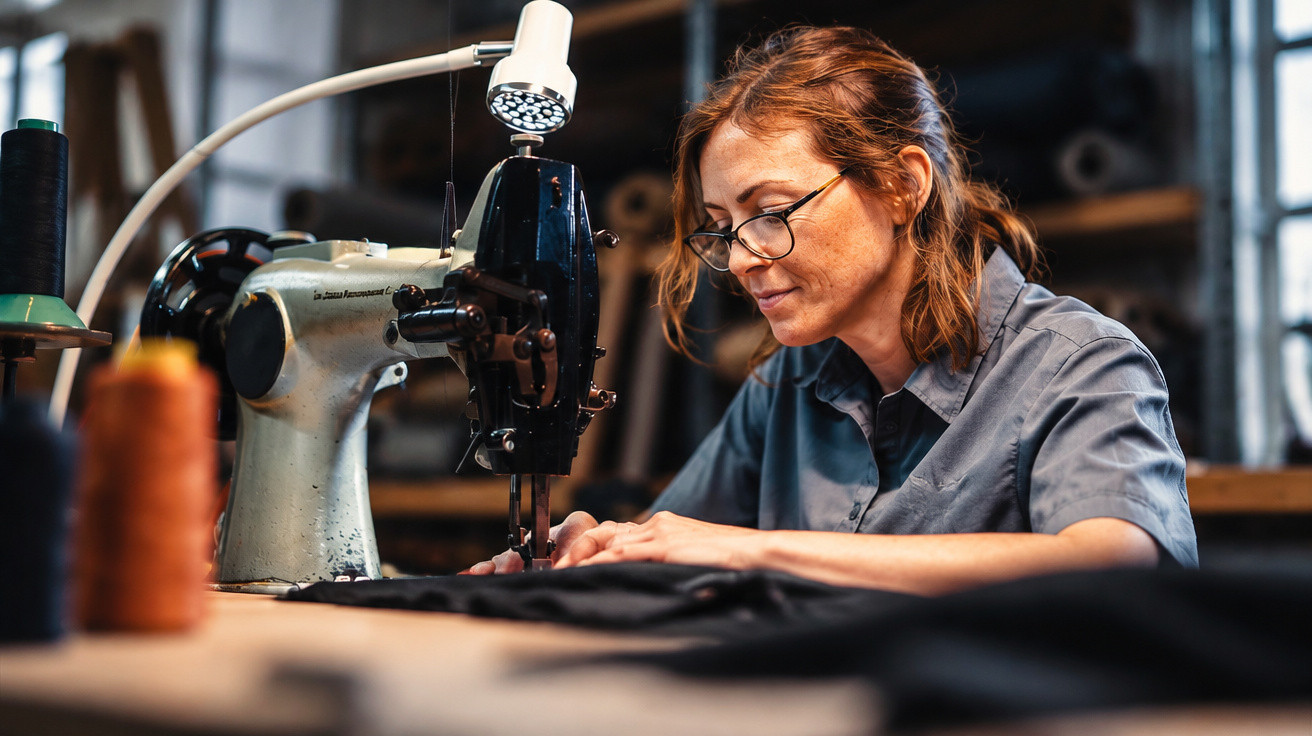
Ali Leeves arguably carries the greatest responsibility of them all. Based in the upholstery room, she completes the final stage of each project. Her work begins only after cars have received thousands of hours of painstaking attention, meaning a single slipped tool could mark the gleaming paintwork. Once she has finished, meanwhile, it is her leatherwork, textiles and stitching that an owner will see and touch every time they drive.
She gives no indication that the pressure troubles her. Following 18 years spent upholstering one-off furniture pieces, she joined Eagle four years ago. “I saw it advertised and thought ‘not really my bag’, but then I looked at the company, then came and had a look around and I was hooked.”
Photography: Huckleberry Mountain
Her responsibilities extend beyond trimming the complete cabin and boot - work that generally requires months for each car - and can include helping clients make their selections. “We had a customer who was absolutely adamant on the colours he wanted for his car and they were, um... quirky. We couldn’t quite necessarily see it, but we pulled it together by toning the colours and adding some fabric and made it work. I also suggested a little surprise, a paisley trimmed glovebox as it kind of went with the theme. And he loved it.”
The car currently under Ali’s care is Eagle’s most bespoke commission to date. It is a Lightweight GT that thoroughly justifies its title, with countless titanium parts and mother-of-pearl buttons inset into the dashboard, each surrounded by platinum. Quilting covers much of the cabin, including the Alcantara headlining, which is sewn using an old Singer sewing machine. “I tend to use it for the thicker fabrics and leather because it just glides through that bit easier. I oil her once a year, but she tells me. She gets a little bit cranky.
“I do really like doing headlining. One of the bits I miss from furniture upholstery is getting the pattern matching exactly right with a plaid or tartan where everything had to try to tally and match.”
The results are sensational – every Eagle interior TG has seen seems to glow with inner health and radiance
Hand-finished materials and demanding details
Which area is the worst to trim? “Urgh, doing the underdash, upside down in the footwell, trying to avoid glue falling on your face. Not my idea of fun. The biggest challenge is jobs where you only have one go at something. So, for example, gluing the neoprene onto the door sills – it’s got to be stretched properly, there can’t be any air bubbles. That’s tricky.” Ali admits that it did go wrong on one occasion, “and cleaning and stripping it all back was a nightmare”.
The workshop carries the scent of leather. Large hides hang from racks, fabric rolls sit beneath the worktops, and there are reels of thread alongside drawers packed with intriguing implements: punches, hammers, needles and scissors. “I can get quite miffed if people pick up scissors and I don’t know what they’re going to use them for. No, you are not picking up those and cutting paper with them when those are for leather or fabric. These are my favourite,” she says, lifting a pair with leather wrapped around one handle. “I think that just makes them fit me. They have different weights to them, and their own quirks.”
Nothing in the room appears new or cutting-edge. Most tools have a reassuring weight that makes it seem as though they direct the hand as much as the hand directs them. There is no laser cutter for the leather and no computer calculating the most efficient or economical way to use a hide. Yet nothing is wasted: offcuts are retained and sent to schools.
There are hundreds of separate pieces of trim, fabric, foam, leather, material and neoprene. Every one must be cut, prepared, trimmed, fitted, stitched and made - quite simply - perfect. It is all achieved by hand and by eye. The outcome is extraordinary: every Eagle interior Top Gear has encountered appears to radiate health and vitality from within.
Choosing an Eagle Low Drag specification
How would Ali specify her own car? “It would be a Low Drag, to me they are the most beautiful. Not easy to work on, especially in that pinched area behind the seats. And personally I don’t think you can go wrong with a classic navy exterior and mid-tan interior... but having said that, when something like this mixes it up you go, ‘actually...’.”
Only four cars annually leave this hushed, immaculately maintained yard, hidden in a remote part of the High Weald. “Do we realise how good we are? I think you take your own discipline for granted, but it blows my mind when I see what others do here. It’s like magic.”











Comments
No comments yet. Be the first to comment!
Leave a Comment