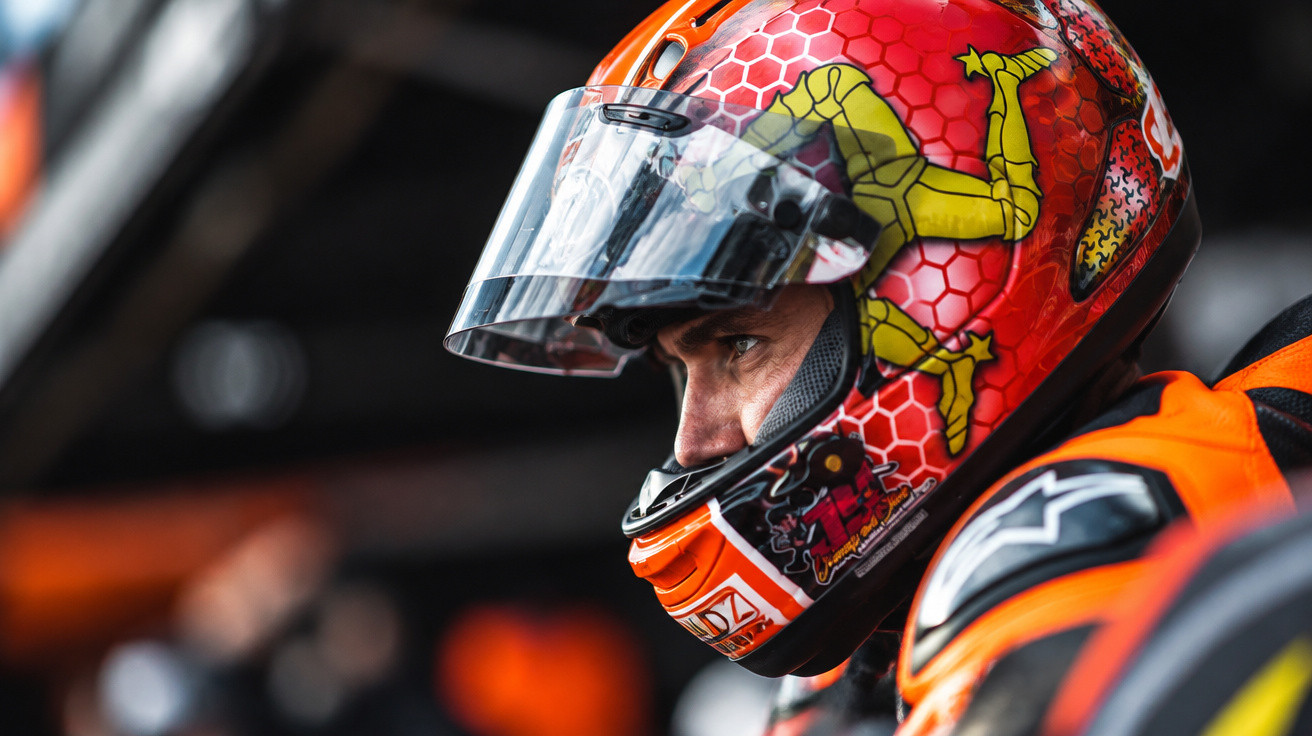
I am sprawled on a mattress in Ros’s front garden, with my arms resting across her garden wall. The first motorcycle has set off half a mile away. In roughly 13 seconds, before it reaches us, it must tackle the jump at St Ninian’s crossroads, the sharp descent of Bray Hill, the bend beside the traffic lights at the bottom and Ago’s Leap: an almost imperceptible crest, but one pronounced enough to send bikes into wheelies and jumps. They are travelling at 185mph.
With my nose cautiously edging beyond the pavement, I can see down towards the bend and hear each and every gear change. Every rider is making a screaming, flat-out upshift. I wait for the first machine to arrive. However many TT onboard videos you have seen, certain things cannot be anticipated. I can hear the bikes approaching, yet when they streak past this close, exploding by like fireworks, my reaction is wholly instinctive and primitive: it is a jump scare.
The Isle of Man TT is the most overwhelming spectator event I have experienced, far more so than F1 or a football ground. That comes from knowing what the riders are confronting. I look at the roadside furniture - an unforgiving thicket of lamp posts, traffic lights, driveways, kerbs and stone walls, all hard, sharp-edged and unyielding - and my mind says 30mph, not 185mph. The mismatch between the speed and the visceral proximity makes what I am witnessing difficult to process.
Photography: Huckleberry Mountain
Now consider what it is like for the men and women riding the bikes: 168kg machines with more than 250bhp, delivering power-to-weight ratios that would embarrass an F1 car. Consider the nerve, ability and bravery needed to take on this 60.72km road circuit, then to learn it so thoroughly that every drain cover, pothole, camber change and crosswind point is known. All the while, riders must accept hazards beyond their control: a falling branch, a wandering rabbit or mechanical failure. No other race in the world exposes competitors to such immediate danger of death or severe injury. Equally, no race does more to reduce those dangers through outstanding emergency treatment and support.
At the start line, the marshal places a hand on each rider’s shoulder before they depart. It is a reassuring, paternal gesture, made before the light turns green and the gladiators launch into their arena. “There’s nothing quite like this course, or this event,” Peter Hickman told me. “For us it’s the peak of what we get to do, the adrenaline rush here is like no other.”
Peter Hickman, the lap-record holder, prepares
His existing record is 16:36.115, at an average of 136.358mph... “But for the first two thirds of the lap until we get to Ramsey, the average is up over 150mph.” A 140mph crash in practice this year rules him out of contention.
Ros’s garden
Spectating is not entirely unregulated, however. Certain locations are strictly off limits, while more than 520 marshals provide line-of-sight cover across the full course.
Isle of Man TT nerve centre
More than a dozen people operate the race from the control tower on Glencrutchery Road in Douglas. Their roles cover everything from co-ordinating with the emergency services and supporting the clerk of the course to incident officers and sector controllers. Screens display live camera footage and filming links. Every support car, race bike, sidecar and medical vehicle used in the event carries live-feed GPS.
We are now able to bring the whole hospital, the resuscitation team, the emergency theatre, to the patient’s side
Sidecar
There are four motorcycle classes but only one sidecar category, although the machines may use anything from a 600cc four-cylinder engine to a 900cc twin. Ryan and Callum Crowe set a new lap record this year, averaging 121.021mph.
Approaching Hillberry Corner
This is among the most intense viewing points: only a low wall divides spectators from bikes passing almost within arm’s reach at close to 200mph.
James Mylchreest
He is the fourth generation of his family to drive TT support cars, giving them more than 100 years of involvement with the race. BMW is now the vehicle supplier, supplying course cars, medical vehicles and rapid motorcycles for travelling marshals.
Road racing is not awash with money
Beyond the leading handful of teams, riders depend on local sponsorship and even cash contributions simply to compete.
Jumping bike
A bike takes to the air over Ago’s Leap. “Any time there’s a junction with another road, you’ll get a jump,” says Hickman. “The tiny changes of angle and camber are enough to lift wheels or pop the whole bike into the air when we’re going so fast.”
Medics
It is easy to assume that the TT, motorcycle road racing’s final stronghold, takes a casual approach to safety. It does not. Instead, it operates at the forefront of medical capability. “If you look at most circuits, even F1 or Moto GP, they will stabilise [the patient] and evacuate,” says the TT’s chief medical officer, Dr Gareth Davies. “But we are now able to bring the whole hospital, the resuscitation team, the emergency theatre, to the patient’s side and stop the dying process at that point.”
The TT’s MRMS (Manx Roadracing Medical Services) trauma team comprises 80 paramedics, doctors, nurses and ambulance technicians, seven fully equipped BMW X5s, at least two helicopters and a dozen rapid-response medibikes. Its target is to reach every accident within two to three minutes. A historical crash-data heat map helps the team anticipate where incidents may occur, and a research programme now monitors riders during the race.





Comments
No comments yet. Be the first to comment!
Leave a Comment