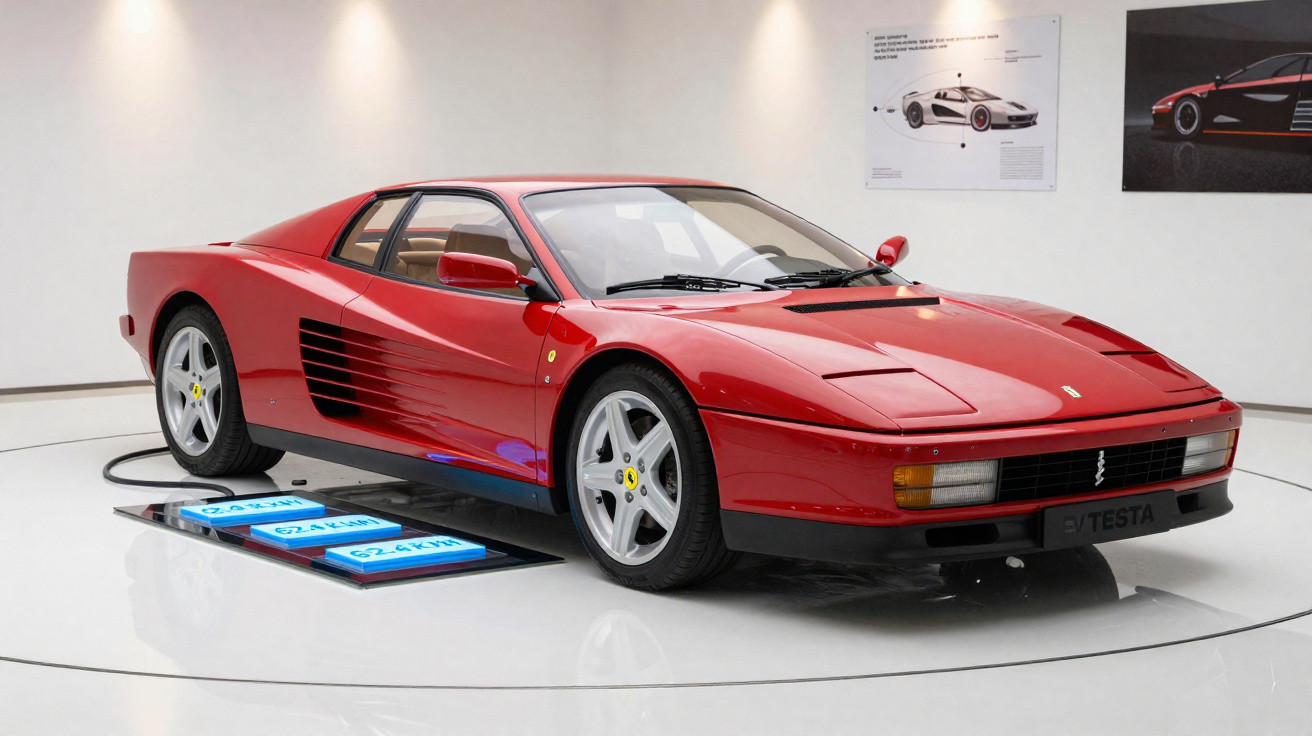
A symbol of the “mad” 1980s, the Ferrari Testarossa was not only an aspirational car for an entire generation; it remains an icon within the Maranello marque’s world today.
Much of its appeal is down to the naturally aspirated 4.9-litre V12 that powers it. If you have never heard this Italian unit, you should: it is a genuine symphony.
There is no need to say that discussing the Testarossa - and its imposing 12-cylinder engine - means entering sacred territory for petrolheads. For many, therefore, imagining it without that engine is an impossible exercise.
Yet there is always someone who sees things differently, and the Testarossa shown here has just undergone the greatest transformation of its life: its V12 has been removed and replaced with an electric motor from a Tesla.
The conversion was carried out by Electric Classic Cars, a British company specialising in turning combustion-engined classic cars into electric vehicles. The reasoning behind this sacrilege is the challenging and costly upkeep required by a classic such as the Testarossa.
Ferrari Testarossa electric conversion
More than 500 hp
We do not know precisely which Tesla served as the donor car, but the various episodes published on Electric Classic Cars’ YouTube channel, which document the conversion, reveal that the electric motor produces 400 kW (around 544 hp) of maximum power and 600 Nm of peak torque.
These are striking figures, particularly against the 390 hp and 480 Nm delivered by the original V12. In standard form, the Testarossa reached a top speed of 290 km/h and accelerated from 0 to 100 km/h in 5.8 seconds.
Battery layout and weight distribution
The effect this conversion has had on this “Prancing Horse’s” performance is unknown, as is its electric range between charges. What is known is that it uses a 62.4 kWh battery pack.
In total, this Testarossa - sorry, Teslarossa - has three battery packs: one 10.4 kWh unit beneath the front bonnet; another 10.4 kWh unit in the centre, where the fuel tank would normally sit; and a third, main 41.6 kWh pack behind the seats.
All three batteries, along with the electric power unit, have been positioned as low as possible so they do not compromise the centre of gravity of this electric Ferrari Testarossa. According to the British company, it now has better weight distribution than it did when it left Maranello.
There is no doubt that this conversion makes this electric Ferrari Testarossa easier and cheaper to use. Even so, it remains both heresy and sacrilege.
Source: Electric Classic Cars


Comments
No comments yet. Be the first to comment!
Leave a Comment