So, what have we got here?
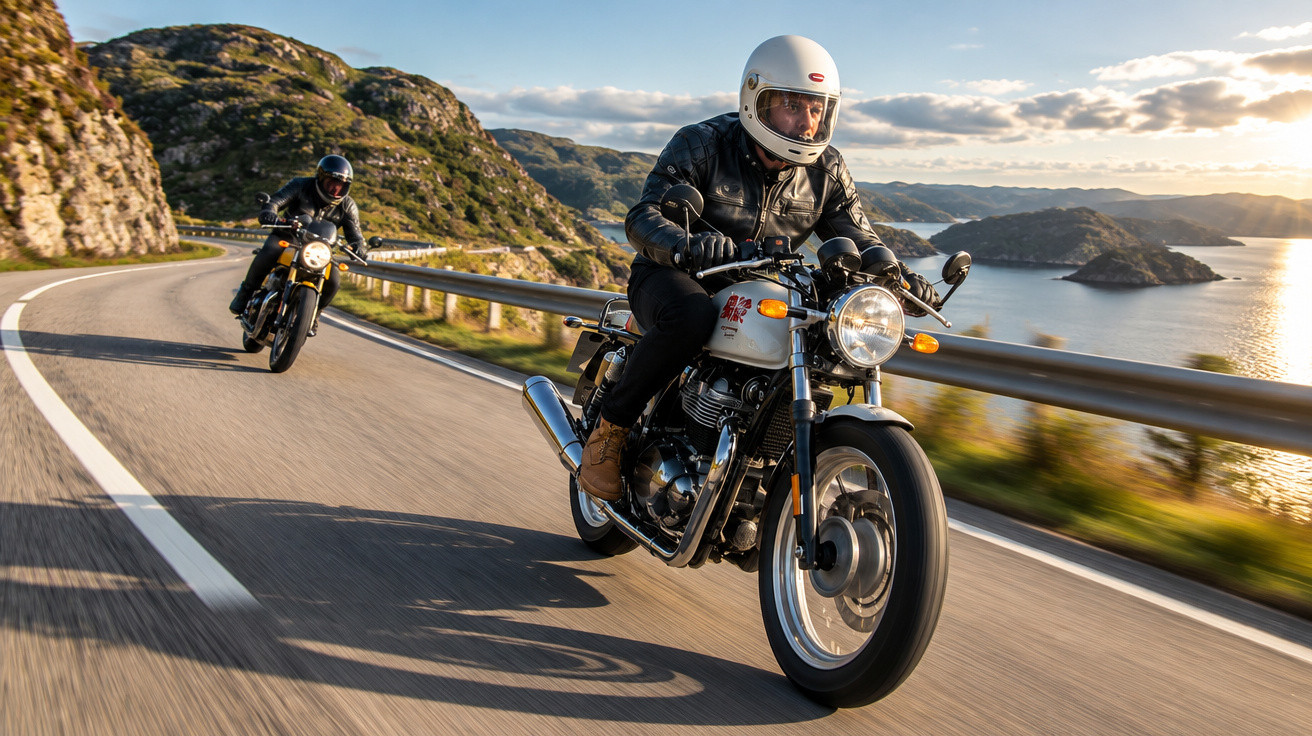
The Royal Enfield Continental GT 650 is one of the two 650 twins Royal Enfield has launched to challenge motorcycles such as the Triumph Street Cup and Kawasaki W800. Its sibling is the Interceptor 650: a naked cruiser that channels doobielicious Sixties California with its distinctive teardrop fuel tank, quilted two-person seat and broad, braced handlebars. It is an attractive, unintimidating machine that has swept through the market, recently becoming the UK’s best-selling bike. The reason is simple: it delivers considerable value, with prices beginning at £5,700. That is an awful lot of motorcycle for less than six grand.
Royal Enfield Continental GT 650: what sets it apart?
How does the Continental GT differ?
Primarily, it is all about the appearance. In fact, that is virtually the entire difference. Mechanically, the Interceptor and Continental are almost identical. Each uses a completely new air-cooled 650 parallel-twin engine. Its power and torque figures are not enormous, but that is beside the point. At a time of absurd headline numbers, it is more than sufficient in every situation, and lets you make proper use of the engine. The key distinction is that the Continental is a café racer, intended to capture the character of the Fifties Continental GT 250.
Royal Enfield has swapped the wide bars for clip-ons, reshaped the tank, exchanged the bench seat for a solo unit - though a passenger seat can be specified if you want to carry a friend - and shifted the footrests rearwards. They are modest alterations, yet they transform both its visual appeal and its road manners. Rather than the Interceptor’s chin-up, shoulders-back posture, you are placed in a more purposeful riding position, encouraging you to work the bike harder.
Remarkably, though, it is no less comfortable than the Interceptor. Usually, a café racer would leave your wrists and hips screaming in pain. We covered more than 2,000 miles on one in under a fortnight without any problems. Royal Enfield, then, deserves a tip of the hat.
Royal Enfield heritage and the Continental GT
Hang on - who is Royal Enfield? It sounds rather regal.
Few marques evoke the appeal of old-school motorcycling as strongly as Royal Enfield. Having produced its first motorcycle in 1901, it is the oldest motorcycle brand to have remained continuously in production. Manufacturing moved from the UK to India in 1955 and has stayed there ever since; indeed, India has more than three million Royal Enfields. For the first time since 1970, Royal Enfield is also returning to a large twin-cylinder engine in an effort to attract a more international audience to its iconic name. That is where the Continental GT and Interceptor come in.
Right. So, what is it like to ride?
It is an absolute doddle. It is not excessively heavy, its controls are light and its seat is comfortable. You sit in an authoritative position without compromising access to the controls, so confidence arrives as soon as you start it. The exhaust note may initially disappoint, however. Still, there are now plenty of cans available to fix that.
The four-stroke, air- and oil-cooled parallel twin runs smoothly thanks to its 270-degree crank. With 47bhp and 32lb ft of torque, it responds from low revs and pulls cleanly and with purpose from 2,500rpm through the six-speed gearbox - a first for Royal Enfield. The top three ratios genuinely feel as if there is little between them, but that is not an issue. You still use every one, and doing so adds a sense of interaction and enjoyment that the car industry is gradually erasing. Power delivery remains beautifully linear right up to the redline at around 7,000rpm, although it sadly never develops a truly naughty soundtrack when pushed hard.
Continental GT 650 handling, brakes and tyres
Although Royal Enfield’s headquarters are in Chennai, both the Interceptor and Conti GT were developed at its new technology centre at Bruntingthorpe Aerodrome in the UK, the world-famous JLR car park. Even so, the suspension settings are very soft. India may have roads as riddled with potholes as ours, but UK riders generally encounter them at greater speeds. On the Interceptor, that means you can use all the suspension travel and frequently meet the bump stops.
Fortunately, the ByBre brakes are capable enough of scrubbing off speed and restoring control. Pirelli Phantom Sportcomp tyres offer more than enough grip for a bike of this kind, too, so you can begin shifting about on the seat and playing with the chassis. It is a genuinely entertaining little motorcycle.
I really like the way it looks.
We do as well - and apparently so does everybody else on the road. Wherever you stop, someone will come over for a conversation about it. “That’s a proper looking bike, mate. Sod all that sports stuff. When I think of bikes, I think of that!” is a familiar response at petrol stations. You will visit those fairly regularly, given the small 12.5-litre tank: roughly every 125 miles.
Its design is a classic one that leads your gaze around every detail. At first, the dominant tank grabs your attention. Your eyes then move to the large, polished 648cc engine beneath it, before following the old-fashioned twin exhausts down, round and out as they emerge at the rear in a V-shape. It is a straightforward, tidy and effective recipe, with a wonderfully timeless look.
It sounds like a bargain.
It certainly is. With a starting price of £5,700 - rising to a little over £6,000 if you want an upmarket finish or painted tank - it is highly competitive, substantially undercutting rivals from Triumph and Harley-Davidson. Granted, its hardware and electronics are not as premium as those fitted to competitors: you get ABS, and that is your lot, with everything else controlled by your right wrist. But that is all you need if you are not treating things too seriously.
What is more, there is no cheaper route into a properly made, brand-new, traditionally styled twin-cylinder motorcycle. You can spend the money left over endlessly customising it until your brain explodes, which is precisely what we would do.
Score: 9/10



Comments
No comments yet. Be the first to comment!
Leave a Comment