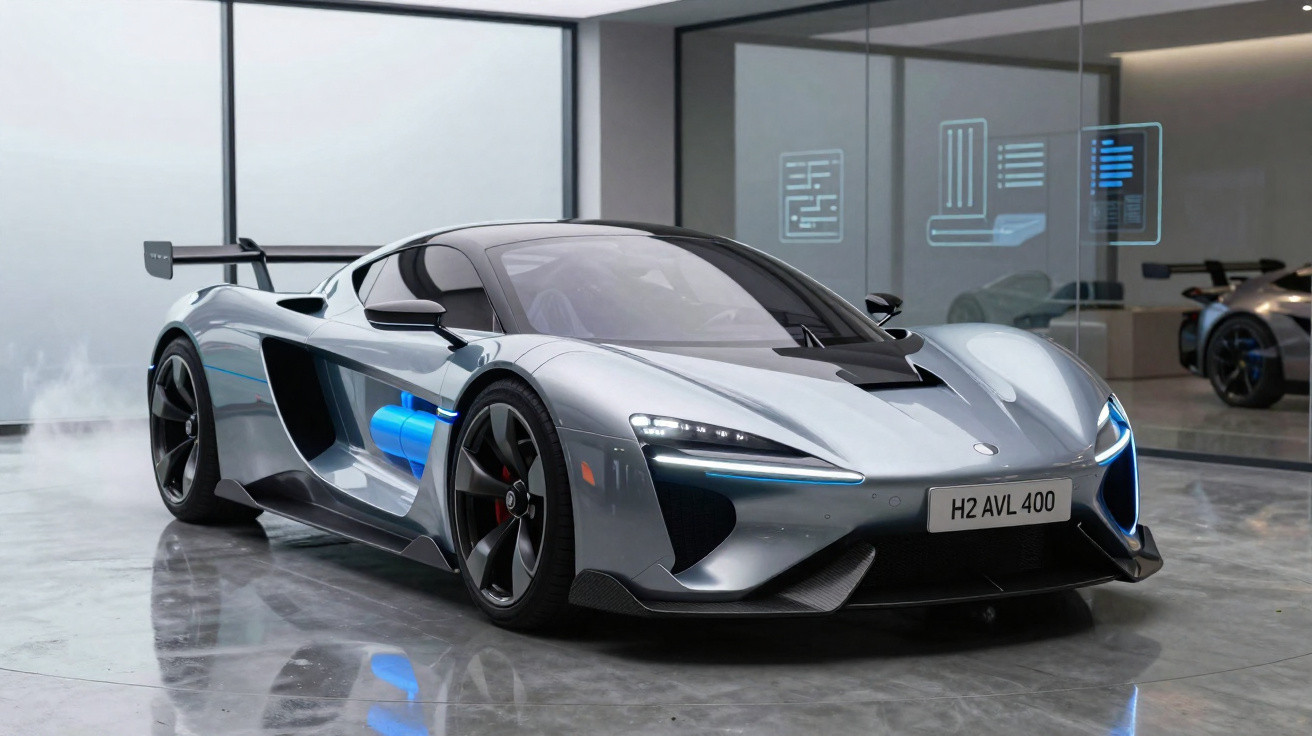
On 8 March 2024, motorsport and development company AVL Racetech announced an innovation that sounds like science fiction: a high-performance engine fundamentally powered by hydrogen and precisely injected water. It produces 400 PS and reaches up to 6,500 rpm, using a concept that promises the feel of an internal-combustion engine with substantially lower emissions. This immediately raises a question: have manufacturers and policymakers committed too early to battery electric cars alone?
How this new engine works
Strictly speaking, this is not a ‘water engine’, but a hydrogen combustion engine with water injection. The principle is straightforward: hydrogen supplies the fuel, while a system injects heated water into the combustion chamber. Together, these elements are intended to address several weaknesses associated with conventional combustion engines.
- Hydrogen provides the energy and burns without CO₂ originating from the fuel itself.
- Hot water delivers local cooling, steadies combustion and enables higher compression.
- Result: greater power, fewer harmful exhaust emissions and a lower risk of engine knock.
AVL Racetech says the combustion process is considerably more homogeneous. The more evenly the flame propagates through the cylinder, the more efficiently the engine can use its fuel. In principle, this resembles racing-engine technology, albeit with an entirely different energy source.
“With around 400 PS and 6,500 rpm, the new hydrogen engine clearly targets the performance level of conventional sports-car combustion engines – while aiming to run far more cleanly.”
The turbopump: the heart of AVL Racetech’s technology
At the centre of the system is the so-called turbopump. It ensures that the hydrogen and water enter the engine at the correct pressure and precisely the right moment. Although that may sound highly technical, it is crucial in real-world use: the engine can remain stable, efficient and durable only when flow, temperature and injection quantity are all accurately controlled.
This is precisely where AVL Racetech’s engineers are concentrating their work. The turbopump is designed to:
- meter the hydrogen precisely;
- heat and inject the water appropriately;
- compensate for pressure fluctuations arising under high loads.
The result is effectively a hybrid of a conventional combustion engine, water injection and modern hydrogen technology. The aim is substantially lower lifecycle CO₂ than a petrol engine, alongside significantly lower raw-material requirements than a large battery.
Is it genuinely new? Earlier attempts at the technology
The idea has not appeared from nowhere. Manufacturers such as BMW experimented with water injection years ago, including its use to increase the output of turbocharged engines. Hydrogen combustion engines have also repeatedly attracted attention, but policymakers have generally pushed them aside in favour of fuel cells and, later, battery electric vehicles.
AVL Racetech’s innovation lies in combining these approaches:
| Approach | Core idea | Weaknesses / obstacles |
|---|---|---|
| Water injection in petrol engines | More power, reduced thermal stress | Hardly any environmental advantage; primarily a tuning tool |
| Hydrogen fuel cell | Electricity generated from hydrogen, with an electric motor providing drive | Expensive, complex, requires platinum, vulnerable to cold-weather issues |
| AVL’s new hydrogen combustion engine | Direct combustion of H₂ plus water injection | No mass-production experience yet; H₂ infrastructure is lacking |
It is this fusion of familiar components in a high-performance set-up that makes the approach so significant. Suddenly, the cards in the powertrain race are being dealt again.
A threat to the electric car or merely a niche project?
The key question is whether an engine of this kind could genuinely displace electric cars. For now, the honest answer is: only in certain circumstances.
“Whether battery electric vehicles truly come under pressure depends less on the technology than on policy, infrastructure and costs.”
Where the new engine could have an advantage
At first glance, the hydrogen combustion engine looks attractive in several areas:
- Rapid refuelling: hydrogen can be replenished in minutes, much like petrol.
- Weight: there is no multi-tonne battery pack, which matters particularly for sports cars and commercial vehicles.
- Emotion: sound, engine speed and gearshift sensations – many of the things enthusiasts miss in electric cars.
- Raw materials: less dependence on lithium, nickel and cobalt.
Such an engine could be an alternative to batteries in motorsport, heavy lorries and long-distance transport in particular. In these applications, electric drivetrains reach limits in terms of range, charging times or weight.
Where battery electric cars remain strong
On the other hand, there are clear facts in favour of battery electric vehicles:
- Charging-point networks are expanding more quickly than hydrogen filling stations in many countries.
- Electricity is generally cheaper than hydrogen, especially where H₂ is ‘grey’ hydrogen produced from natural gas.
- Electric cars are exceptionally efficient, with little energy lost as heat.
- Major manufacturers have already invested billions in battery factories and vehicle platforms.
For a conventional commute of 30 kilometres a day, an electric car remains difficult to beat. The new engine is instead aimed at applications in which battery concepts begin to struggle.
How clean is a hydrogen engine in reality?
The engine itself produces no CO₂ from its fuel during operation: burning pure hydrogen primarily creates water vapour. However, its true climate impact depends on how the hydrogen is produced.
- Green hydrogen: produced by electrolysis using renewable electricity; highly climate-friendly.
- Grey hydrogen: made from natural gas, with a high CO₂ burden upstream.
- Blue hydrogen: produced with carbon capture; still controversial and expensive.
There is another factor: every stage from electricity to hydrogen and back to propulsion consumes efficiency. A battery electric car uses renewable electricity more directly, whereas a hydrogen combustion engine requires additional conversion steps. Climate performance is therefore determined not only at the exhaust pipe, but across the whole chain – from wind turbine to wheel.
What AVL Racetech must test next
AVL Racetech’s engine remains a technological preliminary stage rather than a production-ready solution. Long-term testing will be decisive. Among the questions that need answering are:
- What is the real efficiency across several load ranges?
- Which exhaust emissions actually occur, including nitrogen oxides (NOx)?
- What does wear look like under continuous high load, especially for valves and pistons?
- Can the engine be integrated into current platforms without developing everything from scratch?
- How expensive is the entire system compared with electric drivetrains and diesel?
Only once these issues have been resolved will it become clear whether manufacturers are prepared to change direction seriously, or whether they will use the engine solely as a motorsport flagship project.
What this development could mean for motorists
For many people, one question matters most: should they change their buying decisions? In the short term, no. The new engine is more a signal that the powertrain race has not yet been decided.
“Anyone buying an electric car today is choosing a technology that has long become part of everyday life. The hydrogen engine is more a glimpse of possible future scenarios.”
Three groups are likely to find it especially interesting:
- Sports-car enthusiasts who struggle with the silent electric world.
- Hauliers and fleet operators focused on range and refuelling time.
- Countries with substantial surplus renewable electricity that could convert it into hydrogen.
For these groups, a robust hydrogen combustion engine could become an interesting option alongside fuel cells and batteries – particularly if existing engine plants can be converted rather than shut down completely.
Key terms to understand
A great deal of terminology surrounds this subject, and it can easily become confused. Here is a quick guide to three central terms:
- Hydrogen combustion engine: an engine that burns hydrogen in the cylinder as petrol is burned, but requires different injection and ignition systems.
- Fuel cell: converts hydrogen chemically into electricity, which powers an electric motor, and operates very quietly.
- Water injection: a technology that injects water into the intake system or cylinder to lower temperatures and increase power or improve efficiency.
AVL Racetech’s approach partly combines these elements for a clear objective: higher output with lower emissions, without entirely abandoning the familiar driving experience of conventional engines.
How far this idea can go will now depend on real-world test mileage, political decisions and the creation of viable hydrogen infrastructure. One thing is certain: the new engine challenges the apparently firmly established dominance of battery electric cars and adds fresh fuel to the debate over the powertrain of the future.




Comments
No comments yet. Be the first to comment!
Leave a Comment