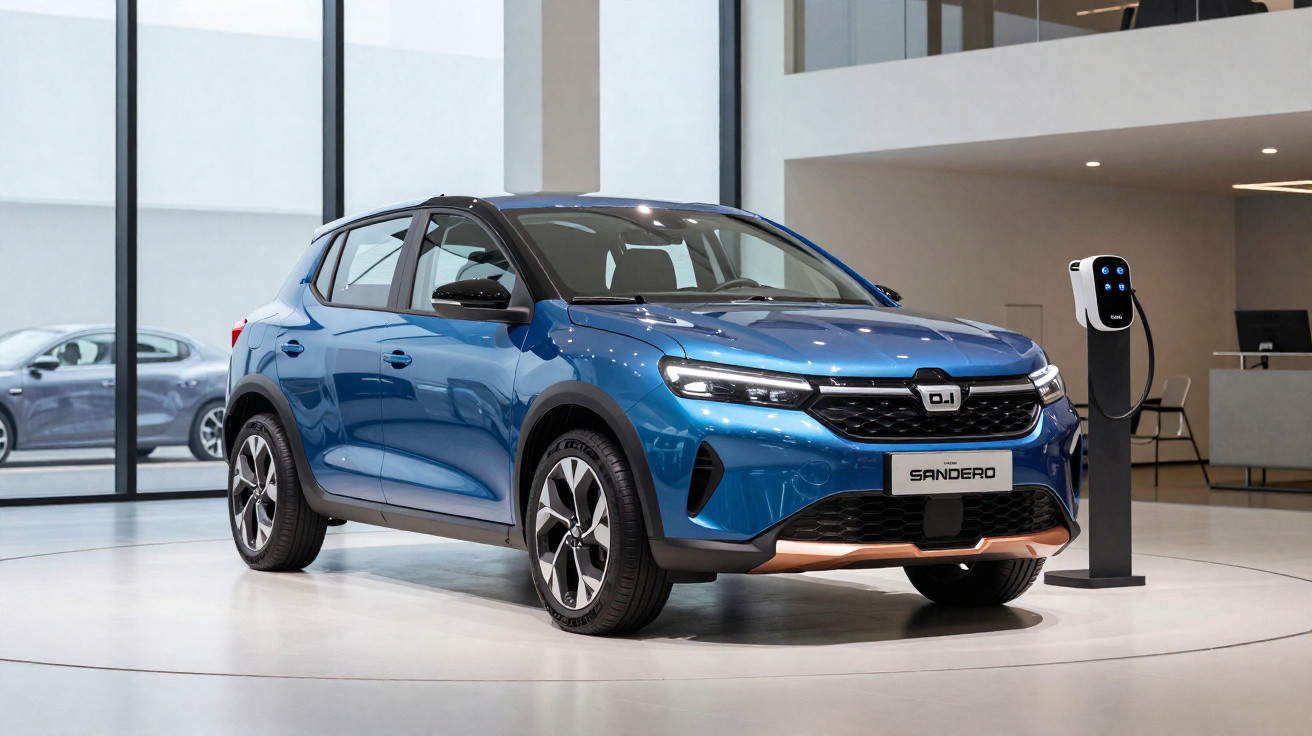
The enduring Romanian favourite is approaching a turning point: Dacia’s successful Sandero must reinvent itself for the electric age.
For years, the Dacia Sandero has been something of an unsung hero in European registration figures. While manufacturers such as Volkswagen, Renault and Stellantis pour resources into costly electric-vehicle projects, Dacia continues to sell its affordable supermini in five-figure volumes almost effortlessly. Renault’s corporate restructuring and new future strategy, however, are putting the previously straightforward formula of “a lot of car for little money” to the test.
Renault’s FutuREady plan: Dacia must become more electric
Renault, Dacia’s parent company, has set out clear requirements through its “FutuREady” strategy package. Dacia, a brand previously defined chiefly by value and durability, is expected to electrify its range far more extensively. At present, its only fully electric model is the Spring city car.
“By 2030, Dacia intends to launch three additional electric models, substantially expanding its battery-electric line-up.”
At the same time, the company does not intend to eliminate everything associated with combustion engines overnight. Instead, the brand is deliberately pursuing an intermediate route aimed particularly at value-conscious customers who are not yet comfortable switching to a fully electric car.
Multi-energy rather than compulsory electric power
Dacia is adopting a modular approach to its powertrains. The planned mix includes:
- petrol engines for conventional buyers seeking the lowest possible costs
- Eco-G versions using liquefied petroleum gas (LPG), promising lower running costs and reduced CO₂ emissions
- hybrid powertrains that combine an internal-combustion engine with an electric motor
- further fully electric cars in the lower price segments
Models such as the Jogger and Duster are already performing well with this multi-energy strategy. The new Striker crossover, measuring around 4.62 metres and positioned between an estate car and an SUV, is intended to advance the concept further while bridging the gap between the traditional compact class and crossovers.
What will happen to the Dacia Sandero?
The question of greatest interest to many readers is whether the Sandero will remain in the range at all. The answer is remarkably unambiguous.
“There is no internal discussion of discontinuing the Sandero – on the contrary, the model is regarded as an indispensable pillar of the brand.”
Across Europe, the supermini is Dacia’s best-selling model. In France, for example, the brand registered more than 6,500 vehicles in the first two months of the year, exceeding Renault’s Clio and R5 E-Tech over the same period. A model with that pulling power is not simply put to one side.
The current generation will continue for several years
Moreover, the existing model range has only recently received a facelift. Its front end, cabin and infotainment have been updated, while the driver-assistance systems have been refined. Manufacturers only make such changes when they expect several more years of production.
In its documentation, Dacia refers to a “next chapter” for the Sandero. Although that wording is intentionally open-ended, it clearly signals that the name will remain while the technology changes. An all-new generation is not imminent, but its outline is already beginning to emerge.
What might the next Dacia Sandero generation look like?
One point is clear: the next Sandero is set to offer a far broader choice of powertrains. The manufacturer has announced a “multi-energy” range, and this means more than simply adding another engine option.
“The future Sandero generation is expected to combine petrol, Eco-G and very probably a hybrid powertrain under one roof.”
This approach makes sense in view of Renault’s group targets. Renault has stated that Dacia aims to achieve around two thirds of its sales from electrified powertrains by 2030. That target is scarcely realistic without a high-volume, strongly demanded model such as the Sandero. A Sandero with hybrid technology is therefore viewed as almost certain.
Combustion power remains – with electric assistance
Rather than moving immediately to a fully electric supermini, Dacia is likely to follow the hybrid route. There are three reasons for this:
- Price: Battery-electric cars in the supermini segment are still difficult to offer at low prices. Integrating hybrid technology onto an existing platform is cheaper.
- Target group: Sandero buyers place considerable emphasis on purchase and running costs, rather than maximum range or high-tech gadgets.
- Infrastructure: Not every market where the Sandero performs strongly has a dense rapid-charging network.
A hybrid Sandero could cover many urban journeys with electrified driving, yet still be refuelled normally on longer trips. That would represent a tangible benefit for commuters on a limited budget.
New electric superminis are getting closer – will the Sandero face in-house competition?
Alongside the Sandero’s continued development, Dacia is pressing ahead with a new generation of small electric cars. The existing Spring mini EV is expected to be replaced in a few years. At the same time, company documents mention another fully electric supermini range designed to cover the lower end of the price scale.
This inevitably raises the question of whether a future electric supermini could make the Sandero partly redundant. Within the group, the expectation is instead that the models will have separate roles: the battery-electric city-car type will primarily serve urban transport, while the Sandero, with hybrid or Eco-G power, will appeal to buyers who regularly travel longer distances or lack access to home charging.
Positioning will be crucial
Whether this strategy succeeds will depend heavily on pricing. Dacia’s appeal rests on the straightforward message of “affordable, robust, simple”. If a future electric supermini gets too close to the Sandero, a price conflict could arise.
Industry observers therefore expect the electric city car to be particularly compact and pared back, while the Sandero remains positioned as a “classic” supermini with slightly more space, comfort and range. This could allow both models to coexist without directly cannibalising each other.
What does all this mean for buyers in Germany, Austria and Switzerland?
Anyone considering a Sandero today need not worry about buying an “outgoing model”. The current generation will continue to receive support, spare parts and updates for several years. The recent facelift reinforces that point.
It is nevertheless worth monitoring future developments. For high-mileage drivers or commuters in urban areas, an upcoming hybrid Sandero could prove more appealing than the current petrol-only and Eco-G versions. Lower consumption, improved emissions figures and potentially tax benefits all support electrified powertrains.
It is also important that Dacia is likely to remain true to its philosophy of using proven technology from Renault’s parts bin. This reduces development costs and the potential error rate. Buyers wanting an affordable car without too many early teething problems stand to benefit from precisely that approach.
A brief look at key terms
Autogas, sold by Dacia under the Eco-G name, is essentially liquefied petroleum gas (LPG). Its benefits are a lower fuel price and generally reduced CO₂ emissions. Many Sandero drivers particularly value this combination of economical mileage and respectable range.
Hybrid powertrains work differently: an electric motor assists the combustion engine when pulling away and accelerating. In towns and cities, many systems can travel short distances using electric power alone without requiring charging; the battery is replenished primarily through braking energy and engine operation. This type of technology suits a supermini that spends much of its time in urban traffic.
From today’s perspective, there are many indications that the Sandero name will not disappear from registration figures in the coming electric era – although it is likely to change significantly in both technical and strategic terms. Anyone keeping an eye on the affordable Romanian should follow Dacia’s next model announcements closely.

Comments
No comments yet. Be the first to comment!
Leave a Comment