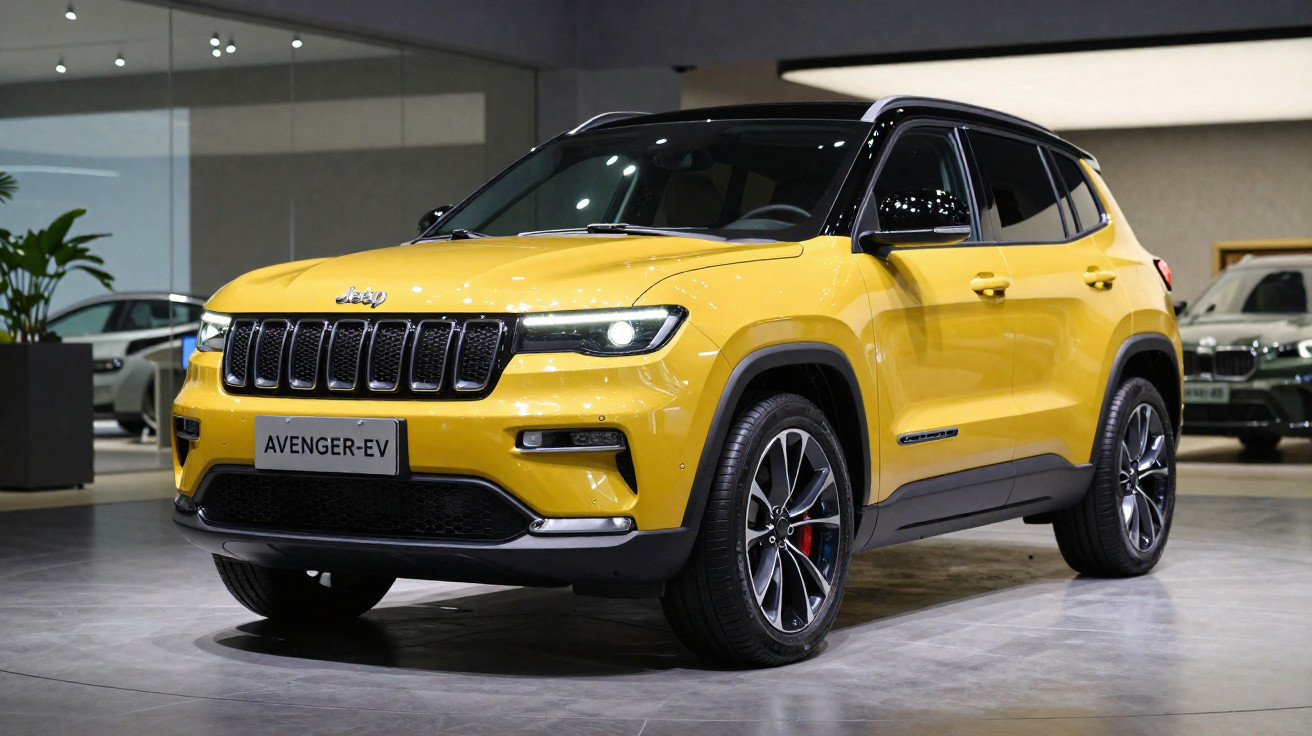
Do not be afraid to ‘push the boundaries’. The Jeep Avenger can venture beyond the city.
If you are considering buying a Jeep Avenger Electric, your taste in cars is probably similar to that of Italian buyers. That is neither praise nor criticism; it is simply a fact. This compact American SUV has become a genuine sales success in the country of pasta, pizza and Ferrari.
Sadly, this test will not be about Italian food or supercars, however much I might have liked it to be. Instead, the focus is on the Avenger Electric’s energy consumption and driving experience.
It was my companion for a week, and the following paragraphs explain what that experience was like. It is an unpretentious proposition, as several exterior details reveal. The image gallery shows exactly what I mean:
A closer look reveals a ladybird walking across the roof, while the black windscreen surround features a child using a telescope to look at the stars, positioned on the opposite corner of the windscreen.
At the rear, the window surround depicts a mountain to create a more adventurous atmosphere. That theme is reinforced by the seven-slot grille logo and two circles, recalling the front end of the historic Willys, the brand’s first model. This detail also appears in various places around the Avenger.
An American with a European accent
This B-segment SUV is an American vehicle developed in Europe for European buyers, and it is not even planned for sale in its home market. Jeep also says the Avenger is aimed at families living in cities, something that would only recently have been associated with the American brand.
The Jeep Avenger is bigger inside than out
The Jeep Avenger arrived on the market roughly a year ago. Since then, much has already been said and written about the American brand’s first fully electric model. One of the best examples is the video presented by Guilherme Costa during its international launch:
Even so, the excellent driving position and generous cabin space, both front and rear, deserve another mention. It is not class-leading, but it is far from cramped, and rear passengers have good headroom and legroom. That said, four occupants remain the ideal maximum.
The choice of most of the materials used inside is less impressive. Some areas, such as the centre console, would have benefited from fewer hard plastics.
Less usual is the placement of the gear selector controls on the centre console. This frees up room between the seats, allowing additional storage areas to be fitted. However, it was not particularly practical: during certain manoeuvres, it was almost always necessary to look at the controls to make sure the right setting was being selected.
Real-world range in the city
Real-world range is one of the main concerns for electric-car buyers, and there are two clearly different scenarios depending on how the vehicle is used. City driving is one thing; open-road driving is another.
As expected, urban driving is where it travels furthest while using the least energy, thanks to continual brake-energy regeneration. It is even possible to exceed the brand’s stated 400 km combined-cycle figure.
Naturally, that requires a light right foot, but here is a figure that suits disciplined yet relaxed urban use. Straight to the point: expect 380 km of range in the city without making much effort.
In other words, without pushing it hard but without treating the Stellantis M3 motor fitted to this model too gently either. It produces 115 kW (156 hp) and 260 Nm of torque. Drive goes exclusively to the front wheels, although several driving modes are available for tarmac and beyond.
On that subject, it is important to note that the available horsepower varies according to the selected driving mode. Eco provides 80 hp, Normal offers 106 hp, and the promised 156 hp is only available in Sport.
In Sand and Snow modes, only the way torque is delivered to the wheels is adjusted. There is no four-wheel drive, but this assistance allows the front-wheel-drive system to perform a few miracles. But if you do not have much faith, it is best not to leave the tarmac…
Real-world range on the road
The Jeep Avenger Electric is a good city companion. It measures just over four metres long and less than 1.8 m wide. It also weighs under 1600 kg, which is no bad thing… for an electric vehicle.
On the motorway, the Avenger’s electric system suggested that it was outside its preferred environment. There is enough power, certainly, but without regenerative braking assistance, consumption rises sharply.
On regular roads at a moderate pace, however, everything makes more sense, with regeneration demonstrating perfectly how it works. The 54 kWh battery (51 kWh usable) welcomes every bit of energy returned to it.
What was the Avenger’s final result?
For most of my journeys, the air conditioning remained on automatic mode, set to 21 °C, with “Normal” mode selected. After all, that is how the vast majority of Avengers will be driven.
At the end of the test, the recorded figure across my various journeys was 17.3 kWh/100 km, translating into real-world range of around 315 km across a mix of motorway, dual carriageway and urban driving.
In purely urban use, the Avenger achieved 14.1 kWh/100 km, although I was left with the impression that this figure could have been lowered further. I did not try. The aim was to use it normally, without excessive caution or overdoing the accelerator.
Plenty of equipment, but…
The car tested was in the mid-range Altitude trim, which has a starting price of €41,700. This particular example, however, also came with several optional extras and additional equipment packs.
With a more distinctive metallic paint finish (Lake Blue), a package of safety and driver-assistance equipment, and more comprehensive connectivity features, the final price of this Avenger rose to €47,150.
That is already a rather high price for an SUV in this segment. It is even more so after testing the Avenger’s ‘twin’, the Fiat 600e - also in a version that was not the best equipped - which cost €10,000 less than this one.
That is the price to pay for a distinctive image and a design that will surely make many buyers say “this is exactly what I want” without looking at the price. Drive one and you will understand why I mention that feeling.



Comments
No comments yet. Be the first to comment!
Leave a Comment