Renault’s resurgence has rested on skilfully delivered electric reinterpretations of familiar models, including the 4 and 5. Yet the Clio is not prepared to fade into the background, despite its survival having once looked far from certain. A combustion-powered supermini with a manual transmission still has a place, and Renault’s effective EV programme is, ironically, what has enabled it to remain.
The sales figures make a compelling case. In the 35 years since its debut, Renault has shifted almost 17 million Clios through five generations and across 120 countries, including 1.3 million in the UK. It leads European car sales over the first half of the year. Now comes generation six: predictably larger, equipped with intelligently updated, economical combustion powertrains, and loaded with the technology and connectivity buyers now regard as essential.
Renault Clio powertrains and platform
Built on the group’s CMF-B architecture, which is related to but separate from its EV platform, the new Clio will reach the UK with two powertrain choices, while European markets receive additional options. Headlining the range is a fresh 1.8-litre E-tech hybrid producing 158bhp. Its two small electric motors contribute 151lb ft of torque and draw power from a 1.4kWh battery. Together, these components cut emissions to 89g/km and achieve combined fuel economy of 72mpg. Renault says the hybrid should operate in e-mode for around 80 per cent of typical town driving. It also cites Formula One-derived expertise, with 15 possible combinations of the ICE and electric motor according to the driver’s demands. Horse Powertrain, Renault and Geely’s joint venture, supplies the engine.
At the bottom of the range sits a 1.2-litre three-cylinder unit delivering 114bhp, offered in the UK exclusively with a manual gearbox. So yes, somebody is still making one. (Europe can specify a six-speed dual-clutch automatic instead. That is presumably the version you will hire on holiday.) Steering response is quicker than on the previous model, while several drive modes arrive in the usual Renault manner.
Bigger, bolder Renault Clio design
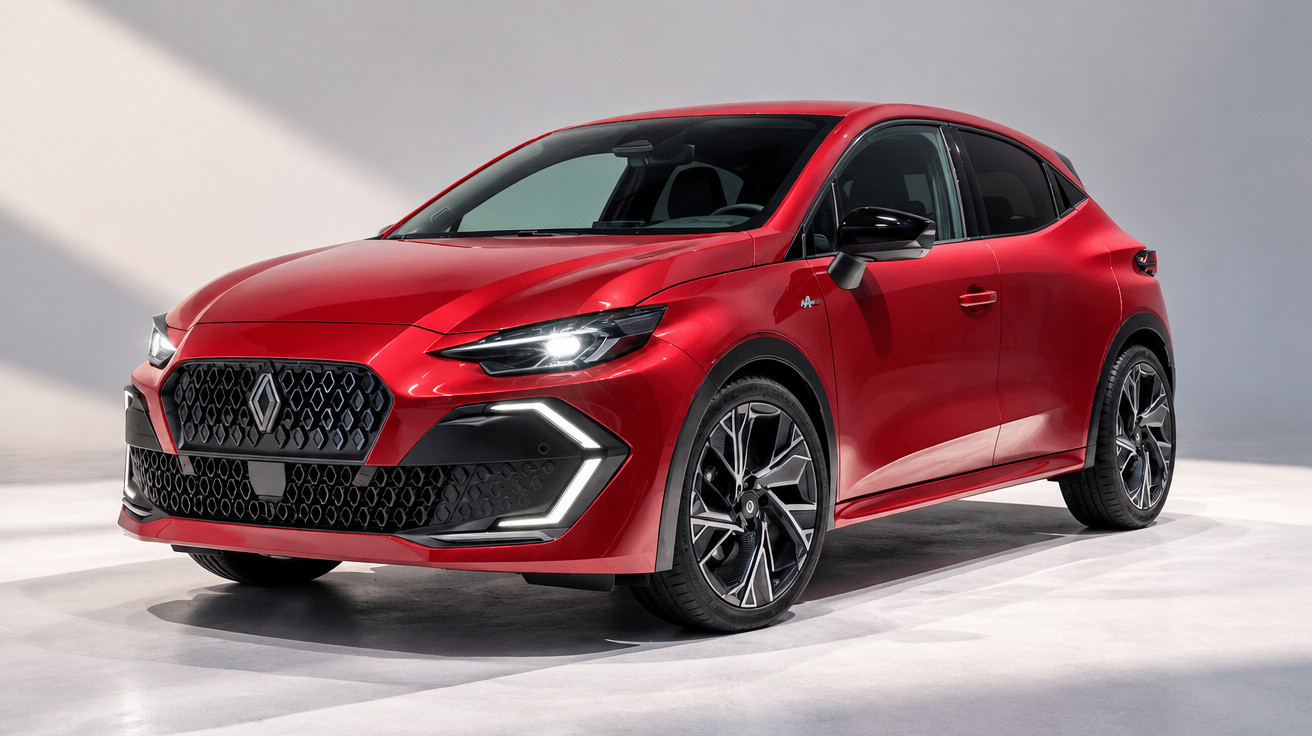
Do Renault’s post-modern retro tendencies, as seen with the 4 and 5, signal a radical reinvention of the Clio? Not really. The car has expanded, measuring 4.1m in length: 67mm more than its predecessor, as well as 39mm wider and 11mm taller. Its electric relatives can embrace cuteness; this sixth-generation Clio is more assertive and, as a result, less elegant than one might anticipate from a compact French car.
In our view, the nose is rather fussy, though it is at least neither anonymous nor shapeless. The profile has greater definition, and the rear three-quarter angle is more successful still. A neatly descending roofline and flush door handles create an almost coupé-like outline. We also appreciate the line running above the rear lamps and the bulge beneath them. Black wheel arches and distinctive 18-inch alloy wheels push the look towards sportiness, although no styling effort could bring it near our much-loved mid-Nineties Clio Williams, the hot-hatch benchmark. Seven paint colours will be offered from launch, with two shades of grey among them. It appears the 5 alone gets the vivid colour schemes. Renault Sport remains in operation, but there is no confirmation yet of a proper hot-hatch version of the new Clio.
Renault Clio interior technology and space
Renault’s Open R Link infotainment system combines two 10.1-inch displays and integrated Google services. That means Google Maps, Google Assistant voice control and Google Play, which provides access to more than 100 apps. Connectivity and technology are key strengths. Wireless Android Auto and Apple CarPlay are included, while upper trims add a wireless charging pad. Owners receive 2GB of complimentary data each month for three years, and the apps sit within the infotainment system, removing the need to depend on a phone.
This is a familiar Renault arrangement, although the Clio adopts a slightly more upmarket approach than its all-electric siblings. Fresh dashboard materials are joined by LED illumination selectable in 48 colours. Not long ago, this kind of ambient customisation was confined to considerably more expensive cars. The interior door cards also gain an appealing illuminated insert.
The ‘esprit alpine’ specification swaps cloth for Alcantara and adds a burnt-metal treatment. Recycled content makes up a greater proportion of the cabin, exceeding 85 per cent in the highest trim. Newly designed seats also focus heavily on sustainability and feature colour-matched contrast stitching. It does not come across as a budget car.
Choose Harman Kardon audio and five sound settings become available, created by French electronic-music pioneer Jean-Michel Jarre (a solo French equivalent of Kraftwerk – you will know Oxygène Pt.4 even if the name means nothing to you). The larger dimensions free up more cabin room, an area in which the new Clio clearly outperforms the 4 and 5 by seating five occupants comfortably. There is additional interior stowage, two front USB-C ports, wireless charging and a 12V socket at the rear. Boot capacity reaches 391 litres.
Driver assistance and UK arrival
According to whether you select Evolution, Techno or Esprit Alpine trim, the new model gains a wider suite of ADAS equipment, with as many as 29 features available. They include active driver assist with intelligent adaptive cruise control, reverse emergency braking and, a Renault first in Europe at least, emergency stop assist. The latter stops the car completely should its driver fall ill or become inactive. If that sounds like the automotive equivalent of the ick, the My Safety Switch control lets you deactivate two of as many as five ADAS functions. Naturally, this equipment is also part of the EU’s General Safety Regulation 2 (GSR2), which requires ever more sophisticated, and irritating, driver-assistance technology. An in-car camera watches for fatigue and distraction, supported by a safety coach and scoring system designed to promote safer driving. Renault is taking a swipe at Euro NCAP’s increasingly draconian oversight of the motor industry here, while placing some responsibility back with the driver.
The new Clio is not due in the UK until early 2027; do not overlook the expense and complexity of developing right-hand drive. It aims to occupy a distinct position alongside its more flamboyant electric relatives. Efficient combustion power and a manual ’box in an affordable small car? That established formula is not finished yet.




Comments
No comments yet. Be the first to comment!
Leave a Comment