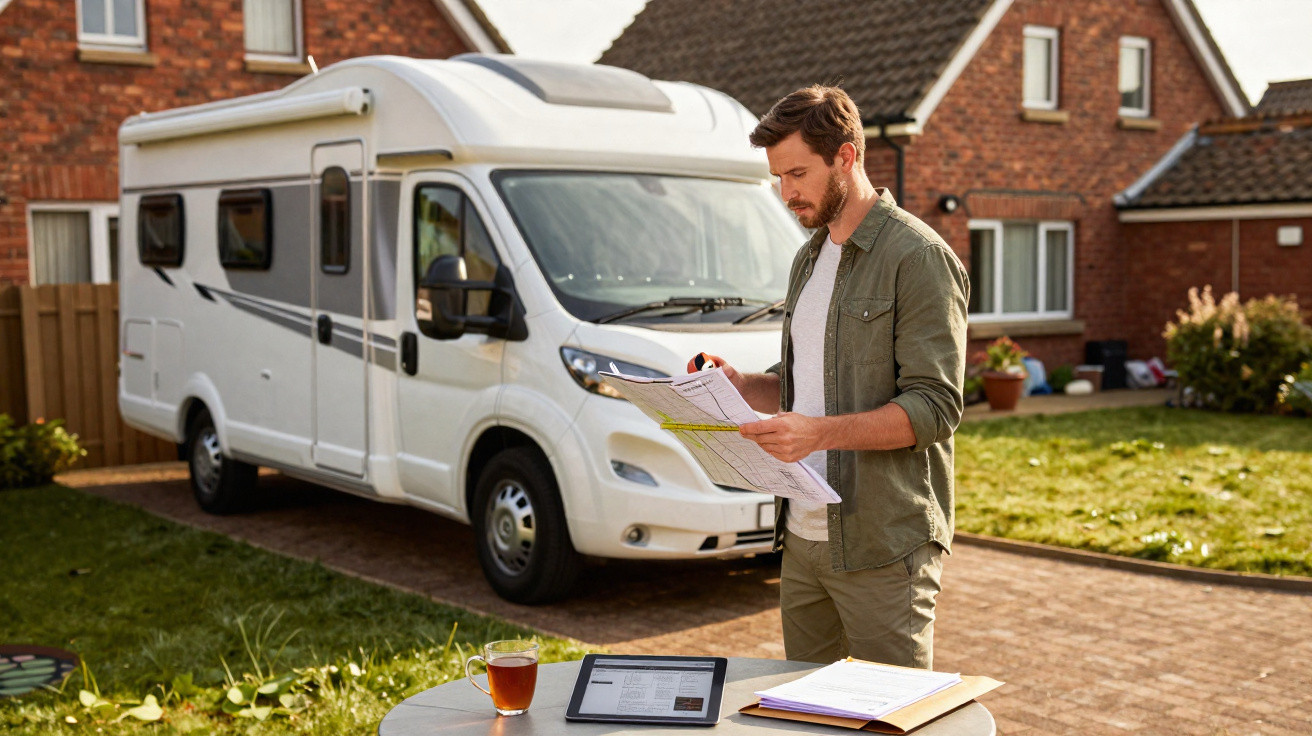
Every summer, Valérie parks her motorhome behind her parents’ house, beneath the shade of an old walnut tree. The plot is large, the family has Sunday lunch there, and nobody had ever objected to the white vehicle staying from June until September. After all, she thinks, it inconveniences no one: it is on private land, plugged into an outdoor socket and mainly used as an extra bedroom when the grandchildren visit. Then, during an ordinary visit concerning a hedge, a council officer stops in front of the motorhome and asks a question that catches her off guard: “You did submit the declaration, didn’t you?” Three summers later, Valérie finds out that family common sense is not always enough when planning rules are involved.
That morning, Valérie had merely intended to clean the motorhome windows before her sister arrived. Bought second-hand after her husband died, the vehicle has become something of a small home on wheels: people sleep in it, drink early-morning coffee there, and store the children’s inflatables inside once summer is over. On the family plot, she genuinely feels at home. We all know how a habit repeated without incident for years can start to feel self-evident. Yet the council officer calmly explains that the length of time it is set up can alter the nature of the issue. One overlooked formality, and the holiday season suddenly takes an administrative turn.
A motorhome on private land is not always exempt from planning rules
The first reaction is often identical: “It’s my land, so I can do what I want.” In everyday life, that seems perfectly reasonable, particularly when the motorhome is unobtrusive, neighbours have not complained and the land has belonged to the family for generations. However, a vehicle used as fixed accommodation, kept in place for a long period and connected to water or electricity may draw the attention of the local council. The matter is not solely about parking. It also concerns how the motorhome is actually used, how long it remains there and the rules set out in the local development plan, the well-known PLU that few people check before putting out the levelling blocks.
In Valérie’s case, the motorhome arrived at the end of May and left after the first October rains: nearly four months every year. The officer told her that, where a caravan or vehicle treated as leisure accommodation is concerned, a prior declaration may be required once it has been installed for more than three months in a year, depending on the precise circumstances. The distinction matters: a motorhome simply parked and ready to drive away will not be assessed in the same way as one that has been made stable, fitted with an awning and occupied every weekend. The vehicle’s name does not tell the whole story; what matters is how it is used on the site.
National rules govern the extended installation of caravans outside designated sites, but each local authority may impose further restrictions through its PLU or local planning map. Agricultural land, natural areas and places exposed to flood risk are subject to particularly close scrutiny. Let us be honest: hardly anyone reads planning regulations between packing suitcases and lighting the barbecue. Nevertheless, that is where the answer lies, sometimes in a technical line about parking mobile homes. The council officer did not necessarily visit Valérie to penalise her; they may also be flagging a situation before it turns into a dispute, especially if a neighbour eventually makes a report.
The step that may prevent an unpleasant surprise
To remove the uncertainty, Valérie began by arranging an appointment with her council’s planning department. She took photographs of the land, the motorhome’s usual dates of presence and a copy of the cadastral plan. It is a straightforward approach and far more reassuring than a quick online search, where very different situations are often confused. The officer can check the relevant zone, the intended parking period and any local prohibitions. If a prior declaration is needed, the application will generally use the appropriate form for works and installations requiring permission, before the council considers the request. The outcome always depends on the local authority and the layout of the site.
A common mistake is to count only the nights spent inside. From the administration’s perspective, however, the period for which the vehicle is installed can carry significant weight, even when no one sleeps in it every night. Valérie believed she was safe because the motorhome was occasionally driven to the market or to a garage, then returned to its usual spot. That short trip does not necessarily remove the appearance of a permanent installation, particularly when the connections, outdoor furniture and routines remain unchanged. It is better to describe the situation honestly to the council than to force it into a more convenient category. Officers encounter these cases regularly and value clear enquiries.
Once the appointment has been made, a few practical details can prevent needless trips back to the counter. The council officer who spoke to Valérie offered her one clear, non-judgemental observation:
“A motorhome can remain a vehicle, but when it becomes a small summer installation, we have to check the rules that apply to the land.”
- Check the land’s zoning in the PLU or local planning map;
- Record the motorhome’s actual arrival and departure dates;
- State whether it is connected to water, electricity or drainage;
- Ask in writing whether a prior declaration is required;
- Keep the council’s reply with the vehicle documents.
When a family routine meets planning law
Valérie had not been trying to bypass a rule. Every summer, she simply wanted to revive a small ritual that reminded her of holidays long ago: folding chairs, children climbing up and down the step, and the yellow light inside the vehicle at dinner time. The missed formality does not automatically mean she will have to give up keeping her motorhome on the family land. Above all, it requires her to view a now-familiar practice differently. Private land is never entirely outside the rules, even if the same family has owned it for fifty years.
Her story raises a question many property owners would rather put off: when does holiday parking become a permanent installation? The answer varies according to the location, the vehicle, the equipment in place and local planning rules. Some readers may discover that they are fully compliant; others may realise that a simple call to the planning department could spare them a recorded-delivery letter or a request to regularise the situation. It is often far more reassuring to ask before matters become awkward. Between the freedom to enjoy a garden and compliance with local rules, there can sometimes be much more room for dialogue than people imagine.
| Key point | Detail | Benefit for the reader |
|---|---|---|
| Installation period | Beyond three months a year, a prior declaration may be needed depending on the vehicle’s actual use and local rules. | Assess your own circumstances before the summer season begins. |
| Local authority rules | The PLU may restrict or prohibit installation in certain areas, particularly agricultural, natural or at-risk zones. | Avoid relying solely on the fact that the land is privately owned. |
| Good practice | Contact the planning department and explain the dates, connections and intended occupancy. | Obtain an appropriate response and retain written evidence of the enquiry. |
















Comments
No comments yet. Be the first to comment!
Leave a Comment