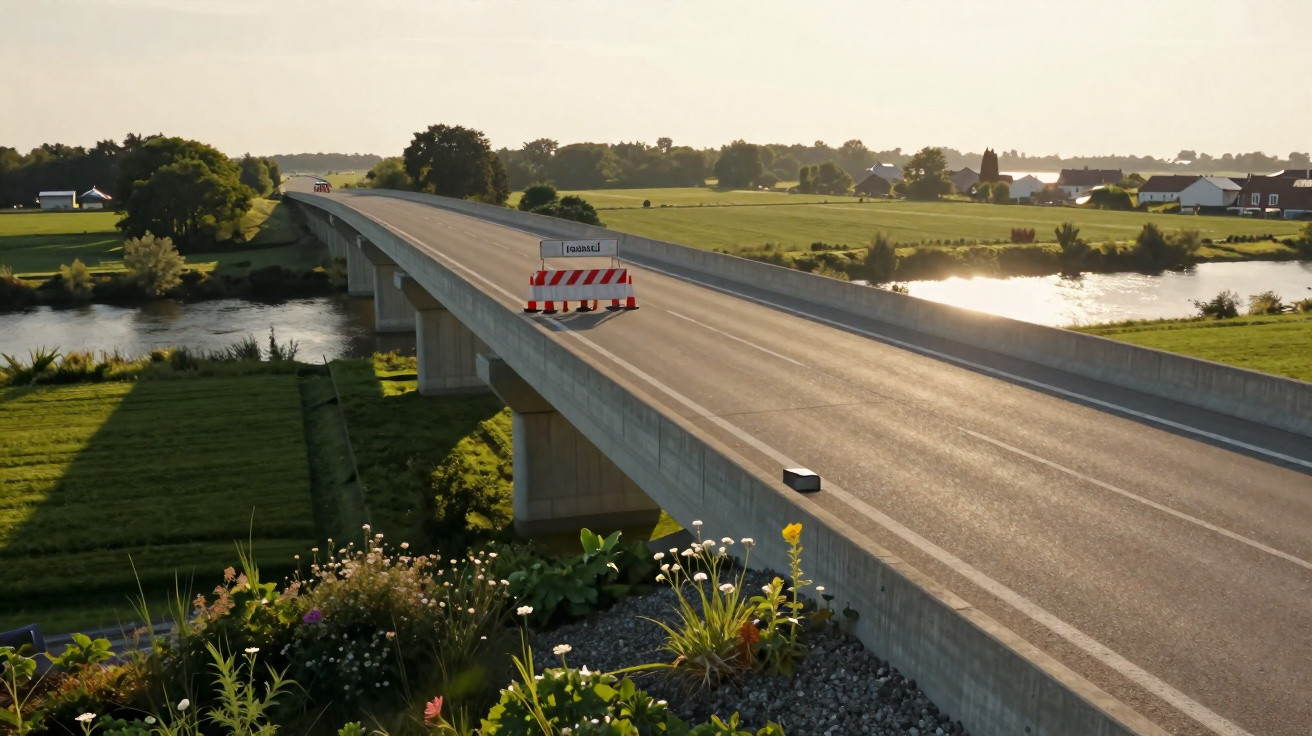
By the motorway, there are sometimes structures that catch the eye without truly being noticed. In Charente-Maritime, a viaduct completed in 2016 cuts across the landscape with its concrete piers, immaculate deck and the appearance of a road ready for the first major holiday getaway. Yet that departure never happened: nine years after construction ended, not a single car or lorry has crossed it. Local residents pass nearby, drivers spot it in the distance, and the same question arises almost automatically: how can a motorway viaduct be built without carrying one vehicle? The concrete offers no answer. Behind this slightly absurd sight lies a story of procedures, missing connections and public decisions that can sometimes move more slowly than cranes. It is a story that inevitably leaves people puzzled.
A brand-new viaduct, but a road that ends before it
From ground level, the structure does not look like an abandoned building site. It is standing, robust, maintained and almost too pristine for an installation finished in 2016. Its piers rise above the land, while the deck waits in silence, like a promise on hold. We all know the instinct when we see new infrastructure: we naturally assume it is already in use, whether it is a school, roundabout or dual carriageway. Here, that assumption quickly falls apart. The viaduct was indeed completed, but the access routes required to open it to traffic have never allowed vehicles to use it.
Nine years without tyres, braking marks or morning queues of lorries is striking, because a motorway viaduct is designed to withstand precisely that. Such a structure involves surveys, materials, months of construction and the substantial involvement of specialist firms. In Charente-Maritime, the contrast between the conspicuous scale of the build and its lack of use is particularly striking for residents. The viaduct exists, but its route does not really exist. Laying a carriageway above a valley or another road is not enough to create a working connection.
The reason lies in elements that maps do not always show: an engineering structure is only one link in the chain. Before it can open, it also needs slip roads, approach routes, safe connections, technical approvals and, in some cases, the resolution of legal disputes or environmental procedures. Road schemes rarely progress as a single unit; one section may be built while another remains stalled on paper. Let us be honest: hardly anyone spends every day reading administrative files and prefectural orders. Yet these documents are often where the very practical future of a bridge or viaduct is decided.
Why can public infrastructure remain unused for so long?
To make sense of such a situation, the first step is to distinguish construction from opening. A viaduct may be technically complete while the wider road project is still not ready to receive traffic. Local authorities, state departments and concession holders must then deal with different timetables, revised budgets, additional studies and regulatory obligations. For a resident seeking answers, the most useful approach is to consult local council resolutions, public inquiries and meeting reports. These records are less spectacular than an aerial photograph, but they often reveal exactly what is still missing.
The common mistake would be to dismiss the matter as simple waste, even if public anger is understandable. Unused infrastructure immediately creates the impression of a forgotten scheme, or even money thrown into the landscape. The reality may be more complicated: a delayed connection, changing traffic requirements or an awaited authorisation can be enough to postpone opening for years. That does not remove the questions around public money or the original planning. However, before blaming one person or body, the full decision-making chain must be examined, from the earliest surveys to the access routes that never followed.
This viaduct highlights an obvious point that is easily forgotten when a structure appears complete: the final part of a project can sometimes be the hardest to finish. Residents therefore have good reason to request a clear timetable, accessible explanations and public monitoring of the commitments made.
“An engineering structure is useful only when it is connected to a real, safe and authorised route.”
- The completion date: it does not automatically mean the structure will enter service straight away.
- Connections: without a completed slip road or access route, the viaduct remains isolated.
- Procedures: environmental, land and safety requirements can slow a scheme for a long time.
- Maintenance costs: even when closed to traffic, a structure still requires inspection.
The quiet symbol of a project that never found its road
After seeing it remain motionless for so long, local residents give it an unusual place in the landscape. This viaduct is neither a ruin nor a monument, nor even a road in the usual sense: it is a completed facility whose purpose remains on hold. It raises a very simple, almost everyday question: what becomes of an object designed to be useful when the conditions for using it never come together? Elected representatives may see a complex case file; residents mostly see empty concrete. The gap between those two views can sometimes seem as impressive as the structure itself.
The story reaches far beyond Charente-Maritime. Everywhere, major schemes encounter this divide between intention and actual use. Building is visible, opening ceremonies make for good photographs, but connecting, authorising, maintaining and explaining require a less glamorous patience. A viaduct without traffic then becomes a rather stark reminder: infrastructure only has meaning if it serves a clearly acknowledged need, right to the final metre. Readers who have seen it, or who know of a similar facility near where they live, probably have their own question in mind: how long can a bridge wait before it becomes something other than a promise?
| Key point | Detail | Value for the reader |
|---|---|---|
| A viaduct completed in 2016 | The structure was finished but, nine years later, has never carried road traffic. | Understand why a visible structure can remain unused. |
| An incomplete project | The access routes, connections or approvals required do not always follow the timetable for the main construction work. | Distinguish between a delivered viaduct and a road that is genuinely open. |
| An ongoing public issue | A closed structure must nevertheless be monitored and maintained. | Assess the practical consequences of infrastructure left on hold. |

















Comments
No comments yet. Be the first to comment!
Leave a Comment