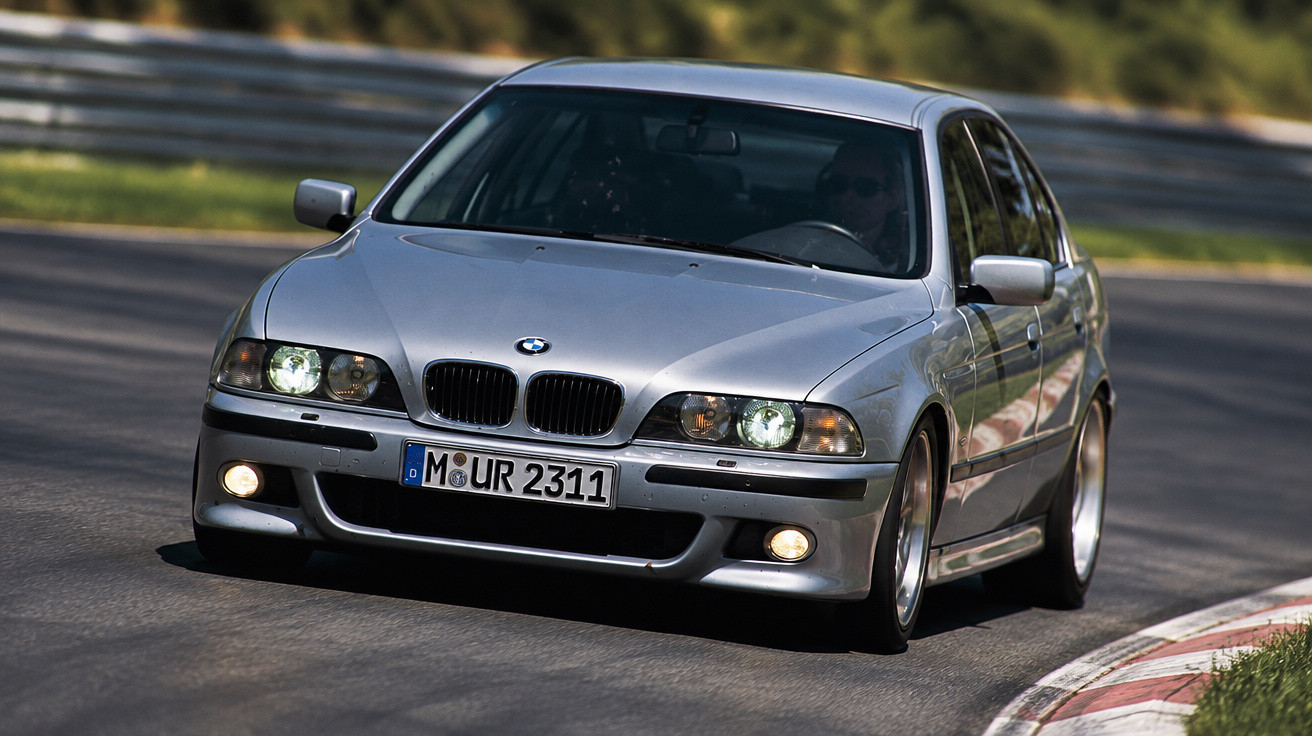
BMW E39 M5: the American-market challenge
BMW North America’s archives have produced another compelling story, and this one is a genuinely substantial one. Serious development work on the E39-generation M5 began in 1993. As BMW considered engines for its new super saloon, it was weighing up a turbocharged straight-six against a V8, with the former a strong contender.
At the same time, BMW was reassessing the M division’s longer-term prospects. The E34 M5’s “mechanically complex” 3.8-litre six-cylinder engine had limited its appeal in America: only 1,476 examples were sold in the USA, representing just 13 per cent of the worldwide production total.
The E30 M3 – kneel before thine mighty arches! – had also struggled. BMW North America had not only turned down the “expensive and too high-maintenance” E36 M3, but had even considered abandoning M cars entirely.
Clearly, that posed a serious problem. BMW M needed American customers on its side. Once a simpler, marginally less technical and more attainable E36 M3 reached the States and exceeded sales expectations, the E39’s engine choice was increasingly assessed according to US buyers’ preferences.
The E39 M5 engine decision
Karlheinz Kalbfell, BMW M’s boss at the time, kept arguing for the six-cylinder option, regarding it as “the heart and soul of BMW”. BMW also discussed a V6, “which would have been a total outlier within the BMW engine universe”.
That route would have been too costly, however, especially after BMW had ‘wasted’ years working out how it might function. The company ultimately selected a V8. With no existing BMW racing V8 to draw upon, M started with the M62 used in the 530i, 540i and 740i.
Choosing that engine meant relinquishing one of M’s best-loved principles: exceptionally high revs. “M’s philosophy at the time was high-revving engines, which we couldn’t achieve with the V8 concept we had,” said Alex Hildebrandt, then the E39 M5 project leader and head of product management.
Even so, the rev limit rose from 5,700rpm in the standard cars to 6,600rpm in the M5, while capacity increased from 4.4 to 5.0 litres. Individual throttle bodies were naturally included, alongside several “maintenance-reducing” internal revisions intended to appeal to American buyers.
Performance and US sales success
The finished car produced a neat 400bhp and 368lb ft of torque, delivered to the rear wheels through a six-speed manual gearbox and limited-slip differential. The rest follows the familiar M5 formula: stiffer springs and dampers, tougher components and larger brakes than the 540i. There was also an exceptionally restrained, aerodynamically honed body, beautiful wheels, and an extensive list of standard equipment. Satellite navigation, leather trim and Xenon headlights were all included for free. Not actually free, of course: the price was $69,700.
“It hadn’t been deliberately designed for the US,” said BMW, “indeed its ‘American’ V8 had come about organically, as the answer to a technical problem rather than marketing concern, but the E39 M5 seemed tailor-made for the US market.”
When E39 M5 production ended in June 2003, US buyers had taken 9,198 cars, just under half of the 20,482 E39 M5s built altogether. Naturally, the excellence of the standard E39 provided a very strong foundation.
“Along with the E36 M3, the E39 M5 turned the US into the world’s largest market for M cars worldwide, helping to ensure the M brand’s future within BMW. Moreover, the V8 engine helped catapult the E39 M5 into a higher echelon of performance,” said BMW.
And it came remarkably close to receiving a turbocharged straight-six instead…






Comments
No comments yet. Be the first to comment!
Leave a Comment