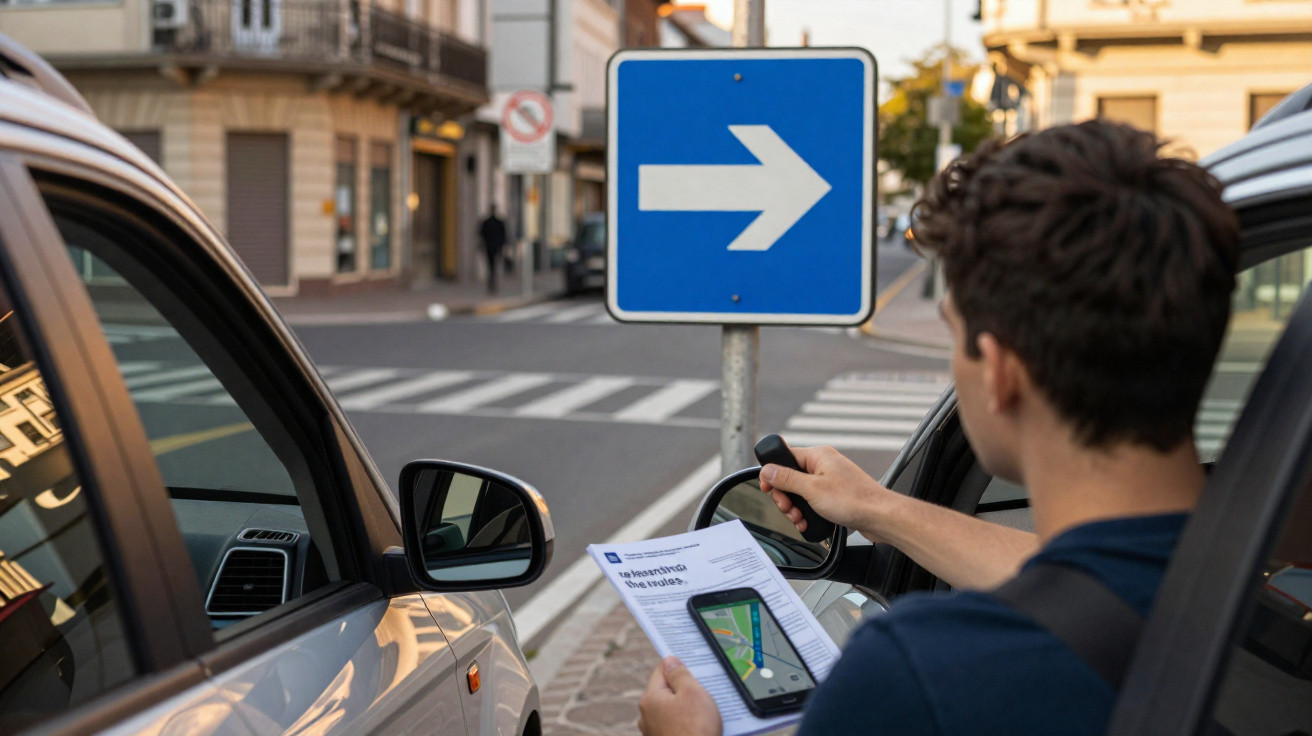
There is no traffic jam and no roadworks – just a single sign on the right-hand verge. Blue, with a white arrow: seemingly harmless, I think. An indicator flashes, and the car hesitates, first edging left and then right. You can almost see the driver wrestling with the question: can he still park here? Does he have to pull out? Or could he suddenly face a fine because the rule has changed?
A few metres further on, a woman pushing a pram looks puzzled at the same sign. She stops; the child points to it and asks loudly: “Mum, what does that mean?” The mother pauses, looks at the parked cars and then at the carriageway. She has no answer.
The whole scene lasts only seconds. Yet it is clear that more than a pictogram in the traffic-sign catalogue has changed. The new Road Traffic Regulations are altering familiar meanings – and turning routine into uncertainty.
The sign everyone knows – but now has to learn again
We pass the same signs day after day, and many no longer register consciously. This particular one, however, stands out immediately: a blue rectangle with a white upward-pointing arrow, sometimes accompanied by parking markings. For decades, its message seemed clear and almost hard-wired into our minds. Anyone travelling here knew that motor traffic now took priority on the road.
That sense of certainty is precisely what the new Road Traffic Regulations disrupt. A sign that once felt like a quiet confirmation of conventional motoring has acquired a different undertone. It is no longer just about those travelling by engine. It also concerns people walking, cycling or pushing a scooter. What appears to be a simple indication becomes a kind of “instruction on conduct” for everyone using the road.
In many towns and cities, the sign is already appearing in subtly altered or expanded settings. Sometimes it comes with supplementary plates; sometimes it forms part of new pilot schemes. In one medium-sized local authority area in North Rhine-Westphalia, for instance, a former 50 km/h road was redesigned. New markings, advisory cycle lanes and wider pavements were introduced – with the familiar sign in the middle of it all, still officially denoting a “priority road”, but now carrying a clearly broadened context.
Where through traffic once mainly swept past, the position is now different: greater consideration for cyclists, clear priorities at redesigned crossings and tighter parking rules. The local authority carried out anonymous counts over a year. Before the change, an average of 1,200 cars an hour used the road at peak times, compared with just under 80 bicycles. Afterwards, there were 1,000 cars – and 230 bicycles. People adapt when rules are more visible and more strictly applied. Some complain, naturally. Even so, traffic appears more restrained and less aggressive.
What is dryly described as a “new regulation to strengthen sustainable transport” affects this very sign in daily life. The priority road, long treated as shorthand for “clear road ahead, I’m in charge”, is becoming a space with much more clearly shared rights and duties. The Road Traffic Regulations sharpen the message: greater obligations to travel at walking pace in certain areas, clearer rules on stopping and parking, and tougher penalties for disregarding pavements and cycle routes.
Many drivers feel as though a rule they have followed for years has suddenly been taken away. Let us be honest: nobody willingly reads through the entire Road Traffic Regulations every year just to remain up to date on every sign. That is exactly where a dangerous grey area emerges. You think you know the sign, but its consequences have shifted. Anyone relying on instinct can suddenly risk far more than a disapproving shake of the head from the driver behind.
What you should do differently now on a priority road
Drivers do not need legal training, but they do need a clear reflex: see the sign, reassess it briefly, and do not simply act on autopilot. On a priority road, for example, this now means looking beyond the carriageway on many streets and actively checking the cycle route and pavements too. Pedestrians and cyclists often have a stronger position at side-road junctions and crossings – and that noticeably changes how you should drive.
A realistic driving style in the world of the new Road Traffic Regulations means turning into side streets more slowly and no longer darting into a parking gap, but first checking whether a cargo bike, a child on a scooter or an e-scooter could appear. Priority is no longer a trump card that sweeps everyone else away from the kerb. It is a framework – and stricter duties of consideration now apply within it.
Most mistakes stem not from malice but habit. Many motorists spot the familiar sign and mentally switch to the old setting: “I’m in the right; everyone else has to wait.” At a time when more people are cycling and children are using kick scooters far more often, that attitude is especially dangerous.
One common error is entering a priority road at 50 km/h without noticing that a newly marked crossing follows shortly afterwards. It may once have been only a pedestrian crossing; now it is a crossing with an explicit priority arrangement for people on foot. The result can be last-second emergency braking, irritated looks – and, in the worst case, an accident report.
Anyone being honest with themselves will recognise the inner voice: “They will not enforce it that strictly anyway.” That small convenience now clashes with higher fines, particularly for parking improperly on pavements and cycle routes or passing too quickly through areas where combinations of signs indicate that a reduced speed is appropriate. Lawmakers did not make these changes for fun, but because accident statistics involving more vulnerable road users had been moving in the wrong direction for years.
A driving instructor from Hesse whom I asked about this puts it very plainly:
“Most of my older learner drivers are not bad drivers. They simply drive as though 2005 were still today. The new meanings of familiar signs only hit home when the penalty notice arrives through the letterbox – or when blue lights appear in the rear-view mirror.”
What can help you avoid this trap?
- Review an up-to-date overview of the most important traffic signs at least once a year – 15 minutes is enough.
- Deliberately ease off the speed whenever new road markings or supplementary signs come into view.
- Mentally reset on priority roads: do not only think “I’m allowed to”, but also “Who else is here, and how vulnerable are they?”
- Question established parking habits: verges, junctions and advisory cycle lanes – what was once tolerated may now be costly.
- When in doubt, act defensively one extra time rather than feel legally entitled but still end up on the losing side of an accident report.
Why one sign suddenly makes us rethink how we drive
Ultimately, this is not about a few symbols on metal plates, but about our self-image behind the wheel. For a long time, the priority road was something like a title of nobility for drivers: those travelling on it were part of the “main flow”, while everyone else had to take their bearings from them. The revised interpretation under the Road Traffic Regulations reform brings another truth to the fore: the street no longer automatically belongs to the strongest mode of transport; it is intended to become shared space.
Many people experience this as a slight loss of control. The confident driver who has everything under control suddenly has to slow down, brake more often and share their attention. For some, that bruises the ego. For others, it is a quiet relief because the pressure to keep pushing on is reduced. Anyone who has tried to cross a busy priority road while holding the hand of a small child can understand why this shift is long overdue.
Perhaps that is the heart of the debate around this sign: a symbol we all know bluntly reminds us that the urban reality of 2024 is no longer that of 1995. More traffic, greater speed, more distraction and more varied forms of mobility. Its new meaning forces us to stay alert – not as perfect experts in the law, but as people travelling alongside other people.
The real question is not: “What exactly does this sign mean legally now?” It is: “How do I want to drive at a time when my decision, made in a fraction of a second, can affect other people’s lives?” That question arises afresh every day, at every junction and at every blue sign with a white arrow. And even if we often push it aside in everyday life, it catches up with us as soon as we start the engine.
| Key point | Detail | Benefit for the reader |
|---|---|---|
| Changed meaning of familiar signs | The new Road Traffic Regulations interpret traditional signs such as the priority road more strongly in the context of pedestrians and cycle traffic. | Readers understand why old habits behind the wheel are no longer automatically safe. |
| Specific everyday effects | Tighter rules on speed, priority and parking apply on streets with familiar signs and new road markings. | Readers can adjust their driving deliberately and avoid both fines and risky situations. |
| Practical adjustment strategies | A short annual refresher on the main signs, greater awareness of cyclists and pedestrians, and a defensive approach. | Readers receive immediately actionable steps to drive more safely and with greater peace of mind. |
FAQ
- Question 1: What has specifically changed under the new Road Traffic Regulations for familiar traffic signs? Many signs retain their basic symbol, but are interpreted differently in combination with supplementary signs, markings and new priority rules. Priority now means greater consideration within clear limits, rather than unrestricted dominance by motor traffic.
- Question 2: As an experienced driver, do I really need to learn traffic signs again? Starting entirely from scratch is unnecessary, but a brief update is still worthwhile. Checking the key changes once a year, for example through the ADAC or official websites, is enough to avoid unpleasant surprises.
- Question 3: Could I face higher fines if I do not know the new meaning? Ignorance is no defence. Fines can now be substantially higher, particularly for parking incorrectly on pavements and cycle routes, driving across crossings or failing to give priority to pedestrians.
- Question 4: How can I tell whether the way I usually park on a priority road is still allowed? Check the markings and supplementary signs: yellow lines, cycle-route pictograms or new parking zones often indicate that places previously used out of habit are now off limits. If in doubt, look briefly for an official parking space rather than stopping “on the off chance”.
- Question 5: What can I do if I suddenly feel uncertain about a familiar sign? Slow down, drive defensively and scan the situation for a few extra seconds. If possible, stop briefly and think rather than trying to work it out while moving. It is better to act too cautiously once than to drive at full speed into a new rule.















Comments
No comments yet. Be the first to comment!
Leave a Comment