Following a difficult spell marked by stagnant sales and substantial cuts to both costs and jobs, Volkswagen is preparing a product offensive intended to restore its former glory.
The German brand has new electric and combustion-engined models on the way, alongside updates for existing vehicles. It promises around ten launches by 2028, with no gaps left in its range.
The brand’s biggest commitment
With the European Union requiring a 100% reduction in emissions from 2035, electric vehicles are Volkswagen’s principal focus for the coming years, and at least four new models are planned.
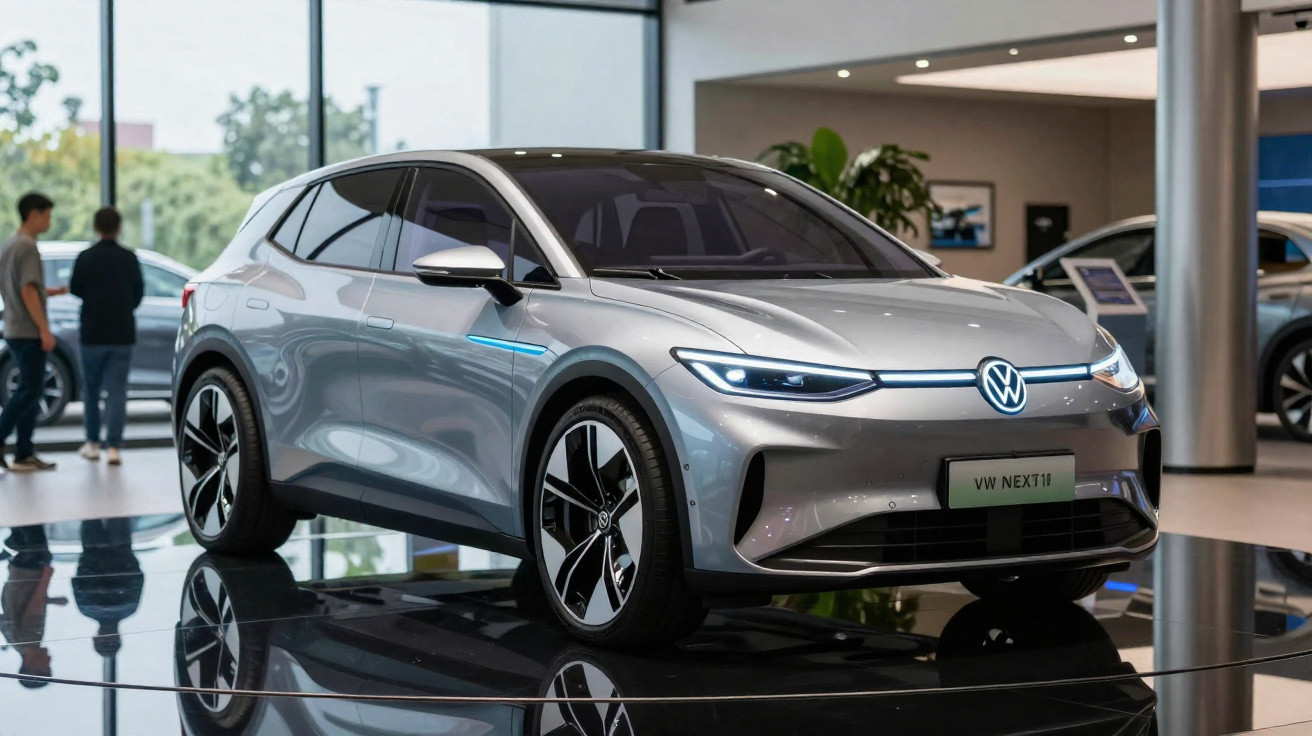
The first to arrive will be the ID.2, due to be unveiled at the Munich Motor Show, running from 9 to 14 September, with prices starting at €25,000. Positioned as the electric equivalent of the Polo, it promises a WLTP range of up to 450 km, as well as high-performance variants.
The ID.2X, the SUV version of the same model, is expected to follow a year later, with its prototype also set to appear in Munich. It will serve as the electric counterpart to the combustion-engined T-Cross.
Volkswagen ID.1 “made in Portugal”
Volkswagen’s commitment to affordable electric cars does not end with the ID.2. Scheduled for production in 2027, the ID.1 will be an electric city car taking over the role previously held by the electric up! It will share much with the larger ID.2, beginning with the MEB Entry platform.
Previewed by the ID.EVERY1 prototype, it will start from €20,000 and be built at Autoeuropa in Palmela. CEO Thomas Schäfer describes it as “the final piece of the puzzle” in the brand’s electrification strategy.
Like the ID.2, the forthcoming ID.1 will use front-wheel drive and, if the concept’s specifications are retained, buyers can expect a minimum range of 250 km, 70 kW (95 hp) and a top speed of 130 km/h. The ID.1 will also be the first model to benefit from the partnership agreed between Volkswagen and Rivian - find out what is involved.
It remains to be confirmed whether these three models will retain “ID” in their names. Schäfer reportedly said recently that the “ID” naming system would soon disappear, with conventional names taking priority. This should be confirmed next month, when the ID.2 is officially revealed.
Electric Golf and T-Roc models
Volkswagen’s electric push will continue from 2028 with fully electric versions of its best-selling T-Roc and Golf. Despite carrying familiar names, however, they will use a different platform from their combustion-engined counterparts: the new SSP (Scalable Systems Platform).
Very little is known about these cars so far, but Volkswagen’s ambitions are unmistakable: it expects them to become its best-selling electric vehicles.
Highlighting the importance of these models, as well as every other vehicle based on the new platform, Daniela Cavallo, chair of Volkswagen’s Works Council, said that “SSP models will be as important to Volkswagen’s future as the MQB platform has been until now”.
New combustion-engined T-Roc set for reveal
Despite its emphasis on electric cars, Volkswagen will maintain a full range of combustion-engined models into the next decade. Demand for electric vehicles remains below expectations, while combustion models continue to be the main source of profitability for most manufacturers.
It is therefore perhaps unsurprising that Volkswagen has committed €60 billion to combustion-engine development by 2028.
The first of the new combustion-engined arrivals will be the second generation of ‘our’ T-Roc, which has established itself in recent years as Volkswagen’s best-selling model in Europe, overtaking the Golf.
Its reveal is less than two weeks away, with the model due to make its public debut at the Munich Motor Show. It will continue to be built at Autoeuropa and has been selected by Volkswagen to introduce its first full hybrid powertrain - a hybrid that does not need to be plugged in, as seen in models from Toyota, Hyundai and Renault.
Until now, Volkswagen’s hybrid powertrains have either been mild-hybrid systems or plug-in hybrids, which can be charged externally; a conventional hybrid was missing. Beyond the T-Roc, this technology is expected to reach other models, including the Golf and Tiguan.
As for the Golf, after it emerged that the current generation could remain on sale until 2035, the German brand’s compact family car will receive another update in 2026. It is expected to gain modest visual changes and improved infotainment, but, as with the T-Roc, the major development will be the introduction of hybrid power.
Major updates for the ID range
Volkswagen will also update further models, including the Polo, which will receive mild-hybrid powertrains for the first time and is expected to be revealed later this year, plus the electric ID.3 and ID.4. The ID.3 is scheduled to arrive in the second quarter of next year.
For the ID.4, whose update is planned for the end of 2026, the changes will be more comprehensive than usual: “it will be a completely different car”, according to Volkswagen’s CEO.
“We felt the need to fit the ID.4 into the new design language going forward, as it remains our most important electric vehicle in terms of volume,” Thomas Schäfer said.

Comments
No comments yet. Be the first to comment!
Leave a Comment