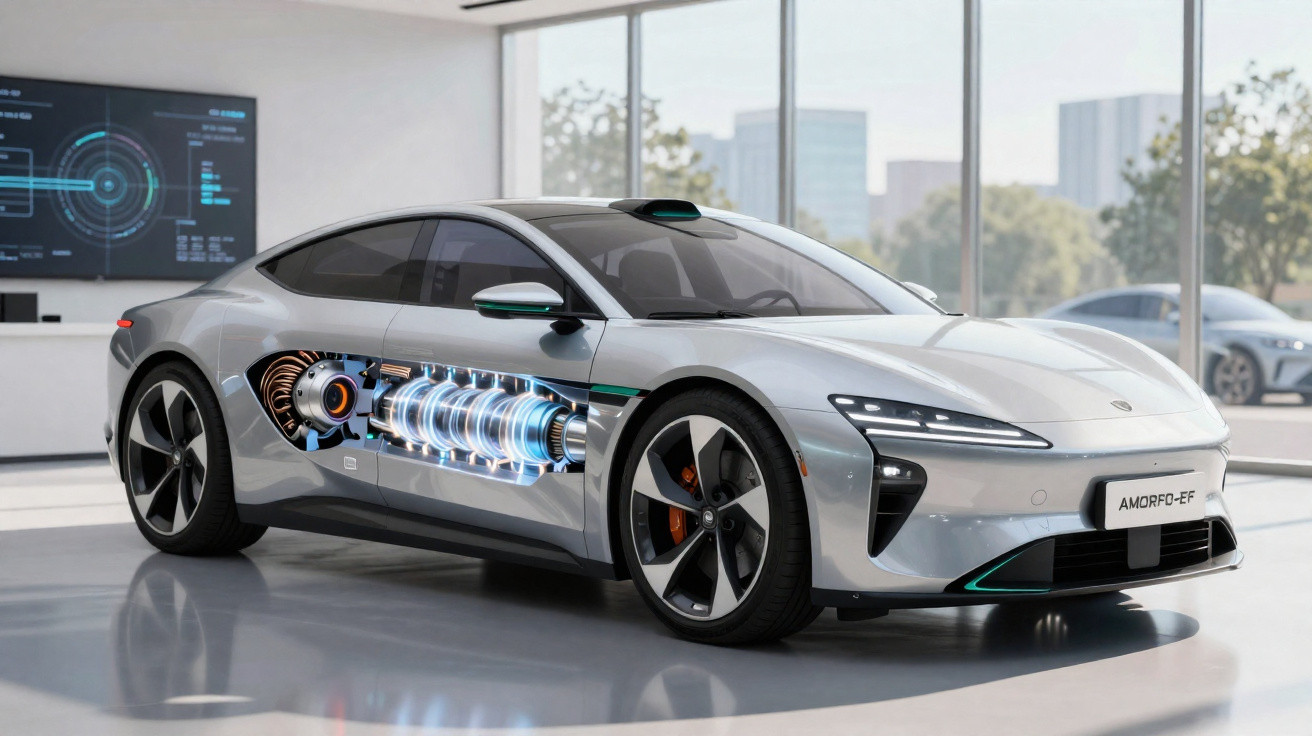
Horse, the joint powertrain venture formed by Renault and Chinese carmaker Geely, has announced a technical record. Its new electric motor, called Amorfo, is said to achieve 98.2 per cent efficiency, bringing it close to the physical limits of what is possible. Behind that sober figure lies a series of unusual engineering decisions – and the prospect that hybrid and electric cars could become noticeably more economical within a few years.
The French-Chinese partnership behind the technology
Horse is an independent company established by Renault and Geely to consolidate powertrain technology, including combustion engines, hybrid systems and electric motors. While European brands have recently focused heavily on dedicated electric platforms, Geely has quietly but consistently upgraded its powertrain development in the background. The Amorfo motor has emerged from precisely this overlap.
The motor is primarily intended for hybrid vehicles, where an internal-combustion engine works alongside an electric motor. However, range-extender layouts and particularly efficient plug-in hybrids are also among the intended applications. With an output of 190 PS and 360 Nm of torque, the Amorfo sits firmly in the technical mid-range rather than the supercar class. Its headline figure is not power, but efficiency.
According to the manufacturer, Horse’s Amorfo motor achieves 98.2 per cent efficiency and halves internal losses compared with conventional electric motors.
The material innovation: amorphous steel in the stator
At the centre of the motor is the stator: the stationary component that creates the magnetic field for the rotor. Normally, stators are made from thin sheets of crystalline electrical steel. Horse has taken a different approach by using amorphous steel.
What does “amorphous” steel actually mean?
Unlike conventional steel, the atoms in an amorphous metal are arranged irregularly, much like those in glass. There is no uniform crystal lattice. This dramatically changes its magnetic properties: magnetisation losses are lower and eddy currents can be controlled more effectively. These eddy currents account for a noticeable share of the energy lost in conventional electric motors.
In the Amorfo motor, the stator laminations are just 0.025 mm thick – ten times thinner than those in a typical production electric motor. That places them in the range of a human hair, or even below it.
- Material: amorphous steel instead of conventional electrical steel
- Lamination thickness: 0.025 mm instead of around 0.25 mm
- Aim: halve the magnetic and electrical losses in the stator
- Laboratory result: 98.2% efficiency
The exceptionally thin sheets restrict the formation of eddy currents, which are unwanted electrical circuits within the metal itself. These currents convert part of the electrical energy into heat, making it unavailable for propulsion. The thinner the sheets, the less room there is for these effects to occur.
How significant the efficiency gain really is
Depending on their operating point, modern electric motors already achieve efficiencies of between 93 and 97 per cent. Many readers will therefore ask: is 98.2 per cent actually noticeable in day-to-day use?
The honest answer is that the difference on an energy-consumption display amounts to only a few percentage points. Horse itself calculates that a complete hybrid system could require around 1 per cent less energy. That may not sound like much, but it has two dimensions:
| Parameter | Typical electric motor | Amorfo motor (Horse) |
|---|---|---|
| Efficiency (laboratory, peak) | 93–97 % | 98.2 % |
| Internal losses | 100 % (reference) | approx. 50 % of the reference |
| System effect in a hybrid | Base | ~1 % lower energy consumption |
At vehicle level, further losses always come into play, including those from the inverter, gearbox, battery chemistry and tyres. The motor itself is only one component. In addition, peak efficiency is reached within a narrow operating window that is not maintained continuously in everyday traffic. This is why the laboratory figure of 98.2 per cent can quickly translate into a real-world reduction in consumption of just 1 per cent.
One per cent less energy consumption may seem insignificant for a single car – but across millions of vehicles over many years, it produces a clearly measurable effect.
Why manufacturers fight for seemingly minor percentage gains
In Europe, manufacturers face pressure from CO₂ limits, while in China efficiency metrics influence subsidies and fleet assessments. Every percentage point saved reduces potential penalties for carmakers, improves ratings and creates scope for larger, heavier body styles without immediately moving into the next CO₂ band.
For fleet operators such as car-sharing providers or delivery services, a 1 per cent reduction in consumption can save several hundred euros in energy costs over a vehicle’s lifetime. The effect becomes even more important when improvements across all components are combined: a more efficient motor, lower-loss power electronics, optimised thermal management and low-rolling-resistance tyres.
From laboratory to road: unanswered questions around the Amorfo motor
For now, the Amorfo remains a power unit on the test bench. Horse has disclosed its performance data and efficiency, but has not yet named a specific production model. There is also no date for when the motor will first be fitted to a Renault or a Geely-related model.
In real-world use, additional factors matter that cannot be fully replicated in laboratory conditions:
- temperature changes ranging from severe sub-zero conditions to heatwaves
- mechanical vibrations, potholes and long-term loads
- manufacturing tolerances for extremely thin laminations
- ageing processes affecting the amorphous steel and insulation
A particularly interesting question is how production of such stators can be organised at high volumes. Amorphous steel is demanding to process. The sheets must be stacked and insulated with precision. Any small imperfection can partially erase the efficiency advantage.
What Amorfo could mean for hybrid and electric cars
In an ideal scenario, the motor enables three different strategies depending on the vehicle concept:
- The same performance with a slightly smaller battery, reducing costs.
- An unchanged battery size, but greater range or lower consumption.
- More performance with the same consumption, for example in heavy SUVs or vans.
Renault could, for instance, use Amorfo in future E-Tech hybrids to reduce consumption in the WLTP cycle by a few tenths of a litre. For Geely brands such as Volvo or Lynk & Co, a particularly efficient electric motor would be a selling point in markets where taxes are closely tied to CO₂ values.
How to picture the effect in everyday use
Take this example: a plug-in hybrid consumes 18 kWh per 100 kilometres in electric mode. If its drivetrain becomes around 1 per cent more efficient through the Amorfo motor, the figure falls mathematically to roughly 17.8 kWh. The driver is unlikely to notice this directly on the display. Over 150,000 kilometres, however, the difference adds up to around 300 kWh.
At an electricity price of 35 cents per kWh, that one car saves about 100 euros. This may appear modest, but if a group sells one million such vehicles, the result is savings in the hundreds of millions of euros in customer energy costs and several terawatt-hours of electricity that does not need to be generated.
Risks and limitations of the new technology
Every new material technology carries risks. Amorphous steel is more expensive than conventional electrical steel. If material prices rise significantly, the economic benefit of the efficiency gain can quickly diminish. Questions also remain over repairability and recyclability, as extremely thin and specially alloyed sheets create new challenges for dismantling businesses.
There is another consideration: a motor with such low losses generates less heat internally. That sounds positive, but it requires highly precise thermal management from engineers. At low temperatures, the motor itself – and potentially the battery as well – must be brought more quickly into an efficient temperature window. Only then can the technology deliver its full potential.
Why efficiency is still worth watching
The Amorfo motor represents a new phase in the competition for powertrain technology. After range, charging capacity and battery size dominated attention for years, the more sober issue of efficiency is once again moving to the fore. Particularly in markets where subsidies are stagnating, clearly better efficiency could be decisive when customers are choosing between two similar models.
For end customers, it will increasingly be worthwhile to look closely at technical data rather than focusing only on PS figures and battery capacity. How efficiently a car turns 1 kWh of electricity into actual kilometres will ultimately determine running costs, residual value and its CO₂ footprint. Amorfo puts this issue firmly on the agenda with an impressive figure – and forces other manufacturers to reconsider how they build their motors.


Comments
No comments yet. Be the first to comment!
Leave a Comment