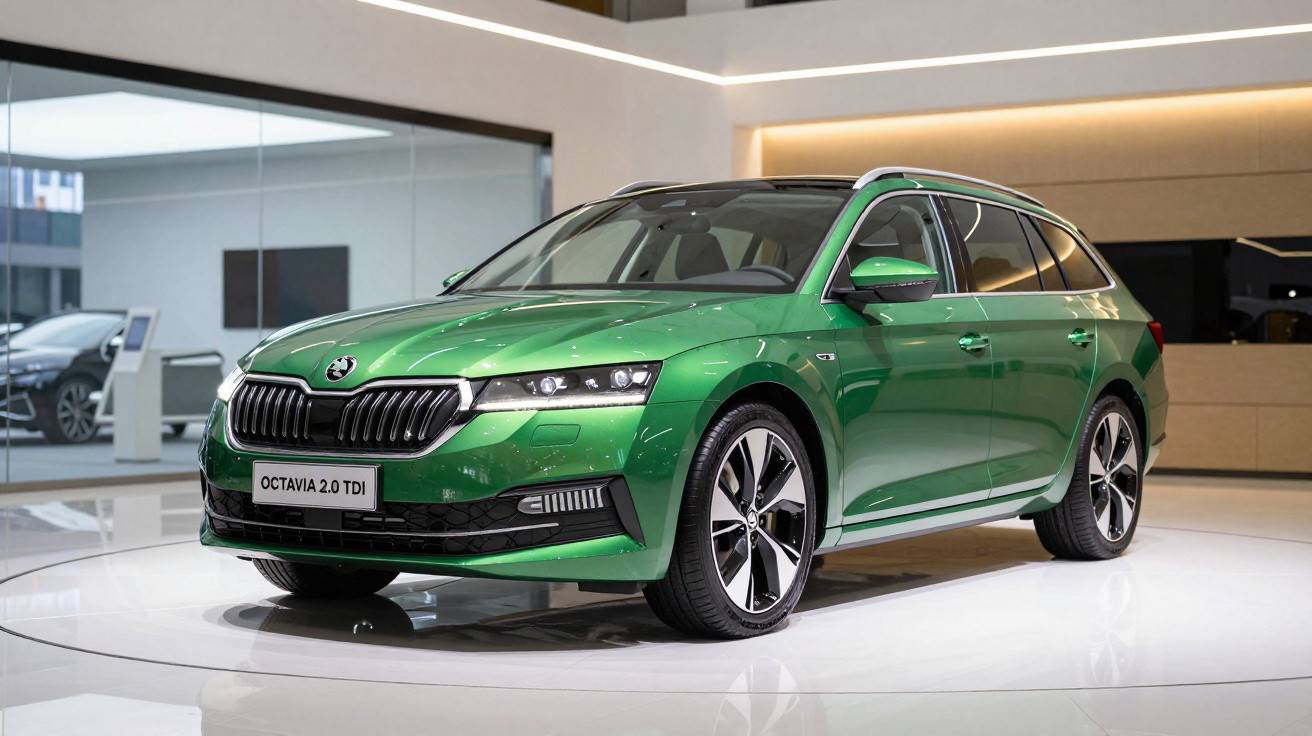
Anyone familiar with the Czech brand knows its greatest strengths: exceptionally generous cabin and boot space, clever interior solutions, proven Volkswagen technology and sensible pricing. The Skoda Octavia Combi, our first encounter with the fourth-generation Octavia, raises the bar so high that few people would object if it wore a Volkswagen - or even Audi - badge.
It would not be the first time that a marked improvement in the overall quality of a Skoda model had created some internal tension within the Volkswagen Group.
When the second Superb arrived in 2008, Wolfsburg headquarters reportedly delivered a few reprimands because somebody had perhaps become too enthusiastic while developing Skoda's flagship, bringing it rather too close to the Passat in perceived quality, design and engineering. That could, in theory, have made life harder for the Volkswagen, which naturally carried a higher price.
I would not be especially surprised if something similar happened with the new Octavia.
Skoda's all-time best-seller
In any case, 24 years have passed since the model officially known as the Octavia I, and more than seven million examples have been built/sold. It remains the only Skoda that is unlikely to be overtaken by an SUV in the Czech manufacturer's list of most popular models any time soon.
The Skoda Octavia heads that ranking by a comfortable margin - almost 400,000 units per year worldwide - while none of the three K SUVs, the Kodiaq, Karoq and Kamiq, reaches half that figure. This is despite the fact that, last year, only SUVs sold more than in the previous year, while the rest of the range recorded worse results than in 2018 due to the decline of the Chinese market.
In other words, the Octavia is Skoda's Golf - which is logical, given that they share the same modular mechanical and electronic architecture - and it is fundamentally a European car. Two-thirds of sales remain on this continent; it is the segment's third best-selling hatchback, behind only the Golf and Ford Focus; and the Skoda Octavia Combi is Europe's best-selling estate car, in the world's largest estate-car market.
That may explain why Skoda first allowed us to see and drive the Octavia estate in early March, leaving the five-door model's reveal until several weeks later, in mid-April.
A more aggressive Octavia
The enlarged, more three-dimensional radiator grille is immediately noticeable, accompanied by a greater number of creases that give the styling a more assertive character. The LED technology used extensively in the front and rear light clusters contributes to that effect.
Aerodynamics have clearly been improved, with a claimed Cx of 0.26 for the estate and 0.24 for the five-door, one of the segment's lowest figures. At the rear, where transverse lines and wider lamps dominate, the Skoda Octavia Combi has something of the current Volvo estates about it.
Dimensions have changed only slightly compared with the Octavia III: length rises by 2.2 cm and width by 1.5 cm. Interestingly, the estate, or Combi, and the hatchback - called Limo despite being a five-door body style - have precisely the same dimensions. Their wheelbase is also identical, whereas the previous estate's was 2 cm longer, at 2686 mm, which is virtually unchanged from the former Combi.
Vast cabin and boot
It is therefore no surprise that rear legroom has not grown, although that is far from a criticism. The Skoda Octavia Combi, and the car generally, remains the roomiest model in its class, as it was before, and offers the segment's biggest boot. It has even grown slightly: by 30 litres in the Combi, to 640 litres, and by 10 litres in the five-door, to 600 litres.
Rear passengers also gain a little extra shoulder room, by 2 cm. This row has direct air vents, with temperature adjustment on some versions and USB-C ports, although the intrusive footwell tunnel - a familiar Volkswagen Group trait - means that two people are ideally accommodated in the rear.
Skoda has also retained its ambition to impress with small practical details that make daily life with the Octavia more pleasant. Alongside the umbrella concealed in the front-door pocket, there is now a USB port in the roof, a funnel integrated into the windscreen-washer reservoir cap, tablet holders built into the backs of the front head restraints and, as seen in other recent Skoda models, the Sleep Package, which provides “pillow-type” head restraints and a blanket for rear occupants.
This estate also has an automatically retracting parcel shelf, while the five-door includes an underfloor boot compartment for storing, for instance, a coat.
Quality and technology raised
Returning to the driver's seat is where the new Octavia's most important advances become apparent. Press-test cars are, of course, usually fitted with virtually every available option, but some improvements are inherent: higher-quality soft-touch trim on the dashboard and front doors, reassuring assembly quality, and styling solutions that bring the Octavia very close to the standard set by certain premium models.
Even if the Czech manufacturer neither wishes nor is able to position itself that way. On the question of whether a car is premium, I always remember spending a few days testing a Cadillac ATS in the United States, then returning directly to Portugal to drive the previous Skoda Octavia. I came away feeling that the Cadillac was the badge-value car and the Skoda was the premium one.
New features include a two-spoke multifunction steering wheel with up to 14 functions, all controllable without taking your hands off the wheel. There is now, for the first time, an electric handbrake, plus a head-up display - another first, although optional - optional heated windscreen and steering wheel, acoustic front side windows with an inner film to make the cabin quieter, and more comfortable, sophisticated seats that can be heated and offer electric adjustment, an electric massage function and more.
Skoda Octavia Combi controls: fingers at the ready
The dashboard, whose curve is somewhat reminiscent of the previous-generation Mercedes-Benz S-Class, is dominated by the central infotainment display and an almost complete lack of physical controls. This is an increasingly common approach, also seen in the latest Volkswagen Golf and SEAT Leon, its cousins.
The infotainment screen comes in different sizes, 8.25 inches and 10 inches, and with varying functionality. The entry-level version offers basic touch operation, the mid-level system adds voice and gesture controls, and the most sophisticated version includes navigation zoom.
Overall, this new layout frees up considerable space around the driver and on the centre console, particularly in versions equipped with the dual-clutch automatic gearbox. This now uses a genuinely compact shift-by-wire selector, which changes gears electronically and could almost have been borrowed from Porsche, which introduced this selector on the electric Taycan.
The instrument panel is digital too, measuring 10.25 inches, and can display different layouts, information and colours. Drivers can choose between Basic, Classic, Navigation and Driver Assistance views.
One major area of progress resulting from this new electronic platform is the availability of level 2 autonomous driving, among other systems, combining lane keeping with adaptive cruise control.
Four ride heights to choose from
There are no major changes to the chassis, as the MQB platform has been retained. Suspension uses MacPherson struts at the front and a torsion beam at the rear, one of the few areas in which the original 1959 model “was better”, since it had independent rear suspension. On the Octavia, only versions with engines above 150 hp receive independent rear suspension. By contrast, 150 hp versions of the Golf and A3 already use this more sophisticated rear-axle design.
However, four different ride heights can now be selected according to the chosen chassis. In addition to the Base set-up, there is Sport, lowered by 15 mm; Rough Road, raised by 15 mm and corresponding to the former Scout version; and Dynamic Chassis Control, with variable dampers.
There are five driving modes: Eco, Comfort, Normal, Sport and Individual. The latter allows 15 different settings to be selected and, for the first time in a Skoda, enables substantially different configurations for the adaptive suspension, steering and automatic gearbox. Everything can be managed through the slider below the central display.
There is also the new slide control, introduced by the Volkswagen Golf and already available on the latest Audi A3 and SEAT Leon, for managing driving modes. Another Skoda first is the ability to adjust individually the parameters that directly affect driving: suspension, throttle, steering and the DSG automatic gearbox, where fitted.
Petrol, Diesel, hybrids…
The engine line-up changes considerably compared with the Octavia III, although it closely mirrors that of the new Golf.
It starts with the three-cylinder 1.0 TSI with 110 hp, followed by the four-cylinder 1.5 TSI with 150 hp and 2.0 TSI with 190 hp petrol engines. The latter two will not, at least initially, be sold in Portugal. The first two may be specified with or without mild-hybrid technology.
The increasingly limited Diesel range is restricted to a 2.0-litre unit, but it is offered with three power outputs: 116, 150 or 190 hp. The 190 hp version is available only with 4×4 four-wheel drive.
Finally, there are two plug-in hybrids, with external charging and an electric range of up to 60 km. They pair the 150 hp 1.4 TSI engine with an 85 kW, 116 hp electric motor, for combined outputs of 204 hp in the iV or 245 hp in the RS iV. Both use a six-speed dual-clutch automatic gearbox, while the more powerful version has progressive steering as standard. It is worth noting that plug-in versions cannot have lowered suspension, because they already carry the extra weight of the 13 kWh battery and would otherwise become too firm-riding.
Pleasantly settled in
Behind the wheel, the impression is of a modern, well-built car. Fears that the steering wheel might be too confusing to use because of its abundance of controls prove unfounded. After an hour, everything can be operated quite intuitively, not least because a regular owner, unlike somebody testing the Octavia, will not constantly be changing cars.
Living almost entirely through digital-screen menus and submenus, with virtually no physical controls in the centre console, demands more concentration and more “finger work” than would be ideal. However, it will not be easy to reverse the direction every manufacturer is taking.
Quieter cabin, more capable chassis
Whatever the road surface or speed, the new Skoda Octavia Combi is genuinely quieter than the model it replaces. This results from suspension developed with that objective in mind, improved sound insulation and the greater structural integrity of the body.
The steering responds a little more quickly, although it does not stand out for communicating what is happening between the tyres and the tarmac. It does not particularly encourage sporty driving, as transitions between direction changes are not especially agile, but with a degree of common sense it does not readily run wide in corners.
The suspension is well balanced, delivering adequate comfort and stability. Only on very uneven surfaces does the rear axle become a little more unsettled.
The manual gearbox is sufficiently quick and precise without being outstanding, making the most of the 150 hp 2.0 TDI engine. Its main virtue is that it delivers all 340 Nm from just 1700 rpm, although it loses its “breath” early, from around 3000 rpm.
A 0-100 km/h time of 8.9s and a 224 km/h top speed show that it is far from slow. However, it is worth remembering that if the huge rear load area is heavily filled and more than two occupants are travelling, the weight of this more-than-one-and-a-half-tonne car will begin to take its toll in several ways. When the engine is worked hard, it also becomes slightly noisy.
Double NOx filtration is good news for the environment, even if the driver will not notice it, as is fuel consumption expected to vary between 5.5 and 6 l/100 km in normal driving. That is slightly above the claimed 4.7, but remains a good real-world average.
In Portugal
The fourth-generation Skoda Octavia arrives in Portugal in September, with the 2.0 TDI tested here expected to cost €35,000. The Skoda Octavia Combi is expected to be priced between €900 and €1,000 above the five-door.
Prices are expected to start at €23,000 for the 1.0 TSI.
Skoda Octavia Combi 2.0 TDI Technical Specifications
| Skoda Octavia Combi 2.0 TDI |
|---|
| Engine |
| Architecture |
| Valve gear |
| Fuel system |
| Capacity |
| Power |
| Torque |
| Transmission |
| Drive |
| Gearbox |
| Chassis |
| Suspension |
| Brakes |
| Steering |
| Turning circle |
| Dimensions and capacities |
| Length x width x height |
| Wheelbase |
| Boot capacity |
| Fuel-tank capacity |
| Wheels |
| Weight |
| Performance and consumption |
| Top speed |
| 0-100 km/h |
| Combined consumption |
| CO2 emissions |
* Figures in the final approval phase
Authors: Joaquim Oliveira/Press-Inform.

Comments
No comments yet. Be the first to comment!
Leave a Comment