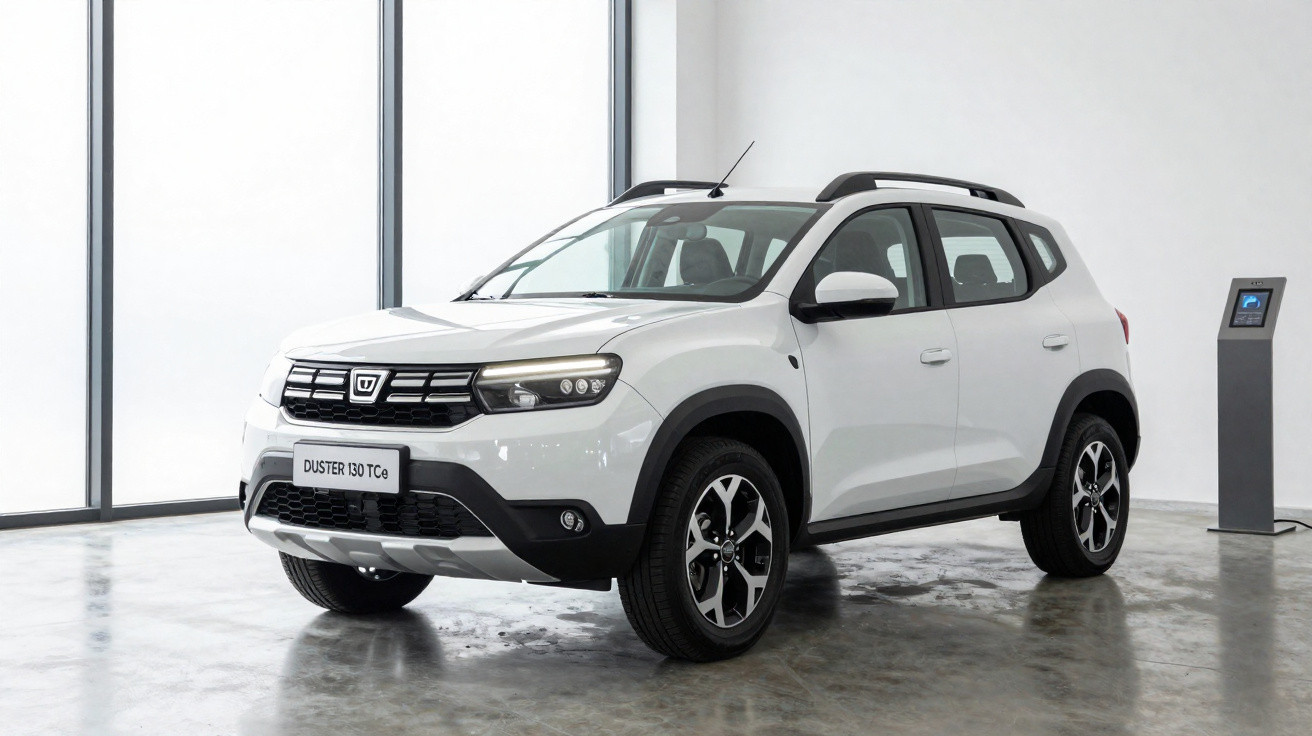
If there is one thing the Dacia Duster does not lack, it is a choice of engines. Having already put the frugal bi-fuel unit (petrol and LPG) through its paces, as well as the sought-after 4×4 version with its Diesel engine, we set out to assess the strengths of one of the more powerful engines available in the Duster: the 130 hp 1.3 TCe petrol.
It is not the Romanian SUV’s most powerful option, however, as it has recently gained a new 150 hp version of the same 1.3 TCe. That does not make this 130 hp model any less appealing, particularly given the sizeable increase over the 101 hp LPG version I was able to test.
But do those extra 30 hp warrant the additional €1650 over the economical bi-fuel version? The following paragraphs provide the answer.
Simply Duster
Compared with the other two Dusters I drove, the big difference with this example was… its colour. Rather than the eye-catching “Arizona Orange”, this Duster wore the equally interesting “Iron Blue”. Both colours cost €400, although buyers unwilling to spend extra on paint can choose the standard “Glacier White”.
Inside, as on the outside, everything remains unchanged. In other words, there are hard-wearing materials, solid assembly quality and ergonomics that are difficult to fault. Nevertheless, it is in the cabin that the petrol Duster scores over the 4×4 and LPG variants I tested.
Against the 4×4 version, the petrol Duster offers a slightly larger boot: 445 litres rather than the 411 litres available in the more adventure-focused variant. Compared with the LPG model, boot capacity is the same, but the lack of an LPG tank means it can retain its spare wheel.
More powerful, yet economical
With 130 hp and 240 Nm, this engine makes the Dacia Duster more responsive, although it also highlights that dynamic handling is not its principal focus or strongest quality.
Starting with the positive side, the biggest difference between this Duster and the LPG version is not so much the additional 30 hp as the extra torque - 240 Nm versus 170 Nm. This makes performance more readily available, simplifies overtaking and delivers swifter acceleration in gear.
As a result, there is less need to work the well-ratioed six-speed manual gearbox, although its shift action would benefit from feeling slightly more polished.
The other side of the power and torque increase becomes apparent when you decide to use all 130 hp on a more twisting road.
While its handling is predictable, do not expect to extract much driving enjoyment from the Romanian SUV… at least when travelling on tarmac. The fun begins when you head onto dirt tracks, where the Duster is transformed. Its somewhat soft suspension and generous ground clearance allow you to explore your inner Sébastien Loeb.
Speaking of the suspension, it is also responsible for the high level of comfort offered by Dacia’s contender, even on the roughest roads.
There is more good news: the larger engine, along with its increased power and torque, has not resulted in a huge appetite for fuel. Remember that extra torque? It allows the gearbox and the engine’s higher rev range to take more of a rest, enabling this version of the Dacia Duster to preserve the Romanian model’s characteristic frugality.
Over the course of the test, average consumption settled at a very respectable 5.7 l/100 km. This figure came from use that included lengthy motorway stretches as well as several hours spent in stop-start city traffic. For context, on the same routes and using petrol only, the bi-fuel Duster returned an average of 6.5 l/100 km.
Is it the right car for you?
Priced not far above the LPG version, this petrol-powered 1.3 TCe Dacia Duster is the ideal choice for people who like the Duster but do not cover huge distances every day. In that situation, the LPG version’s lower fuel cost definitely has a role to play.
Yes, there is also a petrol-only version with 90 hp from the 1.0 TCe, but given the Duster’s dimensions, that effectively limits it to predominantly urban use.
With these 130 hp and 240 Nm, however, the Duster can handle short city journeys as comfortably as longer trips for leisure or with the family, all without having to shift down two gears whenever you want to overtake a lorry.



Comments
No comments yet. Be the first to comment!
Leave a Comment