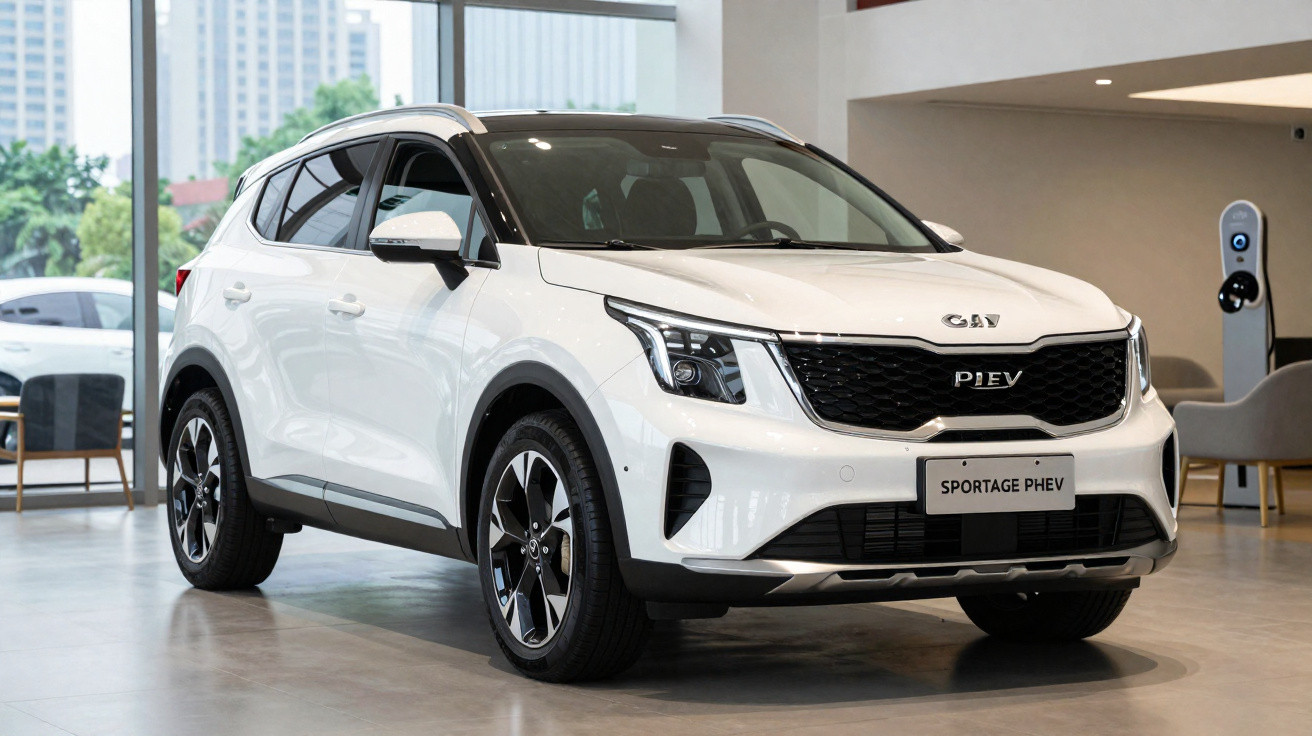
The Kia Sportage plug-in hybrid (PHEV) is the costliest and most powerful Sportage, yet it also promises to be the most economical.
Having already tested the least expensive Kia Sportage of all - the petrol model with a manual gearbox - it is now time to head to the opposite end of the range in price terms.
This South Korean SUV line-up is among the broadest when it comes to powertrains - there seems to be an option for almost every preference - spanning petrol, hybrid and plug-in hybrid models.
Compared with the entry-level version we tested previously, this Kia Sportage stands out for its plug-in hybrid system (which can be charged from a socket), its claimed electric range of up to 70 km, its all-wheel-drive system and its more generous equipment specification.
There are no visual changes compared with other versions, apart from the PHEV (Plug-in Hybrid Electric Vehicle) badge on the tailgate and an additional flap on the right-hand side of the bodywork, which covers the charging port.
The distinction between the Drive and Tech equipment grades can be spotted through the 19-inch alloy wheels and the black trim pieces, which are finished in gloss black rather than simply retaining the colour of the plastic.
Other than that, and excluding the body colour, the two Kia Sportage models that have been through Razão Automóvel are exactly alike.
A more sophisticated interior
While the exterior brings no notable changes, the cabin of this Kia Sportage differs more noticeably from that of the more affordable model. The instrument cluster, for instance, is fully digital here too, but it has a far more sophisticated appearance, closely resembling the display seen in the Kia EV6.
Its plug-in hybrid powertrain and automatic gearbox also mean the centre console has a different layout, incorporating a dedicated rotary control identical to that in the Kia EV6. The driving-mode selector is positioned just below it.
In the Tech trim fitted to the test car, the key can remain in your pocket, while the front seats are adjusted electrically. For colder days, both the seats and steering wheel are heated.
Otherwise, this Kia Sportage retains the model’s familiar strengths, including plentiful room in the cabin for both front and rear occupants, a high standard of comfort and a finish quality that does not disappoint.
Its only real drawback is that the hybrid system takes away some boot space, as the battery is fitted beneath the floor. Even so, 540 litres of capacity remain available, which is still a generous figure and sufficient for most family requirements.
Kia Sportage PHEV: more of everything
As expected, the biggest differences from the previously tested entry-level model become apparent on the road, starting with the engine. The 1.6 T-GDi petrol engine remains under the bonnet, although here it develops 180 hp (+30 hp compared with the petrol-only Sportage).
It is joined by an electric motor contributing 91 hp. Together, the two power sources deliver 265 hp and 350 Nm of torque, making the Sportage PHEV the most powerful version of all.
These are very appealing figures for an SUV of this size, even with a kerb weight close to two tonnes. Furthermore, while the cheapest Sportage drives only two wheels, this Sportage has all-wheel drive.
In a (limited) electric mode
The electrical side of the hybrid system is supplied by a 13.8 kWh battery, allowing Kia to claim a maximum electric-only range of 70 km on the combined cycle. However, this test began with zero kilometres of electric range remaining and in the middle of rush hour.
Even so, it pulled away in complete silence, without waking the combustion engine during the first manoeuvres. At lower speeds, when slowing downhill or while stationary, there were few occasions when the petrol engine started.
On the other hand, in urban use and heavier traffic, the lack of a fully electric mode meant the recorded consumption figures were not especially pleasing, at times exceeding nine litres. Naturally, once we reached open roads, the figures immediately began to fall.
With no battery charge left and over a route combining town driving, country roads and motorway travel, the Kia Sportage PHEV returned an average slightly above seven litres.
With the battery charged
After leaving the Kia Sportage PHEV connected to a socket for a few hours, the battery reached 100%, allowing the real advantage of this plug-in hybrid to be enjoyed: driving in fully electric mode.
In this setting, the South Korean brand’s SUV seems determined to show that it “hates” having to call on the petrol engine.
In fully electric mode, the Kia Sportage can keep pace with other cars without any difficulty. That applies both in town and on the motorway, although, as expected, its benefits become even more apparent in urban driving.
With some care in modulating the accelerator, it is possible to complete an ordinary commute between home and work, for example, without using the petrol engine, resulting in considerable savings. Without taking much care, however, and with the petrol engine being called upon in various situations, the recorded average did not even reach five litres.
In range terms, Kia’s claimed 70 km is highly optimistic and requires ideal driving conditions. Even so, exceeding the 50 km mark before needing to recharge the battery is not difficult.
If regularly charging the battery still places restrictions on how you use the car, the plug-in hybrid version does not make much sense. In that case, the conventional hybrid (HEV), which does not need plugging in, is the better choice. Its savings potential is not as substantial, but its fuel consumption will still be lower than that of the petrol-only version.
Limited scope for personalisation
Buying a new car is an opportunity to tailor the model that we will be driving for the longest period to our own preferences.
With the Kia Sportage PHEV, however, there are no options beyond choosing the body colour. There could be more choice in terms of equipment versions or optional extras, as is the case in other markets.
For example, in PHEV form, what would the Kia Sportage look like with the sportier styling of the GT Line version rather than the Tech trim, which is the only one available in the configurator? For more demanding buyers, why not offer the option of a panoramic glass roof or a better sound system, even if this came at an additional cost?



Comments
No comments yet. Be the first to comment!
Leave a Comment