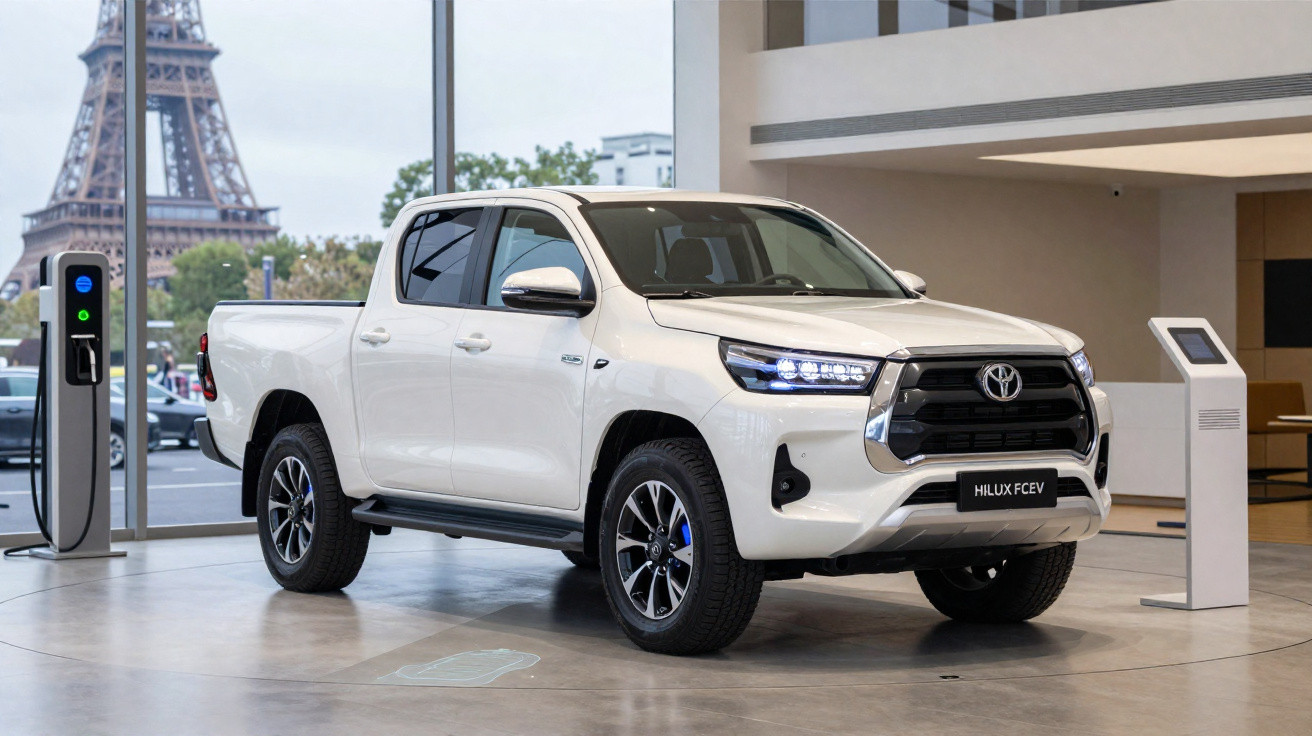
Presented in 2023 at the Kenshiki Forum, Toyota’s annual event for unveiling its latest developments, the hydrogen fuel-cell Hilux FCEV is moving ever closer to becoming a reality.
It remains a prototype, certainly, but the Japanese manufacturer has already been testing it in the United Kingdom, where it has covered several thousand kilometres. Those miles have been completed in demanding real-world conditions, as Fernando Gomes was able to discover in June.
Now, at an event in Paris held alongside the 2024 Olympic and Paralympic Games, I was the one who got behind the wheel of this pick-up, which promises to offer an alternative to diesel and battery-electric models. Is Toyota heading in the right direction? Watch the video:
Multi-energy approach
Toyota has long argued for a multi-energy route towards carbon neutrality, recognising that cutting carbon emissions requires more than battery-electric vehicles alone.
Without disputing the value of that solution, Toyota favours a more pragmatic strategy, summed up by the principle “different needs, different technologies”, while keeping the same objective in sight: reducing pollution.
That is why the Japanese car maker has, in recent years, backed and invested in several solutions, ranging from conventional hybrids (HEVs) and plug-in hybrids (PHEVs) to battery-electric vehicles (BEVs), e-fuels, biofuels and, finally, hydrogen.
In this area, Toyota is pursuing two routes: hydrogen fuel-cell electric vehicles (FCEVs), such as this Hilux and the Mirai, and combustion engines that use hydrogen rather than petrol, as demonstrated by the GR Corolla H2 Concept that took part in the Fuji 24 Hours.
Hydrogen remains a priority
Despite Toyota’s considerable efforts to develop hydrogen technology, the reality is that the Mirai - Toyota’s hydrogen fuel-cell electric saloon, which we have already tested - is still not selling at the pace the Japanese manufacturer had anticipated. In 2023, for instance, 3737 Mirai units were sold worldwide.
Even so, Toyota remains committed to this technology and has just entered an agreement with BMW to jointly develop a third-generation hydrogen fuel-cell system. It will replace the technology currently used by the Mirai and the Hilux FCEV driven here.
Toyota’s hydrogen ambitions are not limited to cars, either. The Japanese brand has been applying its fuel-cell technology to many other forms of transport, beginning with the hydrogen buses built by CaetanoBus in Vila Nova de Gaia. Toyota also offers solutions for fitting these hydrogen fuel cells to lorries and boats.
Toyota Hilux FCEV uses Mirai technology
To assess the feasibility of this model, Toyota - through Toyota Motor Manufacturing UK - has built 10 fully operational prototypes, all of which have been following a rigorous test programme in the United Kingdom.
It was one of these prototypes that I had the chance to drive, albeit only briefly, on a small track near Paris, in Dreux, at the Circuit de l’Ouest Parisien.
At the heart of this Hilux is the FCEV system already familiar from the Mirai. At the front, where a diesel engine once sat, there is now the fuel-cell system that generates electrical power, along with the cooling system and control unit.
In the middle of the chassis sit three carbon-fibre tanks, holding 7.8 kg of hydrogen and designed to withstand 700 bar of pressure. Behind them is a small battery with a capacity of just over 1.2 kWh.
Mounted above the rear axle is an electric motor producing 134 kW (182 hp) and 300 Nm of maximum torque. And yes, I know what you are thinking: this hydrogen Hilux is rear-wheel drive only. However, during the event I asked one of the engineers responsible for the project, who assured me that, should the model reach production, it will have four-wheel drive.
As for range, it could reach 650 kilometres, although Toyota has not disclosed much consumption data. One thing is assured, however: there are no exhaust-gas emissions, only water. That is right: the chemical reaction between hydrogen and oxygen inside the fuel cell produces only water, which can be released by pressing a button.
What is the Hilux FCEV like to drive?
The drive was short, yet highly revealing. Interestingly, I drove this model immediately after trying the Hilux with its 2.8-litre diesel engine and 48V mild-hybrid system, as well as the new battery-electric Hilux that Toyota sells in Thailand.
Believe it or not, the hydrogen version was the one I liked most. It is the most refined of the three and impresses with how easy and smooth it is to use: the steering is pleasantly light, there is no noise or vibration, and acceleration is very progressive.
This is also helped by the fact that the prototype uses a different rear suspension setup, unlike the conventional rigid axle of the combustion-engined Hilux. It provides greater comfort and a better ability to absorb road imperfections.
The only thing missing was a run on an off-road course, which would have shown whether having only two driven wheels, for now, could prove limiting.
Does the hydrogen Hilux have a future?
The next few years will be decisive, particularly as Toyota promises more range and a substantially lower price with the arrival of its third-generation fuel cell.
Toyota estimates a cost reduction of around 37% with annual production of 100,000 fuel-cell systems. That figure rises to 50% with annual output of 200,000 units - whether for cars, pick-ups, lorries, buses or stationary systems.
Naturally, this progress could prove decisive in Toyota’s decision on whether to produce the hydrogen Hilux. Yet after this brief encounter, I have little doubt that it is a product with huge potential, especially when everything it offers is weighed against a battery-electric alternative.
Range is not an issue, refuelling times are comparable with those of a combustion-engined vehicle, and, according to Toyota, payload and towing capacity match those of a diesel Hilux. The main drawback is the refuelling network, which remains virtually non-existent in countries such as Portugal.
When compared with equivalent diesel alternatives, there are advantages here too, starting with emissions, although the Hilux FCEV still falls behind when torque is considered.





Comments
No comments yet. Be the first to comment!
Leave a Comment