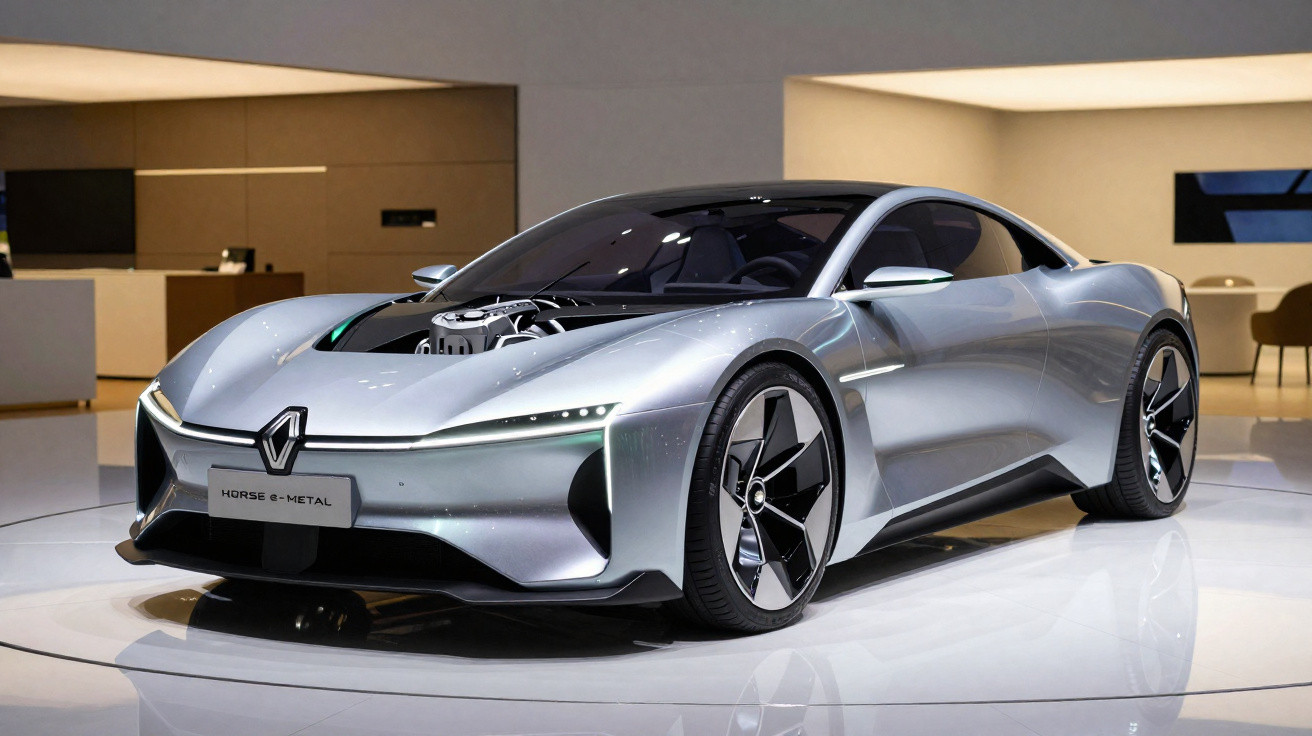
A little-known powertrain specialist from the Renault universe has announced a figure that has immediately caught the industry’s attention: 98.2 per cent efficiency. The claim relates to a newly developed electric motor designed primarily for hybrids, with a specialised metal at its core. Although it may sound like a subject for laboratory engineers, it could have direct everyday implications for range, energy use and running costs.
Renault and Geely target the efficiency crown
The backdrop is that, for more than a year, Japanese and European companies have no longer been the only ones setting the pace in powertrain technology. Chinese manufacturers including Dongfeng, Changan and BYD are launching motors with striking performance figures in quick succession. It is in this competitive environment that Horse, the Renault and Geely joint venture, is looking to establish itself.
Horse is responsible for powertrains within the group, spanning conventional combustion engines through to highly developed hybrid systems. The company has now unveiled a new electric motor known internally as “Amorfo”. Its central innovation is a distinctive material used in the stator, the component that creates the electromagnetic field and drives the rotor.
According to the manufacturer, the motor delivers 98.2 per cent efficiency – a figure previously seen only in technical studies.
What matters in everyday driving is that almost every kilowatt-hour of electricity supplied is converted into actual propulsion. Energy lost as heat is reduced substantially.
The Horse Amorfo motor uses amorphous steel rather than conventional laminations
Usually, an electric motor stator is made from stacked sheets of crystalline steel. Horse instead uses what is known as amorphous steel in the Amorfo motor. Its atomic structure is disordered, much like glass. This apparently modest change has major consequences for how the material behaves in a magnetic field.
In conventional electric motors, eddy currents form in the metal and turn energy into heat. Horse aims to minimise precisely these losses. Two aspects stand out:
- The steel is amorphous, giving it more favourable magnetic properties.
- The laminations are exceptionally thin, measuring just 0.025 millimetres.
By comparison, the laminations in a typical electric motor are around ten times thicker. These ultra-fine layers make it harder for eddy currents to form, significantly lowering internal losses.
Horse claims losses within the motor itself are up to 50 per cent lower – a major advance for an established technology such as electric propulsion.
On paper, this lifts overall efficiency to 98.2 per cent. Current production motors generally achieve between 93 and 97 per cent, depending on load point, speed and temperature. The improvement may appear slight, but it is certainly noticeable at this level.
Performance data: engineered for powerful hybrids
The new electric motor is aimed not at luxury pure-electric cars, but chiefly at hybrids and range-extender vehicles. Its key specifications are:
| Specification | Value |
|---|---|
| Maximum power | 190 PS |
| Maximum torque | 360 Nm |
| Announced efficiency | 98.2 per cent |
| Application area | Hybrids, plug-in hybrids, range-extender vehicles |
With 190 PS and 360 Nm, the motor is well suited to medium-sized SUVs and compact cars with hybrid powertrains. In plug-in hybrids, it could allow the combustion engine to take breaks more often without the driver having to sacrifice performance.
Just a 1 per cent consumption benefit – is it worthwhile?
Across the complete hybrid powertrain, Horse promises an energy-demand saving of roughly one per cent. At first, that may sound underwhelming. Anyone anticipating a new motor technology might expect double-digit improvements instead.
The picture changes in the context of modern powertrains. Many potential improvements have already been exhausted. One full per cent less energy consumption across millions of vehicles means:
- billions of kilowatt-hours less electricity or fuel consumption worldwide,




Comments
No comments yet. Be the first to comment!
Leave a Comment