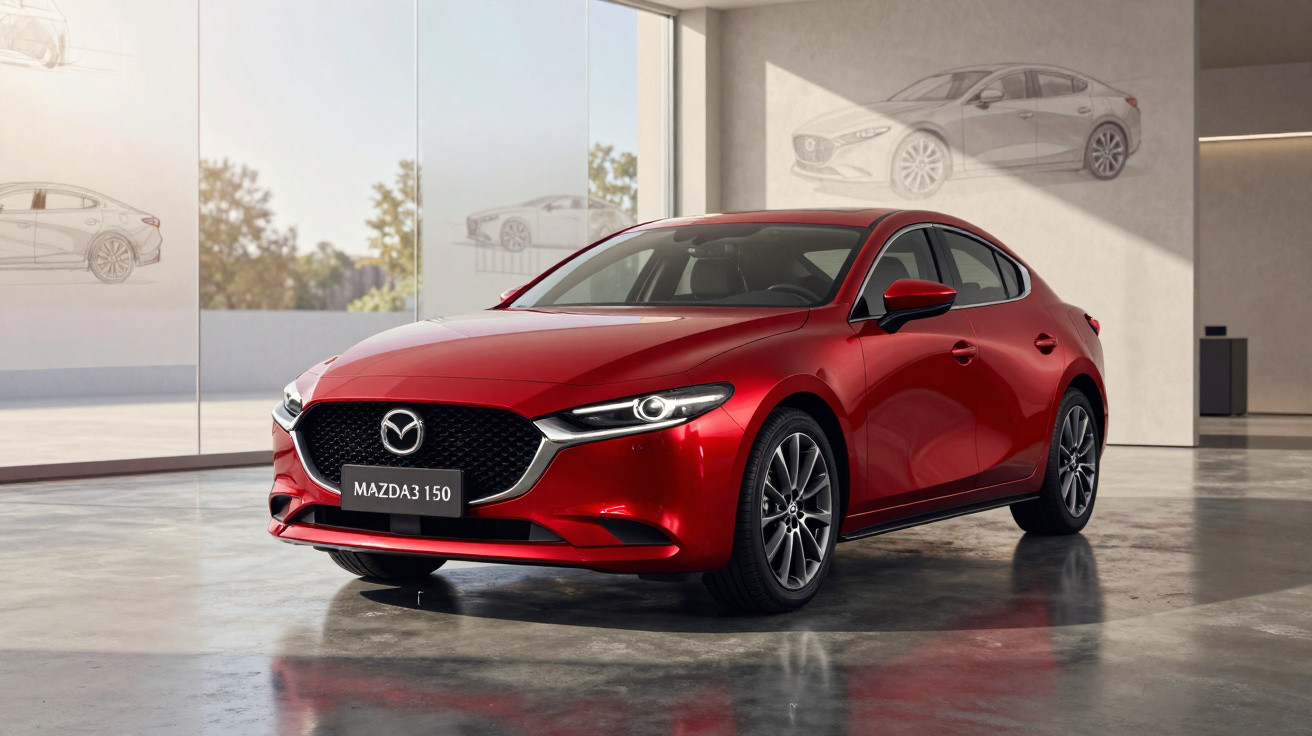
When I tested the CX-30 with this engine, I said it was probably the best choice in the range. The same is true of the Mazda3.
The extra 28 hp, taking the total to 150 hp, seem to offer the best of both worlds. They deliver a noticeable improvement in performance over the 122 hp 2.0-litre, without increasing fuel consumption, while softening one of my biggest criticisms of the Mazda3 - and the CX-30: its long transmission gearing.
The ratios are no different from those of the 122 hp version, but the stronger acceleration and in-gear response enabled by the 150 hp help disguise that trait.
However, anyone accustomed to the turbocharged engines that dominate the market will still need to make more frequent use of this naturally aspirated 2.0-litre engine’s excellent six-speed manual gearbox - among the best in the industry, with a short throw and a superbly mechanical, slick feel.
In other words, tackling steeper hills or overtaking another vehicle requires either changing down or keeping the engine at higher revs.
Not a flaw, just its character
As it is a naturally aspirated engine, peak torque arrives around 2,000 rpm later than in most of the turbo engines we have become used to. Accessing its advertised performance therefore means pressing the accelerator harder than usual or using the gearbox more often - a reminder of another era…
This detail gives the 150 hp Mazda3 2.0 Skyactiv-G a driving experience unlike that of any of its rivals and, I have to admit, one that is more engaging in several respects.
Its naturally aspirated engine ultimately has more character than turbocharged alternatives. It “encourages” you to explore a broader rev range, rewarding you with greater liveliness and a far more “musical” note at higher revs than other forced-induction engines.
Moderate thirst from the Mazda3 2.0 Skyactiv-G
Best of all, its appetite remains similar to that of the 122 hp version, and in real-world conditions it is as competitive as, or better than, the smaller turbocharged engines offered by rivals.
Despite being more powerful and quicker, consumption ranged from 4.5 l/100 km at steady, moderate speeds to 6.6-6.7 l/100 km on the motorway, reaching around eight litres in urban driving. These are very good figures for a naturally aspirated 2.0-litre petrol engine.
A delight to drive
Otherwise, this is the Mazda3 we know. I personally like it enormously, and it remains one of the most enjoyable cars to drive in its segment. From the excellent driving position to the weighting and feel of its controls, the driving experience is a delight, albeit with one or two reservations.
The first concerns the steering: although accurate and correctly weighted, it is not the best communication channel for understanding what the front wheels are doing. And while the brake pedal has excellent modulation, I would personally prefer a little more initial bite from the pads on the discs during the first few centimetres of pedal travel. The stopping power is certainly there, but it takes slightly firmer pressure to access it.
That said, the Mazda3’s handling is marked by high precision and a very natural relationship between our steering inputs and the car’s reactions. It is anything but a dull experience.
If you want to maintain a brisk pace, it “requires” you to keep the engine at higher revs - where its interesting voice stands out - or to use the delightful gearbox more frequently, but I am not complaining. The entire experience makes the car even more engaging than the CX-30, as you sit closer to the ground.
At more relaxed speeds it is comfortable, although this test car’s 18-inch wheels and lower-profile tyres do it no favours beyond appearance: road noise is more apparent and the damping feels firmer than in the CX-30 I tried, which also had 18-inch wheels but taller-profile tyres, or in Mazda3 models fitted with 16-inch wheels.
Inside, the dashboard seems caught between two worlds - analogue and digital. It looks elegant and understated, while there is virtually nothing to criticise in its ergonomics or ease of use. That is not something that can be said of the heavily digital interiors found in several rivals.
Moreover, the cabin is, broadly speaking, trimmed in very pleasant materials, and its build quality is high enough to match rivals positioned further upmarket.
The price of style
Putting personal taste aside, the Mazda3’s exterior appearance remains one of its most distinctive features. Its more sophisticated styling comes at a cost, however, and that cost is visibility.
Rearward visibility in particular leaves much to be desired. The rear screen and rear side windows are too small, while the C-pillar is substantial, making the rear accommodation dark and uninviting.
The placement and/or angle of the A-pillar also proved more troublesome than it should have been, managing to “hide” entire cars on some left-hand bends.
Is the Mazda3 the right car for me?
As I mentioned in my CX-30 test, the Mazda3 remains an acquired taste, largely because of its mechanical character rather than its styling.
I also maintain that the brand’s true compact family car is the CX-30 - which has little SUV about it - rather than this Mazda3, as might initially be expected. As a family car, the Mazda3 falls slightly short, whether because of its gloomy rear accommodation - despite having more than enough room for two people to sit comfortably - or its below-average boot capacity.
I see the Mazda3 more as an alternative to conventional hatchbacks in the segment, with a greater focus on style and image, much as three-door body styles once were. It follows the mould of a Volkswagen Scirocco, but with five doors… Or, for those who are more nostalgic, it is something of a Mazda 323F from the end of the last century.
The Mazda3 positively reflects the Japanese brand’s intention to move upmarket, showing greater attention to detail than other models in the segment, even if its price does not reflect that. Although it comes very well equipped, its price - starting at 32,000 euros - is more in line with mainstream alternatives in the segment when power and equipment are matched.




Comments
No comments yet. Be the first to comment!
Leave a Comment