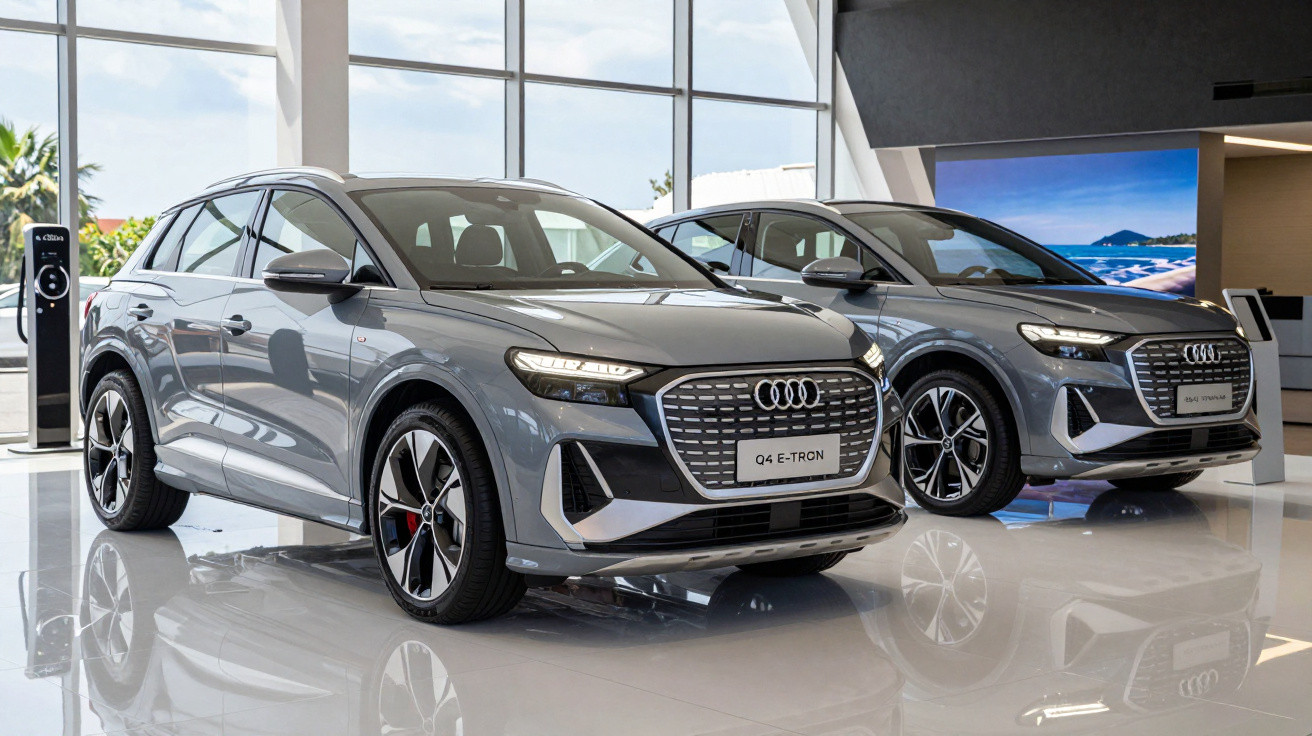
Here they are. We had already seen them in camouflage and had also been shown their interiors. Now, however, we can properly take in the final shapes and styling of the new Audi Q4 e-tron and its more sporting-looking sibling, the Q4 Sportback e-tron.
These new electric SUVs are Audi’s first models to use the Volkswagen Group’s MEB platform, which also underpins the Volkswagen ID.4 and Skoda Enyaq iV, and will feature in the forthcoming CUPRA Born.
Measuring 4,590 mm long, 1,865 mm wide and 1,613 mm high, the Audi Q4 e-tron targets rivals such as the Mercedes-Benz EQA and Volvo C40 Recharge. It promises a spacious, technology-packed cabin, including an augmented-reality head-up display.
Unmistakably Audi and closely resembling the concepts that previewed them, their styling is also highly aerodynamic despite the tall SUV bodywork. The drag coefficient is just 0.28, while the sleeker, arched roofline of the Sportback lowers this figure further to only 0.26.
Audi also highlights the extensive aerodynamic optimisation work carried out. This ranges from flaps in the front air intakes, which open and close according to battery cooling requirements and provide an extra 6 km of range, to refinements beneath the vehicle.
The underbody features spoilers ahead of the front wheels to improve airflow (+14 km of range), partially covered rear-axle control arms (+ 4 km of range), and a rear diffuser that reduces lift over the rear axle.
Plenty of room in the Audi Q4 e-tron
As with the other MEB-based models, both Q4 e-tron variants promise very generous interior dimensions, comparable with those of larger vehicles from higher segments.
That is only possible because of the architecture used. Electric motors occupy less space, while the batteries are housed in the platform floor between the axles, freeing up valuable cabin length. With the motors positioned directly over the axles, there is no transmission tunnel either, leaving the cabin floor entirely flat.
The same applies to the boot, which is notably large for an SUV of this size. Audi quotes 520 l for the Q4 e-tron, matching the capacity of the larger Q5. Curiously, the more sporting Q4 Sportback e-tron increases that figure to 535 l.
Audi also claims a total of 25 l of storage space throughout the Q4 e-tron cabin, including the glovebox.
Perhaps the most unusual feature is the upper door storage area, which can hold bottles with a capacity of up to one litre:
Digitalisation takes centre stage, but…
As expected, digitalisation is central to the interior. Unlike some alternatives, including other Volkswagen Group models built on the same platform, Audi has not followed the minimalist trend of removing every physical button from the cabin.
As in the new A3, Audi retains certain physical controls, including those for the climate control system. This means drivers do not have to use the MMI Touch infotainment system - 10.1 inches as standard or 11.6 inches optionally - for every interaction, which benefits usability.
There is no shortage of technology on board, though. The instrument display is the familiar 10.25-inch Audi Virtual Cockpit, but the major innovation is an optional new augmented-reality head-up display.
The Q4 e-tron is the first Audi to receive this technology, which overlays information - including navigation instructions - onto the driver’s field of vision. Projected onto the windscreen at different depths, it appears to be “floating” over the view ahead.
Three power outputs, two batteries
The new Audi Q4 e-tron will initially launch in three versions: Q4 35 e-tron, Q4 40 e-tron and Q4 50 e-tron quattro. They will be paired with two battery options: a 55 kW unit (52 kWh net) and a larger 82 kWh unit (77 kWh net).
The Audi Q4 35 e-tron uses a rear-mounted 170 hp electric motor producing 310 Nm, meaning it has rear-wheel drive. Paired with the 55 kWh battery, it delivers 341 km of range. The Q4 Sportback 35 e-tron travels slightly further, reaching 349 km.
The Audi Q4 40 e-tron also has a single rear motor and rear-wheel drive, but its output rises to 204 hp and 310 Nm, while it uses the 82 kWh battery. Its range is 520 km, the greatest of any Q4 e-tron model.
For the time being, the range-topping model is the Q4 50 e-tron quattro. As its name suggests, it gains four-wheel drive thanks to a second 109 hp motor on the front axle, bringing total maximum output to 299 hp and 460 Nm. Available solely with the 82 kWh battery, it offers 488 km of range in the Q4 e-tron and 497 km in the Q4 Sportback e-tron.
In terms of performance, the 35 e-tron and 40 e-tron accelerate to 100 km/h in 9.0 seconds and 8.5 seconds respectively, with both limited to 160 km/h. The 50 e-tron quattro reaches 100 km/h in a more impressive 6.2 seconds, while its top speed increases to 180 km/h.
If those figures seem merely agreeable, the weight of these electric SUVs is perhaps the main reason. As we know, batteries add substantial mass: the Audi Q4 e-tron weighs 1,890 kg in its lightest version (30 e-tron) and 2,135 kg in its heaviest guise (50 e-tron quattro).
Charging
The Audi Q4 e-tron and Q4 Sportback e-tron can be charged at up to 11 kW using alternating current and up to 125 kW using direct current. In the latter case, a 10-minute charge is enough to recover 208 km of range.
With the smaller 55 kWh battery, charging outputs fall slightly, with up to 7.2 kW available on alternating current and 100 kW on direct current.
Under control
Positioning the battery between the axles in the floor of the MEB platform gives the Q4 e-tron a lower centre of gravity than might be expected from an SUV. Weight distribution also benefits, sitting close to 50/50 in every version.
At the front, the suspension uses a MacPherson layout, while the rear employs a five-link multi-link arrangement similar in design to that fitted to the brand’s larger models. The wheels are sizeable too, with rim diameters ranging from 19 to 21 inches, and some designs prioritising improved aerodynamic performance.
The most interesting aspect of these new models’ configuration is that most versions are rear-wheel drive, which is unusual for Audi. Apart from the R8, the brand has no models designed from the outset to be rear-wheel drive. These SUVs will therefore tend towards oversteer rather than understeer, although the Ingolstadt brand says systems such as ESC stability control will remain alert to ensure the precise, safe behaviour associated with Audi.
There is scope to make the dynamics sharper, however. Two optional dynamic packages will be available: Dynamic and Dynamic Plus. The first adds sports suspension - standard on S line models - that lowers ground clearance by 15 mm, replaces the steering with progressive steering - standard on quattro versions - and adds driving modes, which are standard on the Sportback.
The Dynamic Plus package adds adaptive damping, capable of adjusting automatically at intervals of five milliseconds. It also works on the brakes with ESP stability control to distribute torque more effectively to the wheels that need it most.
Drum brakes return
Braking will be handled by front discs measuring between 330 mm and 358 mm in diameter. At the rear, however, there are “good old” drum brakes… How? That is right.
Audi’s reasoning is easy to understand. In electric vehicles with regenerative braking systems, the mechanical brakes are not used as frequently or as intensely as those in an internal-combustion vehicle. Pads and discs last several times longer and require replacement far less often - there are many cases of brake pads lasting well beyond 100,000 kilometres.
Using drum brakes also reduces wear, lowers maintenance requirements and decreases the risk of corrosion.
The Audi Q4 e-tron in Portugal
The Audi Q4 e-tron is scheduled to arrive on the Portuguese market in June, with prices starting from €44,700. The Q4 Sportback e-tron will follow later, with its launch expected at the end of the summer, although no price estimate has yet been announced.





Comments
No comments yet. Be the first to comment!
Leave a Comment